
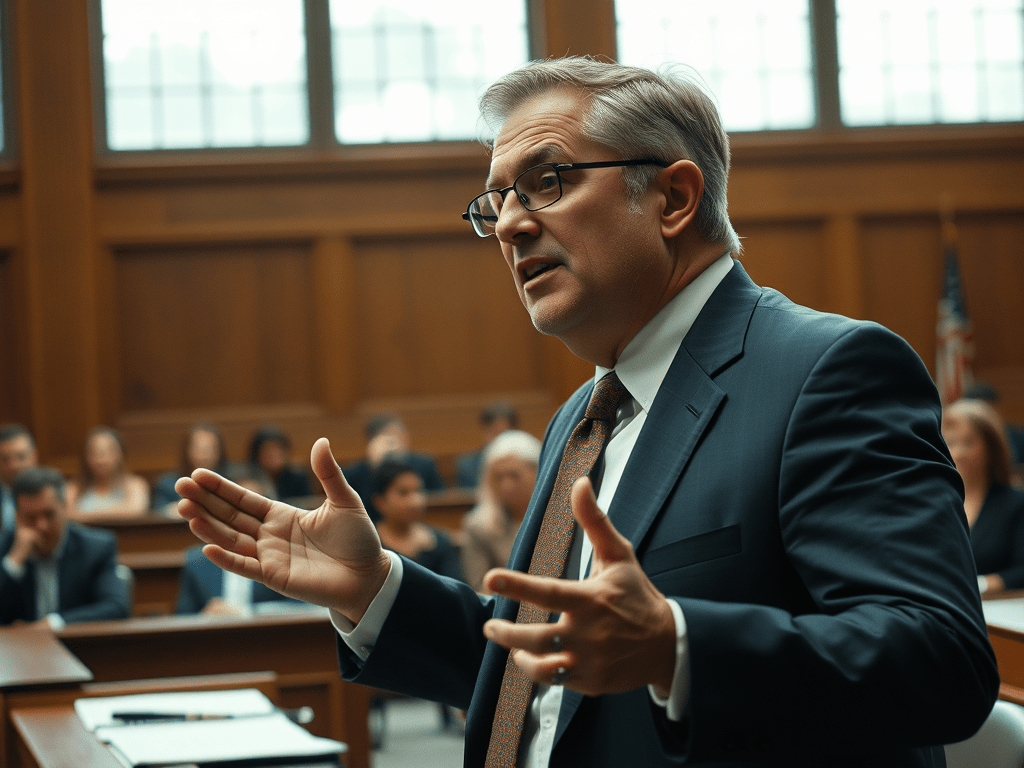
You need a real trial lawyer representing you if you’re going to go to trial. You need one who is not only fearless, but well versed in the law. The law governing trials—the evidence and argument that is allowed—is extremely complicated. For example, there are a lot of conflicting appellate opinions on the issue of preserving the right to appeal when the opposing lawyer makes improper closing arguments. The law, for the most part, is that a lawyer must contemporaneously object and move for mistrial to preserve the right to appeal. But some cases have held otherwise, and there is a strategy consideration in play.
There is something to be said for showing confidence to the jury. A lawyer might be hesitant to interrupt the opposing counsel’s argument, because it might turn off the jury—what is he afraid of? A lawyer who objects too much might make the jury think his client has something to hide. Sometimes, however, you gotta do it. If the opposing lawyer is making an improper argument—such as telling the jury to “be the conscious of the community” or “what if it was your wife?”—the opposing lawyer needs to contemporaneously object to preserve the right to appeal. It is interesting to note that courts have gone in this direction by recognizing that if this were not the law, a lawyer could purposely choose not to object when the opposing party makes a clearly inappropriate argument, hoping his client will be found to be the winner anyway, but then could appeal only if his client loses.
One such case is Fravel v. Haughey, 727 So. 2d 1033, 1034 (Fla. 5th DCA 1999), a medical malpractice case. In Fravel, the Fifth District considered the defendant’s argument that the trial court erred in denying his motion for new trial. The motion was based on the claim that the plaintiffs’ attorney had made improper comments during his closing argument, including comments requesting the jury to act as the conscience of the community and accusing the doctor, his attorney, and his witnesses of committing perjury. The defendant maintained that this improper argument constituted fundamental error and thus was a valid basis for new trial. The appellate court agreed that the statements made by the plaintiffs’ attorney during closing argument were improper and inflammatory, but concluded that the trial court properly determined that the comments did not constitute fundamental error. Fravel v. Haughey, 727 So. 2d 1033, 1034 (Fla. 5th DCA 1999).
The Fifth District noted: “Just like with any other trial error, lawyers have a duty to object to improper comments made during closing arguments, and the failure to raise a contemporaneous objection constitutes waiver.”
The court recognized that it had previously held that civil judgments may be reversed on appeal based on improper argument, even in the absence of a contemporaneous objection, when the improper comments are so extensive that they deprive a party of receiving a fair trial. See e.g., Schubert v. Allstate Ins. Co., 603 So.2d 554 (Fla. 5th DCA), rev. dismissed, 606 So.2d 1164 (Fla.1992). In doing so, however, the court stated that it had “probably been more generous than other districts in determining that improper arguments can constitute fundamental error in the hope that reversals would curb bad practice.” However, said the court, “judging by the frequency with which this issue continues to be raised, at least in our court, these rulings have not seemed to have had the intended effect of discouraging such conduct.”
The court also noted that:
In fact, a case could be made that these rulings have encouraged lawyers to allow improper argument tobe submitted to the jury without objection. Unfortunately, calculating lawyers may choose to remain silent when confronted with improper argument in hopes that, if the verdict is unfavorable to their client, relief might be available in the appellate court based upon review of the improper argument.
Fravel v. Haughey, 727 So. 2d 1033, 1034–35 (Fla. 5th DCA 1999).
The Florida Supreme Court has defined what constitutes fundamental error in the context of final argument. In Tyus v. Apalachicola Northern Railroad Company, 130 So.2d 580, 587 (Fla.1961), citing to its earlier opinion in Seaboard Air Line Railroad Co. v. Strickland, 88 So.2d 519 (Fla.1956), the Florida Supreme Court ruled:
[W]e are committed to the rule that in the ordinary case, unless timely objection to counsel’s prejudicial remarks is made, the appellate court will not reverse on review. This rule is subject to the exception that if the prejudicial conduct in its collective import is so extensive that its influence pervades the trial, gravely impairing a calm and dispassionate consideration of the evidence and the merits by the jury, a new trial should be awarded regardless of the want of objection.
(emphasis in original). It is probably fair to say, concluded the Fifth District, that careful application of this standard will almost always result in a finding that no fundamental error occurred.
The difficulty in meeting the Tyus standard for reversal was noted in Murphy v. International Robotics Systems, Inc., 710 So.2d 587, 590 (Fla. 4th DCA), rev. granted, 722 So.2d 193 (Fla.1998). The Fourth District explained that it had never granted a new trial solely on the ground of unobjected to, improper closing arguments and gave notice that it would not likely do so in the future. Id. at 587. Writing for the court, Judge Klein stated that the court had “all but close[d] the door on allowing this issue to be raised for the first time on appeal.” Id. at 590. Adding an historical perspective on this issue, Judge Klein noted that our supreme court has not granted a new trial solely on the basis of unobjected to, improper argument since 1956 in Seaboard Air Line Railroad Co., 88 So.2d at 519, and that the second district has not done so in forty years. Murphy, 710 So.2d at 589. Interestingly, his research revealed that, other than the first, third, and fifth district courts of appeal in this state, no other court in this country allows improper argument to be raised for the first time on appeal in civil cases. Id. at 591.
The Fifth District continued:
Our reluctance to reverse on the ground of unobjected to, improper argument is not to be viewed as condoning the bad practice of law. Instead, our application of the principle of waiver simply requires trial counsel to fulfill the obligation to raise timely objections when rules governing argument are violated. When argument descends to the level of ethical violations, there are other ways to address the transgression than reversal of a jury verdict. See R. Regulating Fla. Bar 4–3.4(c), 4–3.4(e), and 4–3.5(a). In fact, if the argument submitted by adverse counsel violates the Rules Regulating the Florida Bar, an attorney has the obligation to report the violation to The Florida Bar. See R. Regulating Fla. Bar 4–8.3(a). Judges also have the duty to take appropriate action when they observe counsel engage in ethical violations. See Code of Jud. Conduct, Canon 3D(2). In considering this issue, we find it troubling that trial judges are reluctant to curb the abuse perpetrated by trial counsel in the area of improper comments made during closing arguments.
Fravel included two interesting dissenting opinions. One dissent pointed out “two ironic results of the Fifth District’s new position on these matters.”
First, said the dissent, the court urges trial attorneys to timely make objections and jump through other hoops to preserve the error. Tyus v. Apalachicola Northern Railroad Co., 130 So.2d 580, 587 (Fla.1961) (objection); Baggett v. Davis, 124 Fla. 701, 169 So. 372 (1936) (grounds for objection must be stated); Swan v. Florida Farm Bureau Ins. Co., 404 So.2d 802 (Fla. 5th DCA 1981) (objection must be contemporaneous to give court notice). When the objection is sustained, the party must move for a mistrial. Hagan v. Sun Bank of Mid-Florida, N.A., 666 So.2d 580 (Fla. 2d DCA 1996); Eichelkraut v. Kash N’Karry Food Stores, Inc., 644 So.2d 90 (Fla. 2d DCA 1994); Newton v. South Florida Baptist Hospital, 614 So.2d 1195 (Fla. 2d DCA 1993). Yet attorneys who do so are not much better off.
Reversal by the appellate court for a new trial still depends on the appellate court finding what is essentially “fundamental error”. Grushoff v. Denny’s, Inc., 693 So.2d 1068 (Fla. 4th DCA 1997); Hagan (legal standard is whether closing argument comment is highly prejudicial and inflammatory); Silva v. Nightingale,619 So.2d 4 (Fla. 5th DCA 1993) (comments must be so pervasive as to sway jury from dispassionate consideration). 1040*1040 See also § 59.041, Cleveland Clinic Florida v. Wilson, 685 So.2d 15 (Fla. 4th DCA 1996); Weise v. Repa Film International, 683 So.2d 1128 (Fla. 4th DCA 1996) (judgment may not be reversed unless miscarriage of justice occurs). There ought to be a lesser standard for preserved error in such cases, and at this point, there is not.
Second, said the dissent:
… although we urge trial judges to take a more active role in requiring trial attorneys to adhere to ethical rules of practice and professionalism, we ourselves, as appellate judges, have all but disappeared from this equation, like the Cheshire Cat, fading behind a smile in search of a “bright line,” leaving only the trial judges to fight the battle. Because they must stand for election and are more directly subject to pressure from local bar members than are appellate judges, some may be unable or unwilling to do so. I agree with Judge Harris: I seriously doubt our new bright line approach will improve the conduct of trials in this state.
A second dissent observed that there are two independent, albeit related, issues which present themselves when a lawyer makes, without challenge, an improper, excessive, and unethical argument to the jury. These issues are:
1. May a lawyer raise on appeal improper argument of counsel to which there was no objection below?
2. Does the authority of an appellate court to control improper and unethical lawyer behavior which it determines may have affected the jury verdict (closing argument in derogation of the lawyer’s obligations under the applicable ethical canons and disciplinary rules) and which is apparent from the face of the record permit the granting of a new trial even when no objection was made below?
The first issue set out above is addressed in Tyus v. Apalachicola Northern Railroad Company, 130 So.2d 580, 587 (Fla.1961). The Tyus court determined:
As is disclosed by our opinion in Seaboard Air Line Railroad Co. v. Strickland, [88 So.2d 519 (Fla.1956)] we are committed to the rule that in the ordinary case, unless timely objection to counsel’s prejudicial remarks is made, the appellate court will not reverse on review. This rule is subject to the exception that if the prejudicial conduct in its collective import is so extensive that its influence pervades the trial, gravely impairing a calm and dispassionate consideration of the evidence and the merits by the jury, a new trial should be awarded regardless of the want of objection.
The clear holding of this case, said the dissent, is that one may not raise on appeal an improper closing argument to which he has not objected unless fundamental error can be shown.
But the dissent found a second issue:
Even though Tyus may prevent a litigant who has not objected below to raise the issue of improper closing argument, does Tyus foreclose an appellate court from, on its own, granting a new trial as a sanction against the offending lawyer when it finds that his improper closing argument may have affected the jury verdict and is so offensive and unethical that it demeans the entire judicial process even if no objection was made below?
Further:
And since the offending statements were made in order to influence the jury, cannot the appellate court presume that an argument that violates the strictures of the canons and the disciplinary rules did in fact influence the jury and is therefore harmful? Tyus didn’t consider the issue of whether a court should be able to sanction unacceptable lawyer behavior in the courtroom which may have improperly influenced the jury. It was content to discuss the issue raised before it, which presented the question only in the context of an appeal claiming fundamental error.
The dissent saw a problem:
Even though the Strickland rule on fundamental error, reconfirmed by Tyus, seems simple and straightforward, the facts of Tyus, at first blush, do seem to raise the standard so high that nothing can be considered fundamental error. I’m not at all sure that is the case.
In considering the Tyus holding, the dissent concluded that the court should focus on the announced rule which is constant and not on the determination by that court as to whether the specific improper argument before it, after jury admonishment not to consider it, met the threshold of fundamental error. A court’s determination as to whether a particular argument is sufficiently egregious to influence a jury even after an admonishment not to consider, concluded the dissent, it is subject to change from case to case as the facts change and even subject to change on the same facts from the 1961 court to the present one. It may be that had the facts been even less egregious, but had the trial court not given repeated curative instructions, the Tyus court may have found fundamental error. Such was the case in Strickland.
The second issue set out above, concluded the dissent, is addressed by Borden, Inc. v. Young, 479 So.2d 850 (Fla. 3d DCA 1985), rev. denied, 488 So.2d 832 (Fla.1986). In Borden, Judge Schwartz, after concluding that the conduct of neither counsel was acceptable but that the closing argument of the prevailing lawyer constituted fundamental error even under the Strickland standard, was not content to rely solely on Strickland as the basis for reversal. Judge Schwartz, in a most convincing opinion, observed the following:
Perhaps more important is the broader jurisprudential issue which is raised by cases like this. In our view, it is no longer—if it ever was—acceptable for the judiciary to act simply as a fight promoter, who supplies an arena in which parties may fight it out on unseemly terms of their own choosing, and then, on the ground that the loser has asked for what he received, obediently raise the hand of the one who emerges victorious. We demean ourselves and the system of justice we serve when we permit this to occur. In Schreier v. Parker, 415 So.2d 794, 795 (Fla. 3d DCA 1982), we gave notice that “[a]rguments in derogation of Fla. Bar Code of Prof. Resp. EC 7-24, DR 7-106(C)(3), (4) will not be condoned in this court, nor should they be condoned by the trial court, even absent objection …”
Id. at 851-52.
Hence, said the dissent, the Borden court announced to the lawyers within its district that thereafter arguments in violation of the code of professional ethics would be presumed to constitute fundamental error and that a new trial, even if no objection appears in the record, could be expected as the sanction for such violation. It is thus apparent, said the dissent, that Borden is not a misapplication of Tyus as the majority implies; it establishes an independent, freestanding prophylactic rule of courtroom conduct that the court insists will be followed. In its Borden decision, the Third District committed to enforce the admonishment given to trial judges by the supreme court in Strickland in the event the trial judges did not:
It is the responsibility of the trial court to protect litigants against such interference by counsel with the orderly administration of justice and the protection of the rights of litigants to a verdict “uninfluenced by the appeals of counsel to passion or prejudice.”
Id. at 524.
The dissent asked: “Since the supreme court in Strickland ordered a new trial because of the adverse affect of an unobjected to improper closing argument, did not its admonishment to the trial court authorize it to do likewise?”
The Second District, said the dissent, seems to have rejected this approach. In Hagan v. Sun Bank of Mid-Florida, N.A., 666 So.2d 580, 584 (Fla. 2d DCA 1996), the court stated:
[T]here is a temptation for both trial courts and appellate courts to use the remedy of new trial as a tool to punish misconduct of an attorney, as an officer of the court, without disclosing whether the misconduct resulted in harmful error … But if the trial court employs the remedy of new trial merely to enforce the lawyer’s professional standards, the parties lose the verdict of their chosen jury.
It is apparent, concluded the dissent, in Borden that in requiring a new trial the court found harmful error. The dissenting judge believed that is also true in those cases relying on Borden whether or not harmful error was discussed in the opinion. Further:
And parties often lose the benefit of their verdicts because of lawyer error, often error less serious than a breach of professional ethics. There is no constitutional right, or any right for that matter, to retain a verdict obtained, in whole or in part, through the unethical conduct of one’s lawyer. Clients should complain to their lawyers or about their lawyers and not blame the court when a verdict is lost for this reason. In any event, whether we are considering fundamental error or harmful error (assuming Hagan is correct that there is a difference), how can one prove that an outrageous argument did or did not affect a jury verdict as envisioned by Tyus?
The Borden court, said the dissent, was not suggesting that the appellate court should replace the grievance process in dealing with unethical lawyers nor even that it be an alternative to such process. Rather:
It was content to uphold the honor of its court and the integrity of the judicial process by merely denying the unethical lawyer the benefit of his misconduct. Individual discipline was left to the Bar. This seems to be a reasonable approach.
The dissent noted that the court had, in the past, followed the Borden principle. See S.H. Investment & Development Corporation v. Kincaid, 495 So.2d 768, 771 (Fla. 5th DCA 1986), rev. denied, 504 So.2d 767 (Fla.1987), in which Judge Cobb stated: “The Third District in Borden, Inc. v. Young [citation omitted] has stated it will not condone arguments in derogation of the above cited ethical canons and disciplinary rules, even absent objections. We agree, hence a new trial on all issues is required.” See also Stokes v. Wet `N Wild, Inc., 523 So.2d 181 ( Fla. 5th DCA 1988) (Judge Sharp cites Borden with approval). Therefore, concluded the dissent:
… we have for years granted new trials both under the rule of Tyus as well as under our Borden supervisory role as a protector of the integrity of the judicial process. The majority herein suggests that our efforts to discourage improper closing arguments by applying Borden have been a failure. I’m not convinced that we haven’t made a positive difference. My research discloses only twenty opinions relating to improper closing arguments in civil cases, either with or without objections, since we announced our approval of Borden in 1986. That’s approximately one and a half cases a year that we have found merited discussion in an opinion and, since we have considered unethical closing argument a legitimate reason for granting a new trial, it is doubtful that we would affirm without opinion such cases where improper closing argument was shown. That number is manageable.
This figure is in contrast with the Fourth District, said the dissent, where “it seems as though, in every week in which we sit, we get at least one appeal in which we are asked to reverse because of improper, but unobjected to, closing argument of counsel.” Murphy v. Intern. Robotics Systems, 710 So.2d 587 (Fla. 4th DCA 1998)., rev. granted, 722 So.2d 193 (Fla.1998). But the dissent observed, because the Fifth District should get even a higher percentage of appeals from those claiming improper closing argument (since we have often granted relief) than would be expected in the Fourth District (which has never granted relief), it appears that either the Bar in the Fourth District is unusually optimistic or such improper arguments are much more prevalent there. Hence, concluded the dissent, the Borden approach, at least in this district, seems to have been more effective than the “hands off” approach taken by the Fourth District in curtailing this most undesirable lawyer conduct.
The dissent agreed that the closing argument in the case at bar, “as bad as it was, is not as egregious as the closing argument in Tyus.” It may not measure up to the Tyus standard for fundamental error, said the dissent, if, in fact, Tyus intended to set such an unreachable standard as assumed by Hagan and Murphy.
But because the trial court in the case at bar did not repeatedly admonish the jury to disregard the prejudicial remarks of counsel and did not give a curative instruction (the contents of the Tyus curative instruction that four of the judges believed cured any harm caused by the argument was not set out in the opinion), concluded the dissent, a new trial may well be justified even under Tyus.
Finally, the dissent concluded:
Even though Strickland and Tyus are not recent decisions, there is no statute of limitations on supreme court rulings. By holding that an aggrieved litigant can never (or almost never) show fundamental error (as does Hagan and Murphy), is not the majority “reversing” Tyus and Strickland? In any event, the argument in this case most probably affected the outcome of the trial and certainly violated the precepts of our code of professional responsibility and, under Borden and our cases adopting Borden, reversal would be required. The cause for courtroom ethics and civility is substantially damaged by today’s retreat from our prior cases.
 Donner Law Firm