
By Jeffrey T. Donner, Esq.
May 15, 2026
Boxing has always had a referee problem.
Not in every fight. Not with every referee. But often enough that serious boxing fans know the pattern immediately.
The referee stops watching the fight and starts managing it. He gets too close. He touches fighters. He breaks legal exchanges. He confuses inside fighting with holding. He treats the ropes like some kind of emergency zone. He hears the 10-second warning and acts like the round is over. He gives one fighter a timeout without a rule-based reason. He lets a corner become part of the action. He stops one fight too late, then stops another one too early, as if boxing has adopted the NFL’s makeup-call system.
That is not the job.
The referee’s job is simple: protect the fighters, enforce the rules, and otherwise get out of the way. He is not there to choreograph the fight. He is not there to reset the fighters every time they get close. He is not there to slap gloves down, grab arms, paw at fighters, or interrupt legal work because the action looks messy.
If the fighters’ hands are free, they are allowed to fight.
That should be one of the first principles of boxing refereeing. Apparently, it needs to be repeated.
The Referee Is Not the Third Fighter
A boxing referee should be present without becoming intrusive.
He should be close enough to see the action, but not so close that he interferes with it. He should use his voice before his hands. He should break a real clinch, not every close-range exchange. He should stop a fight when a fighter can no longer intelligently defend himself, not when the action merely becomes inconvenient or physically awkward.
The best referees understand that control is not the same thing as interference.
Control means the referee is calm, positioned correctly, and ready to act when action is necessary.
Interference means the referee constantly touches fighters, grabs hands, pushes gloves down, breaks legal exchanges, and turns the fight into a referee-managed exercise.
Too many referees confuse the two.
That is not a modern problem. It was happening decades ago. It is still happening now. The difference is that now we have better cameras, instant replays, social media clips, and a much larger audience capable of seeing the same nonsense at the same time.
The bad calls are not disappearing. They are just becoming harder to hide.
Richard Steele in Jones-Toney
Roy Jones Jr. vs. James Toney took place on November 18, 1994, at the MGM Grand in Las Vegas. It was one of Roy Jones Jr.’s greatest nights. Jones was fast, loose, creative, and in complete command. Toney was an elite fighter, but Jones made him look ordinary for long stretches.
That should be the only thing anyone notices.
Instead, Richard Steele keeps forcing himself into the picture.
Steele’s performance in that fight is a perfect example of overactive refereeing. He is constantly too close. He is constantly hovering. He touches the fighters too much. He slaps hands down. He breaks exchanges that do not need to be broken. He treats ordinary inside fighting as if it is illegal simply because the fighters are chest-to-chest.
That is not refereeing. That is interference.
Inside fighting is boxing. Fighting chest-to-chest is boxing. Fighting on the ropes is boxing. Short hooks, body shots, shoulder positioning, blocking, framing, rolling, and countering in close range are all part of the sport. A referee who breaks every close exchange because it looks untidy does not understand the sport well enough.
Jones would protect himself in close range with a high glove near his head. That is defense. It is not an invitation for the referee to pull his hand down. A fighter is allowed to protect himself. Unless he is holding, fouling, or refusing to obey a command, the referee should not be physically rearranging his guard.
That is one of the things that makes Steele so irritating in the fight. He seems to believe that proximity itself is the problem. The fighters get close, and he reacts. They are chest-to-chest, and he reacts. They are working inside, and he reacts. Instead of letting professional fighters fight, he behaves like he needs to tidy up every exchange.
Boxing is not supposed to be tidy all the time.
It is a fight.
The 10-Second Warning Is Not the Bell
Steele also had the 10-second problem in Jones-Toney. In the eighth round, he stepped in prematurely after the 10-second warning, as if the round had ended. That is a basic refereeing failure.
The wood clapper is not the bell.
It means there are ten seconds left in the round. The round is still live. The fighters are still fighting. Ten seconds in boxing matters. Ten seconds can produce a knockdown. Ten seconds can produce a knockout. Ten seconds can steal a round. Ten seconds can shift momentum.
A referee has no right to take that time away from the fighters.
There is also no need for the referee to start managing the end of a round like a schoolteacher dismissing children from class. Fighters do not need to be told, “Listen to the bell, gentlemen.” They know what a bell is. They are professional boxers. The command is simple: when the bell rings, stop. Until then, fight.
This is not complicated.
The 10-second warning is a warning. It is not the end of the round. A referee who cannot reliably distinguish the two should not be refereeing major fights.
Chávez-Taylor and the Referee Becoming the Story
Richard Steele’s name is also attached to one of the most controversial endings in boxing history: Julio César Chávez vs. Meldrick Taylor.
Steele stopped that fight with two seconds left in the twelfth round. Taylor had taken punishment. Chávez had hurt him. There is an argument that Steele was protecting the fighter. There is also the obvious counterpoint that Taylor was two seconds away from reaching the final bell in a fight he was winning on the cards.
People can debate that stoppage forever.
The larger problem is that, again, Steele became one of the central figures in the fight.
That should almost never happen.
A referee should not be remembered as much as the fighters. He should not become the drama. He should not become the talking point unless something extraordinary requires it. When the referee becomes a recurring character in boxing history, that is usually not a compliment.
In Jones-Toney, Steele did not change the result. Jones was far too good. But bad refereeing does not have to change the result to damage a fight. It can disrupt rhythm. It can take away legal inside work. It can interfere with tactics. It can make the viewer watch the referee instead of the fighters.
That is exactly what a referee should not do.
The Same Problem Exists Today
The depressing part is that this is not just an old problem. Refereeing was bad decades ago, and it is still bad today.
And lately, the problem has been impossible to ignore.
In a matter of weeks, boxing fans saw three major heavyweight fights produce three different kinds of officiating dysfunction: Deontay Wilder vs. Derek Chisora, Daniel Dubois vs. Fabio Wardley, and Oleksandr Usyk vs. Rico Verhoeven.
That is the whole menu.
One fight had chaos, corner involvement, rope confusion, and strange timeouts.
One fight was allowed to go too long while a brave fighter absorbed unnecessary punishment.
One fight was stopped too quickly after the referee had already given the hurt fighter extra time to recover from a mouthpiece issue.
That is not one bad night. That is a pattern.
British boxing, in particular, has a serious referee problem.
This is not an attack on British boxing as a whole. Britain has great fighters, great crowds, great venues, and real boxing culture. But too many major fights involving British venues, British officials, or British boxing institutions have the same officiating disease: referees interfering with legal work, mishandling rope action, allowing corner involvement, giving unofficial timeouts, and failing to protect fighters at the right time.
That is not a minor issue. In boxing, officiating can change everything. A bad referee can steal a knockout. A bad referee can save a hurt fighter. A bad referee can shorten a round. A bad referee can let one fighter hold, maul, or survive through illegal assistance. A bad referee can also fail to stop a fight when a fighter is absorbing unnecessary punishment.
That is why prominent American fighters should be very careful about fighting in Britain with British referees.
The home crowd is already an advantage. The travel is already an advantage. The local promotion is often an advantage. The last thing an American fighter needs is a local referee who breaks his momentum, mishandles the ropes, tolerates corner involvement, or turns the fight into a managed local event.
Wilder-Chisora Was a Mess
Deontay Wilder vs. Derek Chisora was a warning.
Wilder won the fight, but he should not have had to fight both Chisora and the officiating chaos around him. That bout had moments that should never happen in a serious professional heavyweight fight.
Chisora’s corner entered the ring during a chaotic moment at the end of the opening round. Later, Chisora went through or near the ropes and appeared to receive help from his own side. Then there was the strange eye-complaint sequence, where Chisora seemed to get a pause in the action because he was complaining that he could not see.
That is not how this is supposed to work.
A fighter does not get to create his own timeout because he is uncomfortable. If there is an eye poke or some other foul, the referee has to identify it and handle it under the rules. If there is a serious medical issue, the referee can call in the doctor. If a fighter cannot see and cannot defend himself, the referee has to make a hard decision.
What the referee cannot do is casually pause a heavyweight fight in the middle of danger because one fighter is complaining.
This is boxing. Not customer service.
The corner issue was just as bad. A corner cannot become part of the fight. A fighter cannot receive live-action assistance from his own team and then simply continue as if nothing happened. Maybe the referee has discretion over the precise penalty. Maybe the local rules differ from American commission rules. Fine. But common sense still matters. Once a corner physically enters the competitive space or helps a fighter survive a crisis, the integrity of the fight is compromised.
That should trigger real consequences.
A warning after the fact is not enough.
The rope issue was also mishandled. The ropes are part of the ring. Fighters get trapped on the ropes. Fighters lean on the ropes. Fighters punch on the ropes. Fighters escape from the ropes. That is boxing. A fighter is not entitled to a reset just because the exchange gets ugly or physically awkward.
If a fighter is knocked through the ropes, hurt on the ropes, or effectively saved by the ropes, the referee has to know what he is seeing. Was it a knockdown? Was the fighter prevented from falling? Was the fighter assisted by his corner? Was the fighter unable to continue? Those are not small details. They are the fight.
The Wilder-Chisora bout looked like a referee trying to survive a chaotic event rather than command it.
That is a problem.
Chisora-Scott Was an Older Warning
Wilder-Chisora was not the first time Dereck Chisora appeared in a British fight that left American fans wondering what exactly they had just watched.
Chisora’s 2013 fight with Malik Scott is another example of why American fighters need to be careful when fighting in Britain under British officiating.
Scott was knocked down in the sixth round. He rose at nine and was counted out anyway. That was his first professional loss. The visual was terrible: an American fighter in Britain, against a British-based opponent, rising before ten and still being waved off.
Maybe someone can make a technical defense of it. Boxing people can argue about anything. Boxing people could argue over whether rain is wet if there were a promoter’s purse bid attached to it.
But from a common-sense boxing perspective, it looked wrong. Scott was getting up. He appeared able to continue. The count did not look like a clean, ordinary ten-count ending. It looked like a referee ending a fight while the visiting fighter was rising.
That kind of history matters.
It does not prove every British referee is biased. It does not prove every questionable call is corrupt. But it does prove that American fighters should not sleepwalk into these situations. If you are traveling overseas for a major fight, the referee is not a detail. The referee is part of the contract negotiation.
Dubois-Wardley Showed the Other Side of Bad Refereeing
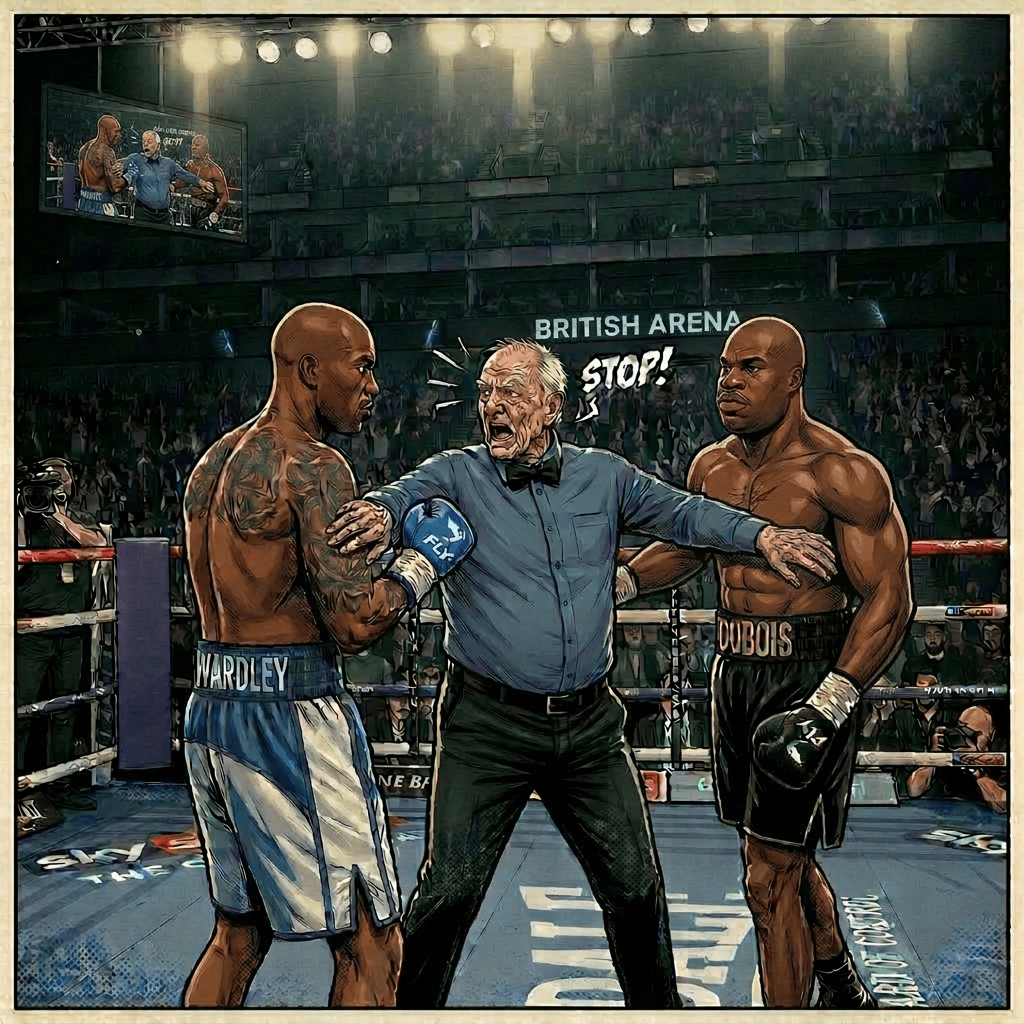
Daniel Dubois vs. Fabio Wardley showed another version of the problem.
That fight had the worst combination in refereeing: too much interference when the fighters were legally working, and too little intervention when a fighter needed protection.
Dubois and Wardley gave the fans a real heavyweight fight. It was dramatic, violent, and memorable. Dubois was dropped early, survived, took control, and eventually stopped Wardley. It was exactly the kind of fight that reminds people why heavyweight boxing still matters.
But the refereeing was terrible.
Howard Foster kept breaking close-range action that should have been allowed to continue. He treated chest-to-chest fighting and rope fighting as if the fighters needed constant resetting. Again, if the arms are free, let them fight.
The referee should not be dragging fighters apart simply because they are close. He should not be resetting action just because a fighter is near the ropes. He should not be acting like inside fighting is illegal.
Then, when Wardley was taking sustained punishment and the fight should have been stopped, the referee allowed it to continue too long.
Wardley showed enormous courage. That is not the issue. Fighters are brave. That is why referees and corners exist. A brave fighter will keep trying to fight when he should be saved from himself.
By the later rounds, Wardley was being beaten up. His face was damaged. His defense was deteriorating. The result was becoming obvious. His courage was no longer the issue. His safety was.
The referee’s job is not to admire courage until the damage becomes grotesque.
The job is to stop the fight when a fighter can no longer intelligently defend himself.
That is the maddening contradiction. Some referees jump in when no one needs them, then disappear when the fighter actually needs protection. They interfere with legal boxing, then fail to prevent unnecessary damage.
That is backwards.
Usyk-Verhoeven Was the Makeup Call Problem
Then came Oleksandr Usyk vs. Rico Verhoeven.
That fight had a different problem. It was not a classic case of a referee letting a fighter take too much punishment. It was a case of inconsistent management at the worst possible time.
Verhoeven, a kickboxing legend but still a boxing novice compared to Usyk, fought far better than most people expected. He made the fight uncomfortable. He gave Usyk problems. He was still in the fight late. Then the fight became bizarre.
In the eleventh round, Verhoeven’s mouthpiece came out after a clean Usyk shot. The referee paused the action and gave Verhoeven extra time to have the mouthpiece replaced. That might sound harmless to casual fans, but in a heavyweight title fight, seconds matter. A hurt fighter receiving even a short break can be a major event. It can interrupt a finishing sequence. It can save a fighter from immediate danger. It can change the round.
Then, after that extra time, the referee stopped the fight with only about one second left in the round.
That is what made it look like a makeup call.
First the referee gave Verhoeven time he probably should not have received. Then, moments later, he stopped the fight too quickly, as if he realized he had given the challenger a break and suddenly needed to compensate.
That is not how refereeing is supposed to work.
A referee should not balance one questionable decision with another questionable decision. This is not accounting. This is not “we gave you thirty seconds, so now we owe the champion a stoppage.”
If Verhoeven was done, stop the fight. If he could continue, let him continue. If the mouthpiece comes out because of a punch and the fighter is under attack, the referee has to be extremely careful before interrupting the action. If the round is about to end and the fighter is still on his feet, defending, and responsive, the referee should be equally careful before waving off the fight with one second left.
The result was the worst of both worlds.
Usyk was deprived of a clean finishing sequence when the action was paused. Verhoeven was deprived of the chance to reach the bell when the fight was stopped seconds later. The fans were deprived of a clean ending.
That is how bad refereeing poisons a fight even when the better fighter may still have been on his way to winning.
Bad Referees Misunderstand Inside Fighting
A lot of bad refereeing comes from one basic misunderstanding: the referee does not understand inside fighting.
Inside fighting is not automatically holding. Chest-to-chest fighting is not automatically a clinch. Fighting on the ropes is not automatically illegal. Two fighters can be close, physical, and still be boxing.
There is a difference between a dead clinch and live inside work.
A dead clinch is when the fighters are tied up and nothing legal can happen. Break them.
Live inside work is when the fighters are close but their hands are free, their bodies are positioned, and punches can still be thrown. Let them fight.
A referee who cannot tell the difference will ruin a fight.
He will break up body work. He will interrupt counters. He will take away a fighter’s ability to work out of trouble. He will protect a tired fighter from the consequences of being trapped on the ropes. He will turn professional boxing into a series of artificial resets.
That is not enforcement of the rules. That is changing the rules.
This is especially damaging in heavyweight fights. Heavyweights are large men. They lean. They wrestle for position. They fall into each other. They use shoulders, forearms, frames, and short shots. They may look clumsy compared to lighter fighters, but ugly does not automatically mean illegal.
A referee who cannot handle heavyweight physicality should not be refereeing major heavyweight fights.
The Ropes Are Part of the Ring
Referees also need to understand the ropes.
The ropes are not a panic zone. The ropes are part of the ring. A fighter can legally fight from the ropes. A fighter can be trapped on the ropes. A fighter can be hurt on the ropes. A fighter can use the ropes defensively. A fighter can escape from the ropes.
The referee’s job is not to drag the fight back to center ring every time the ropes become involved.
If a fighter is being held, break the clinch.
If a fighter is falling through the ropes, determine whether it is a knockdown, a foul, or an accidental tangle.
If a fighter is being helped by his corner, deal with it immediately.
If a fighter is defenseless on the ropes, stop the fight.
But do not treat rope action itself as illegal. That is not boxing. That is referee-managed sparring with a paying audience.
A Fighter Cannot Call His Own Timeout
The Wilder-Chisora eye sequence also illustrates another basic principle: a fighter cannot call his own timeout.
If a fighter complains about his eye, the referee has options. If the referee saw a foul, he can address the foul. If the referee believes there is a medical issue, he can call the doctor. If the fighter cannot continue, he can stop the fight.
But a fighter should not be able to stop the action simply by turning away and saying he cannot see.
That is dangerous. It rewards a hurt fighter for disengaging. It confuses the opponent. It creates an unofficial recovery period. It places the referee in the position of negotiating with a fighter during live combat.
That is not how professional boxing is supposed to work.
A fighter who cannot see may need protection. But protection comes through the rules. It does not come through an improvised timeout.
Good Refereeing Looks Like Thomas Taylor
The correct model is Thomas Taylor.
Taylor is the best referee working right now because he understands the difference between control and interference. He is physically capable, calm, sharp, and authoritative, but he does not make the fight about himself.
He uses his voice. He keeps position. He does not constantly paw at fighters. He does not slap gloves down to prove he is in charge. He does not panic every time fighters get close. He does not act like the ropes are a reason to stop legal action. He does not need to become a character in the fight.
He looks like he could physically impose himself if necessary, but he usually does not need to because he actually knows how to control a fight.
That is what good refereeing looks like.
The irony is that Taylor is a big, athletic-looking referee who could get in the way if he wanted to. But he usually does not. He is calm. He is efficient. He commands with presence and voice. He understands that the best referee is not the one constantly touching fighters. The best referee is the one who keeps the fight under control while letting the fighters fight.
That is the standard.
There Should Be Physical and Competence Standards
A boxing referee should be physically competent. That should not be controversial.
These officials are in the ring with elite athletes. Heavyweights are large, fast, dangerous men. A referee has to move, keep angles, avoid blocking the action, see fouls, recognize damage, manage knockdowns, and intervene quickly when necessary.
This should not be an honorary lifetime appointment.
The fighters train. The referee should be fit enough to do the job.
The referee should also understand boxing. Not just the commands. Not just the procedures. Boxing itself. Inside fighting. Rope fighting. Clinches. Holding. Hitting on the break. Intelligent defense. Accumulated damage. The difference between a hurt fighter who is still defending himself and a fighter who is being allowed to absorb unnecessary punishment.
Bad referees fail because they intervene in the wrong places and fail to intervene in the right ones.
They break legal action.
They ignore illegal assistance.
They give unofficial timeouts.
They stop fights too late.
They stop fights too early.
They confuse control with constant involvement.
That is not a small problem. In boxing, that is the whole sport.
American Fighters Should Demand Neutral Referees in Britain
Prominent American fighters should not casually agree to fight in Britain with British referees.
That is not paranoia. That is common sense.
If the fight is a major international event, the referee should be neutral, physically capable, internationally respected, and technically competent. The referee should not be part of the home-field advantage. He should not be a local official who is comfortable with local habits, local expectations, and local pressure.
Wilder-Chisora should be a warning. Chisora-Scott should be a warning. Dubois-Wardley should be a warning. The broader pattern should be a warning.
An American fighter should not travel overseas and then have to wonder whether the referee will allow legal work on the ropes, enforce rules against corner involvement, distinguish the 10-second warning from the bell, handle a mouthpiece issue correctly, or stop a fight at the right time.
Those are basic requirements.
If a referee cannot reliably apply them, he should not be working major fights.
The Rules Are Not Complicated
This should not be difficult.
If the fighters’ hands are free, let them fight.
If the action is legal on the ropes, let them fight.
If the 10-second clapper sounds, do not stop the round.
If a corner enters the ring or helps a fighter, punish it.
If a fighter complains that he cannot see, either identify a foul, call the doctor, or make a real ruling. Do not give him an unofficial timeout.
If a mouthpiece comes out because of a punch during a live exchange, do not casually interrupt the puncher’s momentum.
If a fighter cannot intelligently defend himself, stop the fight.
If the referee needs to intervene, use a clear command.
If the referee does not need to intervene, stay out of the way.
That is the job.
Boxing is dangerous enough without bad officiating. The sport does not need referees who want to be seen. It does not need referees who constantly touch fighters. It does not need referees who mistake proximity for holding, confusion for control, or interference for authority.
It needs referees who understand the sport.
It needs referees who know when to act.
And just as importantly, it needs referees who know when to disappear.
 Donner Law Firm