
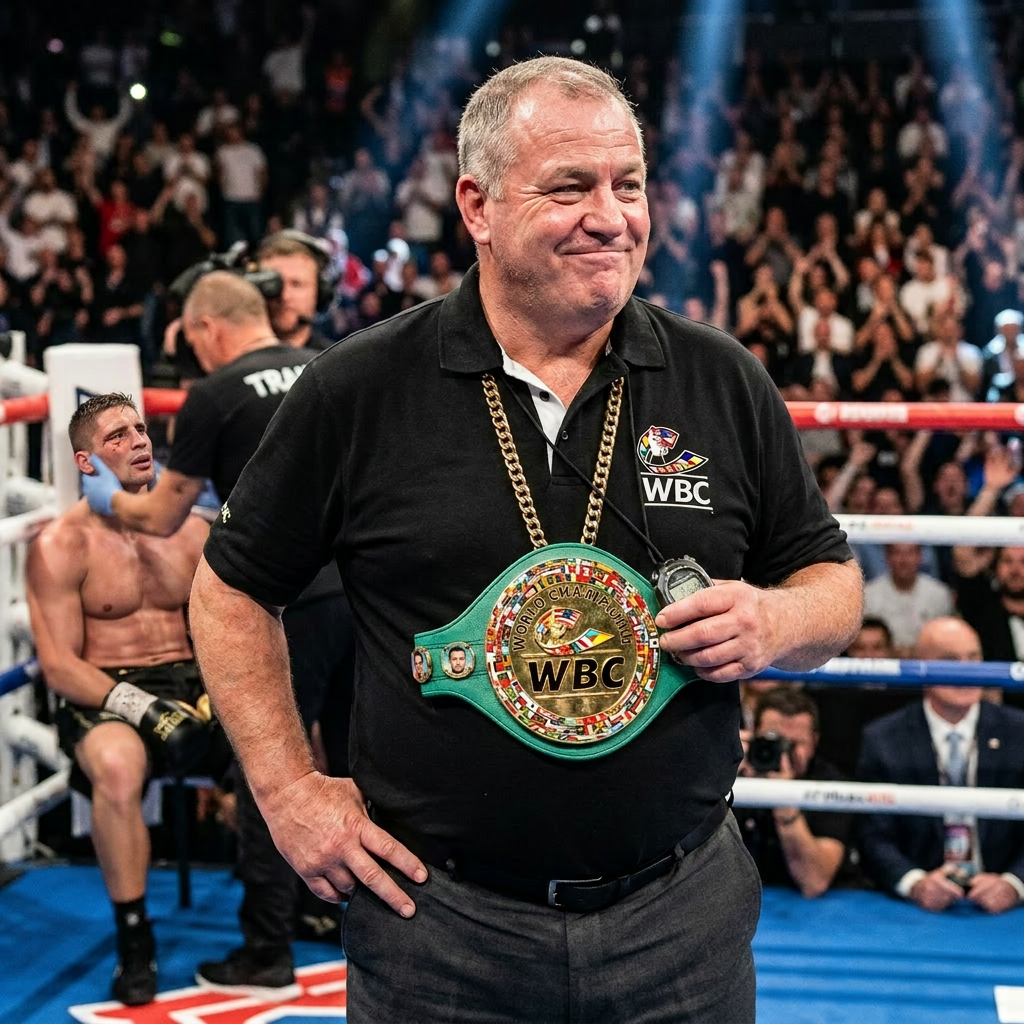
By Jeffrey T. Donner, Esq.
May 24, 2026
I do not think every bad boxing decision is the result of an old-fashioned cash bribe.
That is the cartoon version of corruption: a referee in a smoky room, a promoter whispering in his ear, an envelope changing hands, and the preferred fighter being protected.
The real problem in boxing is usually subtler, more deniable, and more damaging. Boxing has an establishment. Boxing has preferred outcomes. Boxing has television plans, sanctioning-body politics, rematch plans, betting-market expectations, and “this guy is supposed to win” energy around certain fighters. Nobody has to say it out loud. Nobody has to hold a formal meeting. The referee does not need written instructions.
He just knows.
That is what made Oleksandr Usyk versus Rico Verhoeven so infuriating. It was not just a bad stoppage. It was a perfect example of how boxing’s subjective officiating, establishment pressure, inconsistent fighter-safety standards, and built-in favoritism keep damaging the sport.
I am not an Usyk hater. Quite the opposite. Usyk is one of the great fighters of this era. He beat Anthony Joshua twice. He beat Tyson Fury twice. He beat Daniel Dubois twice by knockout. He is not a paper champion or a manufactured champion. He is a brilliant boxer and a historically significant heavyweight. Usyk’s wins over Fury, Joshua, and Dubois are part of why he has a legitimate claim to being the greatest heavyweight of his era. (Bad Left Hook)
But being a fan of Usyk does not require pretending he was winning a fight he was not winning.
Against Rico Verhoeven, Usyk looked wrong from the beginning. Verhoeven, the king of kickboxing and a man with only one prior professional boxing match, used his size, strength, pressure, posture, body work, and physicality to make the fight ugly. Reuters described Verhoeven as applying intense pressure from the start, while Usyk came in unusually heavy and looked sluggish. The fight ended with one second left in Round 11 after Verhoeven beat the count. (Reuters)
That is exactly what it looked like. Usyk was not bouncing around and doing normal Usyk things. He looked heavy. He looked flat. He looked uncomfortable. Verhoeven pushed him around the ring, leaned on him, crowded him, hit him to the body, and disrupted his rhythm. He made the fight happen on Verhoeven’s terms.
This was not supposed to happen. The event was built around the assumption that Usyk, the great boxing technician, would handle the kickboxer. Verhoeven was supposed to be the outsider, the novelty opponent, the brave combat-sports legend crossing over into boxing and eventually being shown the difference between elite boxing and elite kickboxing.
But Rico Verhoeven is not some random celebrity opponent. He is not a YouTuber. He is not a retired athlete playing boxer. GLORY lists him with 66 wins, 10 losses, a 28-1 GLORY record, and markets him as “The King of Kickboxing.” It also says he began martial arts at age five and later moved into kickboxing. (GLORY Kickboxing)
That matters.
In almost any major kickboxing event in the world over the last decade, Rico Verhoeven is not the opponent. He is the attraction. He is the champion. He is the main event. Treating him like a novelty B-side because he crossed into boxing was not just lazy promotion. It was part of the same establishment mindset that infected the ending of the fight. Boxing assumed its champion was the real fighter and the kickboxer was the guest.
That is why the “Rico earned respect tonight” commentary, even when well-intentioned, sounded patronizing. Verhoeven did not need to earn anyone’s respect that night. He had already earned it over a long elite combat-sports career. What he earned in Giza was something more specific: the right to be treated as a legitimate elite fighter who was beating Usyk in the ring.
To its credit, the broadcast did not completely pretend Usyk was cruising. Unlike many boxing broadcasts, where the announcers seem determined to follow the prefight script no matter what is happening in front of them, the commentary largely acknowledged the obvious: Rico was winning rounds. A reported broadcast scorecard attributed to Mike Coppinger had Verhoeven ahead 98-92 entering Round 11. (News.com.au)
That is important because it proves this was not some private delusion by fans who wanted chaos. Serious observers were watching the same fight. Rico was not merely “doing better than expected.” He was controlling the fight.
The official judges, however, somehow had the fight almost even. Two judges had it 95-95 after ten rounds, and one judge had Verhoeven ahead only 96-94. MMA Fighting noted that many fans would question why the scores were that close given Verhoeven’s performance and Usyk’s flat showing. (MMA Fighting)
That is not merely bad judging. That is boxing judging doing what boxing judging so often does: keeping the establishment fighter alive on the cards until something else can happen.
Call it corruption. Call it influence. Call it establishment gravity. Call it subconscious bias. Call it whatever phrase makes people feel less uncomfortable. But when scorecards are that disconnected from what happened in the ring, the result is functionally corrupt. No one has to prove a cash bribe to say that. A system can be corrupt in operation even if no one can prove a particular envelope changed hands.
The cards were a warning. If the fight went the distance, Verhoeven was not necessarily going to get justice anyway. Boxing had already started building the escape ramp.
Then, late in Round 11, Usyk finally did what great fighters do. He found the shot.
Verhoeven had been leaning forward with his head low, and Usyk timed him. He landed the uppercut. He hurt Verhoeven. He dropped him. There is no reason to pretend Rico was fine. He was not fine. He was dazed. He was in real trouble. Usyk had finally created the champion’s moment.
But Verhoeven got up.
He beat the count.
And with one second left in Round 11, referee Mark Lyson stopped the fight. Multiple reports describe the stoppage as coming at 2:59 of Round 11, after Verhoeven beat the count and was still on his feet. (Bad Left Hook)
That is indefensible.
Not because Verhoeven was not hurt. He was hurt. Not because Usyk had not finally turned the fight. He had. It is indefensible because of the timing, the context, the stakes, and what Verhoeven was still doing.
This was not a defenseless fighter lying unconscious on the canvas. This was not a fighter turning his back and refusing to continue. This was not a corner throwing in the towel. This was a hurt fighter who beat the count, remained upright, was still trying to defend himself, and needed to survive one second.
One second.
Let him hear the bell. Let him get to the corner. Let his corner earn its money. Let the doctor look at him if necessary. Let him come out for the twelfth round or fail to come out for the twelfth round. Let Usyk finish him cleanly if Usyk is going to finish him.
Instead, the referee made himself the story.
That robbed Verhoeven for the obvious reason. He had spent almost the entire fight doing the impossible. He deserved the chance to survive one more second and fight the twelfth.
It robbed Usyk too. If Usyk was going to complete the comeback, let him complete the comeback. Let him get the real knockout. Let him prove that the eleventh-round knockdown was the beginning of the end, not the excuse for a referee rescue.
And it robbed the fans. Everyone who paid for the event, everyone watching on DAZN, everyone who sat around all day waiting for the main event, was entitled to see the twelfth round of that fight. That twelfth round could have been unforgettable. Does Rico survive? Does Usyk stop him? Does the kickboxer complete one of the biggest upsets in heavyweight history? Does the great boxing champion pull the fight out of the fire?
We never got the answer.
An appeal will not fix that. Verhoeven reportedly planned to challenge the result, but what meaningful remedy can give back the actual twelfth round? (Talksport) Maybe someone files paperwork. Maybe someone asks for a no contest. Maybe some commission or sanctioning body pretends to conduct a serious review. But nobody can recreate the moment that was taken from the fighters and the fans.
This is what makes the whole thing feel like WWE with real punches. You can still enjoy the athletic performance. You can still admire the fighters. You can still love the sport. But when the endings keep feeling manipulated by subjective officiating, it becomes harder to emotionally invest in the result.
And the double standard is obvious.
Ask the simple question: what if the roles had been reversed?
What if Usyk had dominated nine or ten rounds, got clipped late in the eleventh, went down, got up before ten, and had one second left before the bell? Does anyone seriously believe the referee would have waved it off and declared Rico Verhoeven the winner?
Of course not.
Usyk would have been given every possible chance. The referee would have looked into his eyes. The referee would have asked him to walk forward. The referee would have told him to put his hands up. The referee would have been praised for understanding the magnitude of the moment. Usyk would have been allowed to hear the bell.
That is why fans use words like “rigged.” That is why people say boxing is corrupt. Maybe they do not mean a literal bribe. Maybe they mean what I mean: the sport has an establishment bias so strong that it often produces the same practical result as corruption.
The favored story gets protected.
The outsider has to do more than win. He has to win so clearly that no referee, judge, promoter, or sanctioning-body interest can take it away from him.
Rico Verhoeven almost did that.
He was the kickboxer. He was the outsider. He was the man boxing was supposed to tolerate for the spectacle. And he did not merely survive. He bullied Usyk around the ring. He kept his chin down. He came forward behind a tight guard. He made Usyk deal with a much bigger, stronger man who was not intimidated by the boxing setting. Usyk spent long stretches covering up, moving away, and looking uncomfortable under contact that was not always clean but was still effective.
That is part of heavyweight boxing. A bigger man does not always need perfect textbook punches to impose himself. Even punches that land on arms, elbows, and gloves can move a smaller heavyweight, disrupt him, and make him fight differently. Verhoeven’s best work was not just clean head punching. It was pressure, size, body contact, posture, and physical ring control.
The tactical irony is that Rico probably should have gone to the body even more. Usyk did not appear to have a consistent answer for it. Verhoeven’s body work and physical pressure took away Usyk’s rhythm. He made Usyk look less like the beautiful boxing genius of the Joshua, Fury, and Dubois fights and more like an undersized heavyweight stuck in front of a stronger man.
That may be the larger athletic lesson. Usyk is a great fighter, but he is still a smaller heavyweight. He was a cruiserweight. Against Joshua, Fury, and Dubois, he was brilliant. But against Verhoeven, the size issue looked different because Rico did not just stand at range and get outboxed. He walked him down, crowded him, and made Usyk feel his weight.
There were even moments where Verhoeven’s kickboxing instincts seemed to create angles Usyk did not like. In Round 10, around the 2:12 mark, Verhoeven appeared to land an awkward, martial-arts-looking strike from an angle Usyk was not expecting. Usyk complained as though he had been elbowed. I am not trying to turn this article into a technical debate about one borderline strike; boxing rules do not generally permit true backhand blows. The broader point is simpler: Verhoeven brought unusual rhythm, physicality, and combat-sports instincts into the ring, and Usyk did not look comfortable with them.
That should have been the story.
Instead, the story became another boxing officiating mess.
The contrast with Fabio Wardley makes the problem even clearer.
Just two weeks earlier, Daniel Dubois fought Wardley. Wardley was the unbeaten champion, the media story, and the fighter whose recent career has almost become a case study in boxing’s patience with damage. Wardley fought Frazer Clarke to a brutal, bloody draw in 2024, then knocked Clarke out quickly in the rematch. He later developed a reputation for dramatic comeback stoppages, including his late win over Joseph Parker. (Talksport)
Wardley’s modern identity is chaos. He is tough. He is dangerous. He is brave. He gets hit too much. He survives too much. He keeps himself in fights he appears to be losing, and then he sometimes lands the big shot.
That makes him exciting. It also makes him dangerous to himself.
Against Dubois, Wardley had early success. He knocked Dubois down. Dubois even took a knee intelligently to survive. That is boxing IQ. If you are hurt, you can go down, take the count, clear your head, and reset.
But after those early moments, Dubois started taking over. Wardley was getting beaten up. He was damaged. His face was a mess. His legs were unsteady. Wardley’s own trainer later acknowledged that the fight could have been stopped earlier. (Talksport)
So what is the standard?
When Wardley, the favored story, is getting badly beaten, boxing lets it continue. It gives him more chances. It gives him time to find the miracle shot because that has become part of the Wardley myth.
But when Usyk, the establishment champion, is losing and finally scores one knockdown, boxing suddenly discovers urgency. Suddenly, one second is too much time. Suddenly, fighter safety requires instant intervention.
That is the part that insults people.
Nobody reasonable wants fighters to die. Nobody wants boxing to go back to the darkest version of itself. Doctors exist for a reason. Corners exist for a reason. A fighter who is unconscious, unable to respond, or taking life-threatening punishment should not be allowed to absorb brain damage for the entertainment of the crowd.
But boxing has created a different problem. It has given referees so much subjective discretion that the same basic situation can produce opposite outcomes depending on the fighter, the promotion, the country, the referee, and the storyline.
Sometimes a fighter is on the ground, badly hurt, and the referee still goes through the ritual of counting even though everyone can see the man is finished. Other times a fighter is on his feet, throwing back, and the referee waves it off. Sometimes a boxer beats the count and is still stopped. Sometimes a boxer takes a beating for round after round because he is brave, marketable, or dangerous enough to land one late punch.
That is not a standard.
That is a mood.
So here is the reform boxing should seriously consider: stop letting referees end professional title fights while the boxer is still on his feet.
Make the knockout rule bright-line again. A knockout should mean the fighter is knocked to the canvas and does not beat the ten count. If the fighter wants out, he can take a knee and stay down. If the fighter’s corner wants to save him, the corner can throw in the towel. If the doctor believes the fighter cannot safely continue because of a cut, eye injury, broken jaw, or other medical condition, the doctor can stop it. If the fighter fails to answer the bell, the fight is over.
But stop giving referees a free-floating license to decide, in the middle of the action, that a standing fighter has had enough.
Under the current Unified Rules, the referee is the “sole arbiter” of the bout and the only individual authorized to stop the contest, and there is no standing eight count. (ABC Boxing) That means a referee looking at a hurt but standing fighter usually has two options: let it continue, or end the fight.
That is exactly the problem.
If the referee is nervous, biased, overwhelmed, incompetent, influenced by the moment, influenced by the crowd, influenced by the preferred fighter, or simply wrong, the fight can end without the boxer ever failing the count. That is too much power in one person’s hands.
We do not need referees making that judgment call in most cases. We already have two cleaner mechanisms.
First, the fighter can go down. If he is hurt and wants time, he can take a knee. If he cannot continue, he can stay down and fail to beat the count. That is a knockout.
Second, the corner can stop the fight. That is what the corner is for. If the corner believes its fighter is too brave, too concussed, too exhausted, or too damaged to protect himself, the corner can throw in the towel or refuse to send him out for the next round.
Those two mechanisms are far better than a referee deciding, based on instinct and mood, that a standing fighter who is still trying to fight has had enough.
Would this eliminate every controversy? Of course not. Boxing would still have bad scorecards. Boxing would still have judges who somehow see a completely different fight from everyone else. Boxing would still have incompetent officials, just as baseball has bad umpires and the NFL has bad referees. No rule can create perfection.
But in the area of knockouts and stoppages, this reform would remove a huge amount of controversy. It would make the rule clearer. It would make the result more athletic and less bureaucratic. It would force the fight to end through one of the obvious methods: the fighter cannot beat the count, the corner stops it, the doctor stops it, or the fighter cannot answer the bell.
What it would prevent is exactly what happened in Usyk-Verhoeven: a referee ending a massive heavyweight fight while a hurt but upright fighter was one second from the bell.
That should not happen.
The current system creates a perverse incentive. A fighter who stays upright and tries to fight back can be stopped because he looks hurt. A fighter who drops to the canvas may get a count, a pause, and a chance to continue. That is backwards. If boxing wants fighters to make intelligent survival decisions, then boxing cannot punish the guy who stays upright by letting the referee wave it off whenever the referee feels nervous.
The sport needs less mood and more rule.
The football analogy is imperfect, but it captures the absurdity. Imagine a team dominating a game, leading almost the entire way, and then the favored team finally scores late in the third quarter to make it close. Then the officials stop the game right there and declare the favored team the winner because momentum had shifted.
That is not sport.
That is storyline protection.
In boxing, of course, there is always the possibility of a knockout. That is the point. Usyk had finally created that possibility. Fine. Then let him pursue it. Let the twelfth round happen. Let the athletic contest answer the question.
Do not have a referee answer it with one second left.
The irony is that boxing’s modern safety culture may end up making the sport feel less legitimate, not more legitimate. Fans understand brutality. They understand risk. They understand that fighters choose boxing. They also understand hypocrisy. They understand when one man is given every chance to survive and another is not. They understand when the preferred fighter gets rescued from the consequences of the fight.
And when that happens often enough, fans stop asking whether the sport is corrupt or merely stupid.
Because from the outside, it looks the same.
Boxing does not need another slogan about protecting fighters. It needs consistency. It needs rules that reduce the referee’s ability to decide a fight based on instinct, panic, bias, or the invisible pressure of the establishment storyline.
Rico Verhoeven deserved one more second. Usyk deserved the chance to finish him cleanly. The fans deserved Round 12.
Instead, boxing gave us another controversy.
And once again, boxing has nobody to blame but itself.
 Donner Law Firm