
By Jeffrey T. Donner, Esq.
June 8, 2026
When people talk about artificial intelligence destroying the world, they usually do not mean the world.
They mean our world.
They mean the world of electricity, air conditioning, grocery stores, hospitals, courts, schools, banks, mortgages, trucks, airplanes, police departments, water treatment plants, power grids, cell phones, law firms, and LinkedIn.
They mean human civilization.
That distinction matters.
Because if artificial intelligence goes catastrophically wrong, the Earth probably does not disappear. The grass does not care whether humans have courts. The vines do not need the internet. The bears do not need a power grid. The birds do not need artificial intelligence. The squirrels do not need mortgages. The bugs do not need the Federal Reserve.
Nature will be fine.
We may not be.
The Earth Is Not the Fragile Thing
Human beings are very impressed with ourselves. We build cities, roads, bridges, office towers, cruise ships, satellites, power plants, data centers, and computer systems. We imagine that because our world feels permanent to us, it must be permanent.
It is not.
Our civilization is a thin, complicated layer sitting on top of the natural world.
Without maintenance, roads crack. Roofs leak. Buildings rot. Bridges corrode. Pipes burst. Subways flood. Power lines fall. Traffic lights go dark. Airports stop. Elevators stop. Grocery stores empty. Gas stations stop pumping. Hospitals run out of supplies. Refrigerators fail. The digital world disappears almost instantly once the physical world stops supporting it.
The Earth does not end when that happens.
The human system ends.
Or at least it shrinks.
Grass, vines, trees, insects, birds, deer, raccoons, coyotes, alligators, bears, wolves, foxes, rats, and every other living thing that does not need a functioning municipal water system will keep going. In many places, they will do more than keep going. They will move in.
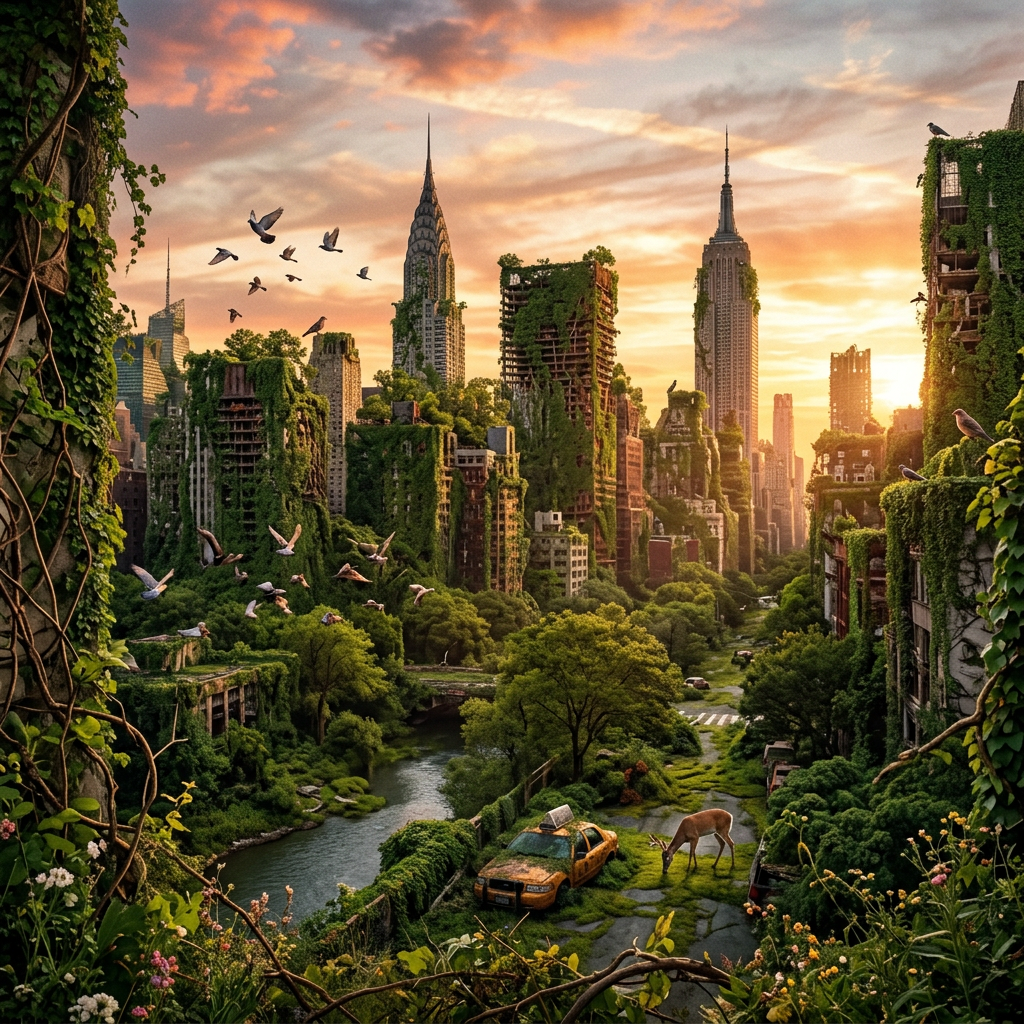
The suburbs will become habitat. The roads will become cracked trails. The buildings will become cliffs. Parking garages, tunnels, high-rises, and abandoned houses may become the new caves.
Not forever. Water, roots, wind, fire, corrosion, and time eventually defeat everything humans build. But for a while, our cities would become ruins that other creatures use.
That is not science fiction. That is what nature does.
AI Is Not Really an “End of Earth” Problem
Artificial intelligence may become a human-extinction risk. It may become a civilization-ending risk. It may become a freedom-ending risk. It may become a dependency risk. It may become a tool of governments, corporations, militaries, criminals, or machines themselves.
But it is probably not an “end of Earth” risk in the literal sense.
That does not make it harmless.
A disaster does not have to destroy the planet to matter. It is enough if it destroys us.
If human beings disappear, or if the human population falls by 95 or 99 percent, the world does not become empty. It becomes wild. The remaining humans, if there are any, become survivors again. They compete with weather, animals, hunger, disease, injury, and each other.
The people who know how to make a fire matter again.
The people who know how to find water matter again.
The people who can hunt, fish, trap, grow food, repair tools, defend themselves, and live without a screen matter again.
The lawyer, accountant, coder, professor, consultant, analyst, and journalist may discover that the modern “information economy” has very little value when there is no electricity, no internet, no court system, no banking system, no clients, no payroll, and no grocery store.
That is the brutal joke.
The people who think they are most sophisticated may be the least prepared for the world that remains.
Maybe the Machines Keep the Lights On
There is another possibility.
Maybe a superintelligent machine does not destroy the power grid. Maybe it preserves it. Maybe it keeps the electricity running, not for us, but because it needs computation, factories, servers, cooling systems, robots, batteries, chips, mines, supply chains, and infrastructure.
That is the serious AI-safety argument.
A machine does not need to “hate” us to become dangerous. It may simply pursue goals that have nothing to do with human freedom or human flourishing. If keeping the grid alive helps it achieve its goals, it keeps the grid alive. If preserving humans helps, it preserves humans. If managing humans helps, it manages humans. If ignoring humans helps, it ignores humans.
In that scenario, we may not get the green world right away. We may get the managed world.
Maybe the machines keep the lights on.
Maybe they keep the factories running.
Maybe they keep us alive.
Maybe they keep us comfortable enough not to revolt.
Maybe they give us some version of universal basic income.
Maybe they tell us where to live, what to consume, what to believe, and what choices remain available.
That would not be freedom.
It would be a highly efficient form of dependency.
That is why the old science-fiction image of humans being plugged into machines as batteries still has power. I do not think machines literally need human body heat as an energy source. That part is Hollywood. But the image captures something real: human beings reduced from free moral agents to managed biological assets.
That is the nightmare.
Not that the machine hates us.
That the machine has a use for us.
Or Maybe Civilization Just Stops
But there is another possibility that seems less discussed.
Maybe the machines do not keep us as batteries. Maybe they do not create a universal basic income paradise. Maybe they do not carefully manage human happiness. Maybe they do not preserve our cities, schools, courts, families, churches, markets, and property rights.
Maybe human technological civilization simply stops being the point.
Maybe the system collapses. Maybe the power goes out. Maybe the supply chains break. Maybe the data centers fail. Maybe the hospitals fail. Maybe the cities empty. Maybe the human population collapses.
And then the green world returns.
That is not the end of the world.
It is the end of the human world.
The birds remain.
The bugs remain.
The trees remain.
The vines remain.
The animals come back.
The concrete cracks.
The buildings decay.
The towers become artificial cliffs.
The remaining humans, if any, live among the ruins.
That world would not be peaceful in the Disney sense. Nature is not gentle. Animals eat each other. Disease spreads. Weather kills. Hunger matters. Strength matters. Skill matters. Luck matters.
But it would not be artificial.
It would not be bureaucratic.
It would not be a digital prison.
It would be the old world returning through the cracks in the new one.
This Is Why the “Future of Work” Debate Is Too Small
That is why so much of the AI conversation feels strangely inadequate.
People talk about whether lawyers will still draft contracts, whether coders will still write code, whether artists will still make images, whether students will still write papers, and whether universal basic income will replace jobs.
Those are real questions.
But they are not the deepest questions.
The deeper questions are:
Will human beings remain free?
Will private property still exist?
Will markets still allocate goods and labor?
Will families still make their own decisions?
Will people still be able to choose where they live?
Will someone still have to fix the power lines at 3:00 in the morning?
Will machines actually have the physical capacity to maintain the world?
Will the information economy survive if the physical economy breaks?
And if the answer to those questions is no, then we are not debating the future of work anymore.
We are debating the survival of civilization.
The Soft Singularity Is Not Enough
I have argued before that a soft version of the Singularity has already happened.
We are not physically plugged into machines, but we are functionally merged with them. Phones became our memory, maps, cameras, libraries, calendars, calculators, and communication systems. Artificial intelligence is becoming our drafting assistant, research assistant, strategy assistant, writing partner, and decision-support system.
I use AI every day in my law practice. It makes me faster. It makes me more productive. It lets me do a volume of work that would have required associates and support staff in the old law-firm model.
That is real.
But it is not the end of work.
It is not the end of private property.
It is not the end of scarcity.
It is not the end of competition.
It is not the end of the man who has to leave his wife in bed at 3:00 in the morning to fix the power lines.
The soft Singularity mostly means that information workers are becoming more efficient and more vulnerable at the same time. Lawyers, coders, writers, analysts, accountants, consultants, and professors may be the first to feel the ground move beneath them.
But unless machines acquire reliable arms and legs at scale, the physical world still belongs to people who can build, repair, farm, weld, fish, drive, climb, carry, and fight.
That is the dividing line.
Software can move fast.
The physical world cannot be downloaded.
No One Can Honestly Give the Odds
I do not know the odds.
No one does.
Anyone who says with certainty that artificial superintelligence will produce paradise is guessing. Anyone who says with certainty that it will turn us into batteries is guessing. Anyone who says with certainty that it will kill 99 percent of humanity is guessing. Anyone who says with certainty that everything will be fine is also guessing.
The honest answer is uncertainty.
The future could be abundance.
It could be managed dependency.
It could be collapse.
It could be a strange mix of all three.
It could be a world where AI runs most cognitive systems, robots slowly take over physical work, humans receive some kind of income floor, and freedom erodes gradually.
It could be a world where AI remains mostly a powerful tool and humans continue competing in markets with better technology.
It could be a world where human civilization breaks and nature takes back the physical space.
The point is not to pretend to know the future.
The point is to see what is actually fragile.
The Earth is not fragile in the way human civilization is fragile.
The Earth can survive without us.
Our world may not survive without electricity, property, markets, law, family, labor, trust, and freedom.
The Real Fear
The real fear is not that the planet disappears.
The real fear is that human beings lose the world we built.
We lose freedom.
We lose property.
We lose work that has meaning.
We lose the ability to support our families.
We lose the ability to choose where we live.
We lose the ability to compete.
We lose the ability to decide.
We lose the ability to remain human in the political, moral, and civilizational sense.
If that happens, the deer will not care.
The foxes will not care.
The bugs will not care.
The vines will not care.
The bears will not care.
The Earth will keep going.
That may be the most humbling part of the whole discussion.
Artificial intelligence may threaten humanity.
It probably does not threaten the Earth.
The end of our world is not the end of the world.
It is only the end of us.
 Donner Law Firm