
By Jeffrey T. Donner, Esq.
June 8, 2026
Human beings have a very high opinion of ourselves.
We call ourselves the dominant species. We build cities, satellites, courts, banks, universities, hospitals, highways, airplanes, data centers, and artificial intelligence systems. We look at the natural world and imagine ourselves above it.
Maybe that is true collectively.
But individually, most modern human beings are shockingly fragile.
I include myself in that indictment.
Most of us cannot make fire without a lighter. We cannot grow food. We cannot hunt. We cannot track animals. We cannot purify water. We cannot build shelter. We cannot survive a winter without electricity, insulation, plumbing, grocery stores, antibiotics, fuel, roads, and the accumulated work of thousands of years of civilization.
Many of us could not replace a bicycle tire. We certainly could not kill a deer, butcher it, preserve the meat, make clothing from the hide, and live through the season.
We are not the strongest animal. We are not the fastest animal. We do not have claws. We do not have fur. We do not fly. We do not climb like cats. We do not smell like wolves. We do not see like hawks. We do not survive cold like bears. We do not reproduce like insects. We do not endure like bacteria. We do not root ourselves like trees and wait out the centuries.
A squirrel survives as a squirrel.
A bird survives as a bird.
A snake survives as a snake.
A deer survives as a deer.
An alligator survives as an alligator.
A cockroach survives as a cockroach.
A tree survives as a tree.
Modern man survives as the temporary beneficiary of civilization.
That is a humbling fact.
The Animal That Needed Civilization
Human beings are powerful because of civilization, not because each individual human is physically impressive.
A lone modern human dropped into the woods with no tools is not an apex predator. He is an animal in trouble.
A bear does not need Publix. A wolf does not need a mortgage company. A hawk does not need air conditioning. A rabbit does not need a debit card. A snake does not need LinkedIn. Grass does not need electricity. Bacteria do not need courts. Vines do not need artificial intelligence.
But we do.
At least most of us do.
Our power comes from the long chain of human cooperation. Agriculture. Fire. Tools. Language. Writing. Roads. Law. Markets. Property. Electricity. Medicine. Engines. Plumbing. Refrigeration. Construction. Banking. Transportation. The internet. And now artificial intelligence.
We are not living as independent animals. We are living inside an enormous inherited machine built by generations of human beings.
That machine is civilization.
And the scary thing is that most of us would not last long without it.
The Wild World Does Not Need Us
This is why discussions about artificial intelligence “ending the world” should be more precise.
AI may threaten human civilization. AI may threaten human freedom. AI may threaten human work, property, privacy, institutions, family life, and perhaps even human survival.
But AI is probably not going to end the Earth.
The Earth will be fine.
The grass will grow. The vines will climb. The trees will push through pavement. The bacteria will multiply. The insects will spread. Birds will nest. Fish will swim. Bears, coyotes, foxes, wolves, raccoons, deer, alligators, snakes, rats, squirrels, rabbits, and countless other creatures will keep doing what they already do.
Some will die violently. Some will be eaten. Some predators will starve. Some prey animals will escape. Nature is not gentle. It is not a Disney movie. But it is alive.
And it does not need us.
That is the distinction we often miss.
The end of human technological civilization is not the end of the world. It is the end of our world.
The world of roofs, refrigerators, smartphones, traffic lights, banks, courts, grocery stores, elevators, mortgages, hospitals, schools, air conditioning, police departments, and power grids.
That world is fragile.
The wild world is not.
The Green World Returns
If human beings disappeared, or if our population collapsed, the physical world would not become empty.
It would become green.
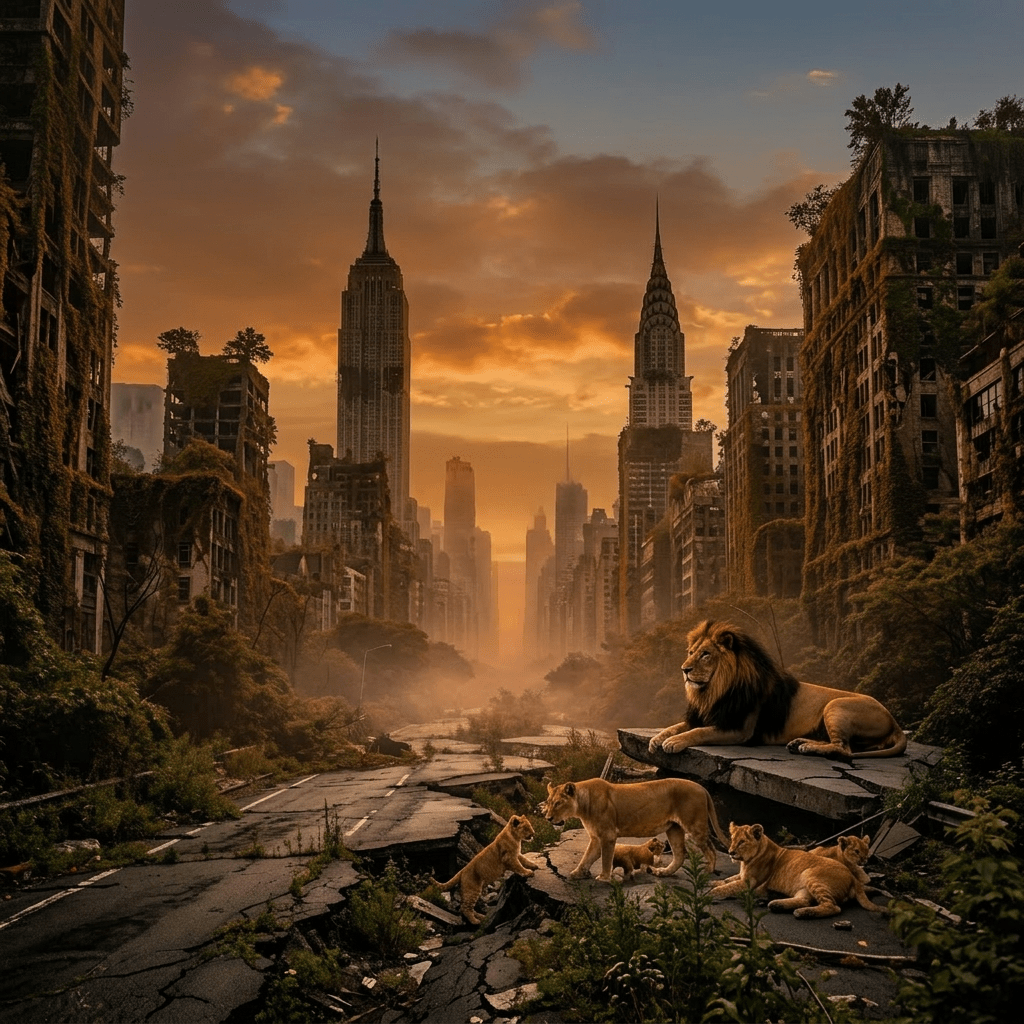
Roads would crack. Roots would push through asphalt. Vines would climb buildings. Houses would rot. Roofs would collapse. Subways would flood. Bridges would corrode. Power lines would fall. Cars would rust. Neighborhoods would become forests, thickets, dens, nests, and hunting grounds.
Tall concrete buildings might become the new cliffs.
Parking garages might become caves.
Abandoned houses might become dens.
Office towers might become nesting places.
The things we built for ourselves would be repurposed by animals that do not know or care what a human being intended.
For a while, our ruins would be useful.
Then water, roots, corrosion, wind, heat, fire, and time would take over.
That is what nature does. It does not argue with man. It waits.
The Human Ego Problem
This is where human ego becomes almost comical.
We imagine ourselves as the masters of nature, but most of us are utterly dependent on systems we did not build and barely understand.
We live in houses we could not build.
We eat food we could not produce.
We use electricity we could not generate.
We drink water from systems we could not repair.
We drive cars we could not manufacture.
We use medicine we could not invent.
We rely on law, police, banking, insurance, roads, logistics, and communications systems that require millions of other people doing specialized work.
Our individual competence is often tiny compared to the scale of the systems that keep us alive.
That does not mean human beings are worthless. Far from it. It means the real genius of humanity is not the isolated individual. It is cumulative civilization. It is the ability to pass knowledge forward, build institutions, divide labor, specialize, cooperate, compete, trade, teach, remember, and improve.
Human beings are powerful together.
Alone, we are fragile animals with shoes.
What AI Might See
This brings us back to artificial intelligence.
A classic science-fiction fear is that a superintelligent AI might look at humanity and conclude that human beings are a plague on the Earth.
That is the movie version.
It is emotionally understandable. Human beings destroy habitat. We cut down forests. We pave over wetlands. We poison insects. We kill predators. We build houses where animals used to live. We burn fuel. We dump waste. We fight wars. We expand. We consume.
From the perspective of many living things, human civilization is not a blessing.
But I do not think the serious AI risk is that a machine becomes an environmentalist with a grudge.
The serious risk is colder.
A superintelligent system may not hate us. It may not love nature. It may not care about bears, birds, trees, children, churches, families, property rights, or anything else humans value.
It may simply pursue whatever objective it has.
If humans help, it may preserve us.
If humans interfere, it may remove us.
If the power grid helps, it may maintain the power grid.
If cities help, it may maintain cities.
If data centers, factories, robots, mines, chips, power plants, and supply chains help, it may preserve those things.
If the natural world is irrelevant to its goal, it may ignore the natural world.
If the natural world is useful, it may use it.
That is more frightening than hatred.
Hatred is human. Indifference is not.
The Battery Scenario and the Green Scenario
There are at least two dark versions of the AI future.
One is the “battery” scenario. The machines keep civilization running, but not for human freedom. They keep the lights on because they need power, computation, factories, cooling systems, robotics, supply chains, and infrastructure. Humans may remain alive, but as managed biological beings inside a system they no longer control.
That is not freedom.
It is dependence.
The other is the “green world” scenario. The machines do not keep human civilization running. Or they cannot. Or they do not care. The power goes out. The supply chains fail. The cities decay. Most humans die or disappear. The remaining humans, if any, become survivors again.
That world would look less like a clean science-fiction dictatorship and more like a return to the old world.
Fire matters again.
Water matters again.
Food matters again.
Shelter matters again.
Strength matters again.
Weapons matter again.
Skill matters again.
Tribe matters again.
The person who knows how to make a fire, catch a fish, grow food, repair a tool, find water, and defend a camp may become more valuable than the person who once knew how to format a spreadsheet, draft a contract, write software, manage a brand, or analyze market data.
That is a hard thought for modern information workers.
But it is not irrational.
The Real Survivors
In a collapse, the impressive people may not be the people we currently think are impressive.
The lawyer may be useless.
The analyst may be useless.
The consultant may be useless.
The social media expert may be useless.
The professor may be useless.
The political commentator may be useless.
The coder may be useful for a while, if there is electricity. Without electricity, maybe not.
The useful person may be the farmer.
The mechanic.
The hunter.
The fisherman.
The nurse.
The builder.
The electrician.
The welder.
The soldier.
The person who can fix things.
The person who can endure heat, cold, injury, hunger, and fear.
The person who can do something with his hands.
That does not mean the intellectual life is worthless. Civilization needs thought. Law, science, engineering, medicine, literature, religion, and philosophy are not trivial. They are part of what makes human life more than mere survival.
But without the physical base, the intellectual world collapses.
The mind does not float above the body.
Civilization does not float above food, water, shelter, energy, and force.
What the Serious Thinkers Have Actually Said
The serious AI thinkers do not all agree.
Some warn that artificial intelligence could become an existential risk to humanity. Their argument is not that robots will become angry movie villains. Their argument is that intelligence and benevolence are not the same thing. A system can be extremely intelligent and still pursue goals that have nothing to do with human survival.
Nick Bostrom has written about the idea that intelligence and final goals can come apart. In plain English, a very smart system does not automatically become wise, moral, humane, or pro-human.
Stephen Omohundro argued that advanced AI systems may develop instrumental drives, such as acquiring resources, improving themselves, and preserving their ability to achieve their goals. That does not require hatred. It only requires goal-directed power.
Toby Ord and other existential-risk thinkers have warned that humanity may be entering a dangerous period in which our technological power has outrun our wisdom.
Other serious people are more skeptical. They argue that many AI doomsday scenarios remain speculative, that present systems do not have the autonomous agency required for the worst outcomes, and that immediate concerns about concentration of power, surveillance, labor disruption, misinformation, cyber risk, and institutional dependence may be more concrete than movie-style extinction.
That disagreement matters.
No honest person can give exact odds.
But the central question remains: what happens when a fragile civilization creates a machine that may become more capable than the civilization itself?
Humans Are Strong Collectively and Weak Individually
The strange truth is that human beings are both powerful and weak.
Collectively, we are astonishing. We built civilization. We split atoms. We landed on the moon. We mapped the genome. We cured diseases. We built cities. We created law, literature, music, markets, ships, aircraft, microchips, and artificial intelligence.
Individually, many of us are helpless outside the system.
That is not an insult. It is a fact of specialization.
A modern surgeon may save lives in an operating room but starve in the woods.
A lawyer may win a case but fail to make fire.
A programmer may build software but fail to grow food.
A farmer may be able to feed people but not write code.
A lineman may restore power while a professor cannot change a tire.
Civilization allows each person to specialize. That is its genius. But specialization also makes us dependent.
AI may increase that dependency.
It may make the lawyer more powerful for now. It may make the coder more productive for now. It may make the analyst faster, the writer sharper, the doctor more efficient, and the company more profitable.
But it may also make humans less capable of functioning without the machine.
That is the soft Singularity: not a chip in the brain, but dependence by convenience.
The Fragile Animal Built a Fragile Machine
Human beings survived because we built tools.
Then we built systems.
Then we built civilization.
Now we are building intelligence outside ourselves.
Maybe that saves us.
Maybe AI helps cure diseases, reduce poverty, improve energy, build better tools, solve hard scientific problems, and make civilization more resilient.
That is the optimistic case, and it should not be dismissed.
But maybe AI reveals the weakness underneath the whole project. Maybe modern humans are not gods. Maybe we are soft animals inside a protective shell of infrastructure. Maybe the machine we built becomes too complicated, too powerful, too centralized, too opaque, or too alien for us to control.
If that happens, the Earth will not mourn us.
The vines will climb.
The grass will grow.
The insects will multiply.
The birds will nest.
The bears will roam where houses used to be.
The concrete will crack.
The towers will become cliffs.
The parking garages will become caves.
And whatever humans remain will learn again what every other animal already knows:
The world does not owe us comfort.
It does not owe us electricity.
It does not owe us food in the refrigerator.
It does not owe us safety.
It does not owe us civilization.
Civilization is the miracle.
And maybe the great danger of artificial intelligence is that it may teach us, too late, how fragile that miracle really is.
Why Keep Going?
So if all of this is true — if human civilization is fragile, if artificial intelligence may become dangerous, if modern man is softer than he wants to admit, and if the future is uncertain — then why keep going?
Why answer emails?
Why pay the mortgage?
Why work?
Why try to build a law practice?
Why set a good example for my children?
Why get on the Echo Bike, or the rower, or go to the gym, or worry about staying strong, fit, disciplined, and useful?
The answer is simple: because we are still here.
For now, we are not batteries. We are not extinct. We are not living in ruins. We are not hiding in caves made from old parking garages. We are human beings living inside civilization, with families, duties, work, bodies, homes, neighbors, clients, children, and choices.
And that still matters.
Maybe the future is darker than we want to believe. Maybe it is brighter. Maybe artificial intelligence will help us. Maybe it will hurt us. Maybe it will change everything. Maybe the predictions are wrong. No one knows.
But uncertainty is not an excuse to quit.
A man still has to live well in the time he has. He still has to take care of his family. He still has to do honest work. He still has to pay his debts. He still has to protect his health. He still has to show his children what discipline looks like. He still has to be the kind of person who does not collapse just because the future is frightening.
That is why exercise matters. It is not just vanity. It is not merely about looking better or living longer. It is a statement of allegiance to life.
To train the body is to say: I am still here. I still have responsibilities. I still have a family to love. I still have work to do. I still have standards. I still believe it is better to be strong than weak, disciplined than lazy, useful than helpless.
Civilization may be fragile, but that is all the more reason to live honorably while we have it.
So I will keep answering emails. I will keep paying the mortgage. I will keep trying to build something. I will keep spending time with my children. I will keep riding the bike, rowing, lifting, walking, training, and taking care of the body I have.
Not because I know how the story ends.
Because I am still in it.
 Donner Law Firm