
By Jeffrey T. Donner, Esq.
June 8, 2026
There is a version of the artificial-intelligence future in which ordinary life changes so completely that work, money, mortgages, jobs, property, and even human freedom no longer mean what they used to mean.
In that version, artificial intelligence becomes artificial general intelligence. Artificial general intelligence becomes superintelligence. The machines improve themselves. Human beings lose control. The economy no longer belongs to human labor. Civilization no longer runs on ordinary human decision-making. Maybe, in the darkest science-fiction version, human beings end up plugged into machines as batteries.
If that is really where this is headed, then I have a practical question:
Why am I still answering emails?
Why am I still billing hours, collecting fees, paying a mortgage, and helping my children get through college if human life as we know it is about to end?
That question is partly a joke. But only partly.
The more serious point is this: the debate over artificial intelligence, universal basic income, and the “Singularity” often skips over the physical, economic, and moral realities that make human freedom possible. If the machines truly take over everything, then all bets are off. But short of that, the world still has to be built, wired, repaired, fed, powered, cleaned, defended, transported, and maintained.
And that means people still have to work.
The Soft Singularity Is Already Here
The full science-fiction Singularity has not happened.
We are not plugged into tubes. The machines are not using us as batteries. There is no Matrix.
But a softer version of the human-machine merger is already here.
It started with the phone. The phone became our memory, map, camera, calculator, library, calendar, filing cabinet, and communication device. Then artificial intelligence became something more: not merely a place to store information, but a tool that helps us think, write, research, analyze, organize, and decide.
I know this directly because I use AI every day in my law practice.
It helps me turn rough thoughts into polished work product. It helps me draft emails, refine tone, analyze facts, prepare demand letters, outline pleadings, organize legal arguments, and think through strategy. I still read the work. I still revise it. I still exercise judgment. I still own the result. But the machine gives me leverage.
That is not theoretical. It allows one experienced lawyer to produce a volume of work that previously would have required associates and support staff.
That is the soft Singularity.
Not a chip in the brain. Not a robot overlord. Not science fiction.
Just a practical merger between human judgment and machine cognition.
But that does not mean work has ended. It means certain kinds of work have changed.
The Soft Singularity Does Not Abolish Work
This is where the argument has to be disciplined.
If the real Singularity happens — the full science-fiction version where human freedom disappears, machines control civilization, and ordinary human life as we know it is over — then the question “why am I still paying the mortgage?” becomes grimly logical.
If we are all about to become batteries for the machine, why am I still answering emails?
But short of that, the argument collapses.
The soft Singularity does not mean nobody has to work. It does not mean universal leisure. It does not mean the mortgage disappears. It does not mean the chicken gets to the grocery store by magic. It does not mean the toilet fixes itself, the power line repairs itself, the roof patches itself, or the fishing boat goes to sea without men willing to risk their lives.
All the soft Singularity really means, at least for now, is that information workers are becoming much more efficient.
Lawyers, coders, consultants, analysts, writers, accountants, marketers, professors, and other people who move information for a living now have a machine that helps them think, draft, revise, research, organize, and communicate. That is a major change. It may destroy some jobs. It may create others. It may make one person do the work of three. It may make solo professionals far more powerful than they used to be.
But it is not the end of work.
It is the acceleration of certain kinds of work.
That distinction matters. If AI merely makes me a more efficient lawyer, then I do not get to stop working. I have to compete with other lawyers who are also more efficient. The market adjusts. Clients expect more. Turnaround times shrink. Work product improves. Margins may compress. The treadmill does not disappear; it speeds up.
That is not universal basic income.
That is competition with better tools.
So the question is close to all or nothing. If the machines truly end human civilization as we know it, then ordinary economic obligations become absurd. But if AI simply makes information workers more productive while physical work, property, housing, food, energy, maintenance, and human ambition remain, then the free market does not disappear.
It just gets faster.
Intelligence Is Not the Same Thing as Arms and Legs
There is a major limitation in the “AI will take over everything” argument: computers do not yet have reliable arms and legs at scale.
Yes, the robot videos are impressive. The robot walks. The robot jumps. The robot opens a door. The robot carries a box across a clean laboratory floor. Fine. I am impressed.
But the real world is not a laboratory floor.
The real world has mud, rusted bolts, bad weather, heat, old wiring, cracked concrete, missing parts, snakes, liability, traffic, human confusion, bad plans, and job sites that do not look like promotional videos.
A robot in a demonstration is not the same thing as a robot that can fix a roof leak during a thunderstorm, repair a power line after a hurricane, pour and finish concrete correctly, diagnose an electrical problem in an old building, crawl under a house to fix plumbing, weld underwater, or work on a fishing boat in dangerous seas.
Even the best robots still have to be transported, charged, maintained, repaired, supervised, insured, and directed. Someone has to bring the machine to the problem. Someone has to decide whether it solved the problem. Someone has to take responsibility when it fails.
So when people say AI will take over all work, I want to ask: all work?
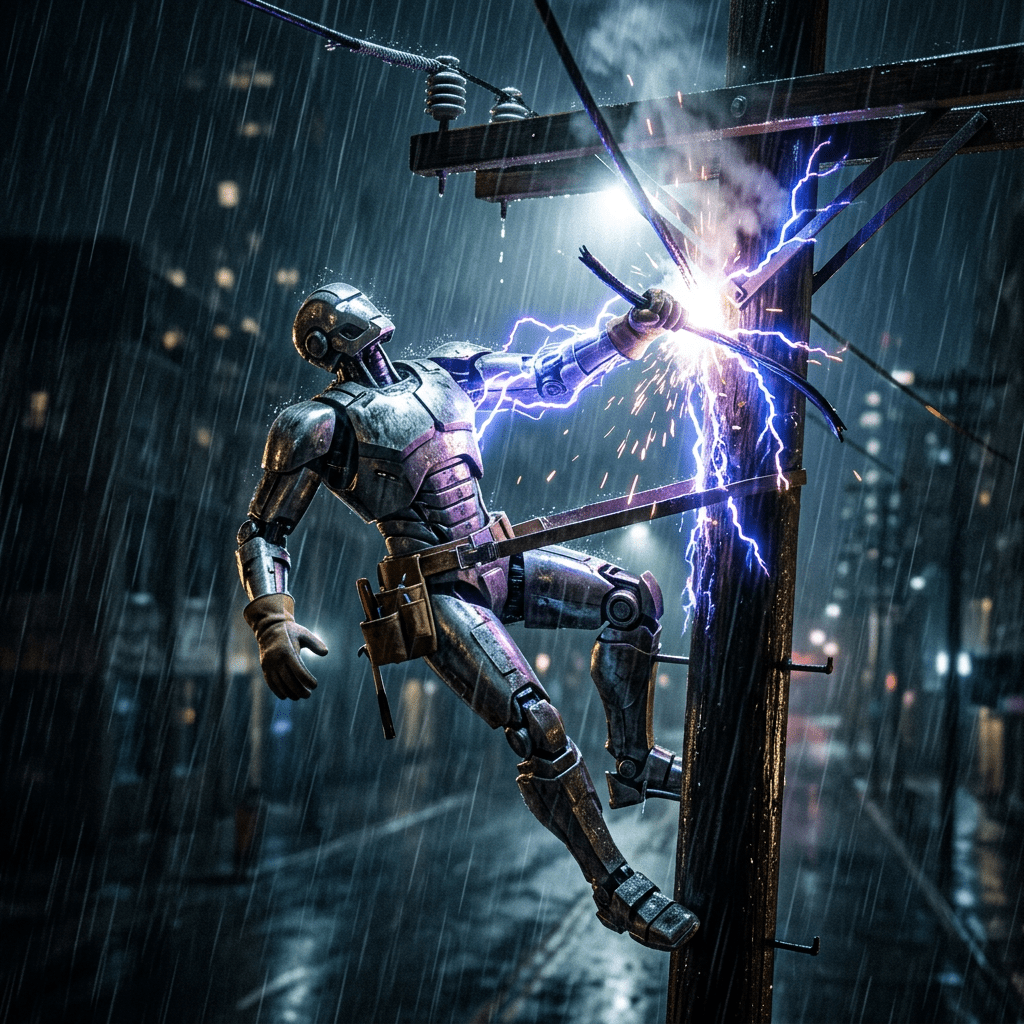
Including the man on the power line?
Including the roofer in July?
Including the plumber under the house?
Including the concrete crew at dawn?
Including the farmer whose crops and animals do not care what the futurists predicted?
Including the offshore fisherman who leaves his family and risks his life at sea?
Maybe one day.
But not tomorrow.
The Man Who Still Has to Get Out of Bed
This is the image that brings the whole debate back to earth.
Who is the man who gets out of bed at 3:00 in the morning, leaves his wife asleep, puts on his boots, and goes out into the weather to restore power after a storm?
Who pours the concrete?
Who climbs onto the roof in July?
Who welds the pipe?
Who fixes the toilet?
Who repairs the sewer line?
Who works on the fishing boat?
Who maintains the transformer?
Who picks, transports, cooks, repairs, builds, wires, hauls, and delivers the physical world that everyone else simply assumes will be there?
That is not a side issue. That is the issue.
A society cannot be made only of people with laptops. The world is not built by moving words and data around a screen. The world is built by people who show up physically, often in bad weather, often in dangerous conditions, often at inconvenient hours, and often at real personal cost.
This is where many elite discussions about the future of work become unserious. They define “work” as an information job. They imagine work as email, meetings, spreadsheets, documents, code, analysis, and commentary. They forget how the chicken got to lunch. They forget who picked the coffee beans, loaded the ships, drove the trucks, stocked the shelves, poured the slab under the building, wired the lights, fixed the sewer line, and restored power after the storm.
So before anyone announces that AI will give humanity a leisurely future, the question must be asked again:
Do the machines have arms and legs?
Can they climb the pole?
Can they repair the roof?
Can they fix the toilet?
Can they weld underwater?
Can they work the fishing boat?
Can they farm in the heat?
Can they pour the concrete?
Can they do all of that reliably, economically, and at scale, without humans still transporting, supervising, maintaining, repairing, insuring, and rescuing them?
If the answer is no, then the no-work future is not a human future. It is an information-class fantasy built on the continued labor of people who do not have the luxury of pretending that work is just email.
The Comfortable Classes Already Live in a Partial Illusion
There is also an uncomfortable class point here.
People like me already live in a partial illusion. I work hard. I have stress, deadlines, clients, mortgages, tuition bills, and business risk. I am not pretending otherwise.
But sending emails from a home office is not the same physical existence as standing on a roof in July, repairing power lines in bad weather, finishing concrete, welding pipe, working offshore, picking crops, driving trucks, or doing dangerous construction work.
A large part of modern comfort depends on other people doing the hard physical work. Often those people have less money, less security, less flexibility, and fewer choices than the professional class enjoys.
That matters.
When a white-collar professional asks, “Why should I still have to work if AI is coming?” the honest answer may be: because the machine is only now coming for the kind of work people like me do.
The roofer already knew work was hard.
The lineman already knew work was hard.
The concrete finisher already knew work was hard.
The farm worker already knew work was hard.
The man on the fishing boat already knew work was hard.
AI may first liberate, or threaten, the people who were already physically insulated from the hardest kinds of labor. That is not a reason to reject technology. It is a reason to be honest about what “work” means.
Universal Basic Income Sounds Simple Until You Ask Who Still Has to Work
The strongest argument for universal basic income is simple: if technology makes society vastly richer, ordinary people should share in that wealth.
That argument is not stupid. It is not childish. It is not mere laziness dressed up as policy.
If AI and robotics allow companies to produce more goods and services with fewer human workers, then the gains will go somewhere. They will go to owners, investors, executives, and the people who control the machines. If ordinary workers are displaced, or if their bargaining power collapses, then some form of basic income may become one way to prevent technological progress from producing mass insecurity.
There is also a dignity argument. A basic income could give people a floor. Not luxury. Not a mansion. Not idleness as a constitutional right. A floor. Enough to avoid desperation. Enough to leave a bad job. Enough to retrain. Enough to survive a transition without being ruined.
There is also a simplicity argument. The modern welfare state is complicated, conditional, bureaucratic, and often humiliating. A universal payment sounds cleaner than a maze of programs, eligibility rules, subsidies, cliffs, and bureaucratic discretion.
Those are serious arguments.
But a floor is one thing.
A society where nobody has to work is another.
And the minute the argument becomes “nobody should have to work,” the question returns:
Who fixes the power lines?
If nobody has to work, who does the work nobody wants to do?
Some work is hard. Some work is dirty. Some work is dangerous. Some work is physically punishing. Some work is boring. Some work destroys backs, knees, shoulders, hands, lungs, and lives.
A society still needs that work done.
Power lines do not repair themselves. Toilets do not unclog themselves. Concrete does not pour itself. Crops do not harvest themselves. Fish do not jump into stores. Roofs do not repair themselves after hurricanes.
In a market system, unpleasant and necessary work must be paid for. If not enough people want to do it, wages rise. That is not perfect justice, but it is connected to reality. The harder, more dangerous, more necessary, or less pleasant the job is, the more society may have to pay someone to do it.
But if everyone receives enough money not to work, society has only a few options.
Pay essential workers much more.
Import workers.
Automate the work.
Ration the service.
Let the service decay.
Coerce workers.
Only one of those options is consistent with a free society: pay people enough to make the work worth doing.
But that is just the market again.
UBI Does Not Abolish Scarcity
Universal basic income also does not abolish scarcity.
Money is not the same thing as housing, safety, land, energy, medical care, food, skilled labor, or desirable neighborhoods. Money is a claim on goods and services. If everyone receives more money, but the number of houses, safe neighborhoods, skilled electricians, roofers, plumbers, linemen, and doctors does not increase, then the extra money does not magically make everyone middle class.
It just changes the bidding.
Give everyone $3,000 a month, and landlords may raise rents. Give everyone $3,800 a month, and home prices, insurance, groceries, tuition, and services may adjust. If more money chases the same scarce things, prices rise.
You cannot print waterfront property.
You cannot print safe neighborhoods.
You cannot print skilled linemen.
You cannot print competent plumbers.
You cannot print fathers willing to climb poles at 3:00 in the morning.
That is the basic problem.
Universal basic income may reduce desperation. It may provide a floor. It may soften economic transition. But it cannot eliminate the fact that real things remain scarce.
And housing exposes that problem immediately.
Who Decides Where Everyone Lives?
Suppose every person receives a basic income. Fine.
Where does everyone live?
Who gets the 60,000-square-foot mansion?
Who gets the waterfront estate?
Who gets the gated island?
Who gets the safe neighborhood with private security?
Who gets the ordinary 2,000-square-foot middle-class house in a decent neighborhood?
Who gets the apartment complex with dangerous neighbors and crime?
Who lives near the good school?
Who lives near the job?
Who lives where the police come quickly?
Who lives where people worry about burglaries, violence, and drive-by shootings?
If the market still exists, then people with more money, better jobs, better skills, better investments, better family support, or better luck will still outbid other people for the better places to live. Inequality remains.
If the market does not exist, then someone else must decide.
That someone may be a government agency. It may be a committee. It may be an algorithm. It may be an AI system. It may be a political class. It may be a bureaucrat. It may be a king by another name.
But someone has to allocate the scarce houses, scarce neighborhoods, scarce schools, scarce views, scarce safety, and scarce convenience.
Once someone else decides where people live, what they receive, what they are allowed to own, and what standard of life they are assigned, we are no longer talking about freedom in the ordinary American sense.
We are talking about managed dependency.
That is the point many UBI discussions avoid. If markets and private property do not allocate scarce goods, political power will. And political allocation is not neutral. It is favoritism, bureaucracy, corruption, waiting lists, party loyalty, influence, connection, resentment, and control.
That does not abolish inequality. It changes the source of inequality from market outcomes to government permission.
That is not liberation.
It is a return to something much older.
Existing Property Rights Do Not Disappear
There is another problem. We are not starting from zero.
People already own homes. People already have mortgages. People already have leases. People already have contracts. People already have debts, businesses, savings, retirement accounts, and obligations.
One person rents for $1,000 a month. Another has a $3,800 mortgage. Another has a $10,000 mortgage. Another owns a house outright. Another has no house at all.
If everyone receives the same basic income, it affects each person differently. For one person, it covers rent and leaves extra money. For another, it barely touches the mortgage. For another, it is spending money. For another, it is not enough.
If the payment is adjusted for need, it is no longer truly universal. If it is universal, it is not tailored to need. If it is large enough to cover high-cost households, it becomes enormously expensive and potentially inflationary. If it is small enough to be affordable, it does not solve the problem its advocates claim it will solve.
And if the government tries to solve all of those differences by rewriting contracts, controlling rents, forgiving debts, reallocating housing, or equalizing assets, then we are no longer talking about basic income.
We are talking about government control over property.
That is a different country.
The Two-Day Work Week Is an Email-Job Fantasy
There is a softer version of the universal basic income argument that says maybe the future is not no work, but less work. Maybe AI and robotics will make society so productive that the ordinary work week shrinks to two or three days.
That sounds pleasant.
It also sounds like something only a person with an email job would say.
A lawyer, consultant, journalist, professor, programmer, or analyst can imagine a two-day work week because much of his work happens on a laptop. He can send emails on Monday, revise documents on Tuesday, and pretend the week has been conquered.
But there is no obvious two-day work week for the man repairing downed power lines after a hurricane. There is no two-day work week for the plumber responding to an emergency leak. There is no two-day work week for the offshore fisherman who leaves his family and risks his life at sea. There is no two-day work week for the farmer whose crops, animals, equipment, and weather do not respect a calendar theory. There is no two-day work week for the electrician, welder, roofer, concrete finisher, truck driver, mechanic, or construction worker whose job exists because the physical world keeps breaking, moving, leaking, collapsing, and demanding attention.
That is the problem with so many elite discussions about the future of work. They define “work” as sitting at a desk, moving words and data around a screen. They forget how the chicken got to lunch. They forget who picked the coffee beans, loaded the ships, drove the trucks, stocked the shelves, poured the slab under the building, wired the lights, fixed the sewer line, and restored power after the storm.
A reduced work week may be possible for some jobs. It may even be desirable for some workers. But it is not a serious answer to the central problem. It is not a universal theory of labor. It is a laptop-class solution to a physical-world problem.
So before anyone announces that AI will give humanity a leisurely future, the question must be asked again:
Do the machines have arms and legs?
If they do not, someone still has to do the work.
Is UBI Communism?
Strictly speaking, universal basic income is not automatically communism. A society could have private property, private businesses, markets, profits, competition, and still provide a modest universal payment funded by taxes, resource revenue, or some other mechanism.
A modest basic income as a floor is one thing.
A complete replacement for work is another.
The larger and more ambitious the program becomes, the more it raises unavoidable questions about property, labor, incentives, scarcity, housing, and political control. If UBI is small, it may not solve the problem. If it is large enough to let people stop working, it creates new problems.
At that point, the debate is no longer merely about compassion. It is about whether a free society can survive if people are promised economic security without work while scarce goods still have to be allocated and essential labor still has to be performed.
That is why critics hear communism in the background.
The technical label matters less than the practical result. If a central authority controls income, housing, labor, property, and allocation, then the ordinary citizen is dependent on that authority.
Call it socialism. Call it central planning. Call it managed equality. Call it algorithmic fairness. Call it whatever sounds modern.
The result is still control.
Competition Does Not Disappear
Even if UBI exists, competition will not disappear.
One person will take the basic income and stay home. Another will take the basic income and work. Another will start a company. Another will invest. Another will take risks. Another will use AI to become more productive. Another will work harder because he wants the bigger house, the better truck, the private school, the safer neighborhood, or the boat for his wife.
Human beings are not equal in ambition, discipline, health, intelligence, risk tolerance, family support, or luck. A government check does not change that.
So inequality returns immediately.
The only way to prevent that inequality is to control outcomes. Control income. Control inheritance. Control housing. Control consumption. Control private property. Control opportunity.
But that is not freedom.
Freedom includes the right to work harder than someone else. It includes the right to take risks. It includes the right to fail. It includes the right to succeed. It includes the right to use your own talent, discipline, judgment, and effort to improve your condition.
The free market is not perfect. It is often unfair. Some people are born rich. Some are born poor. Some are gifted. Some are not. Some can play basketball like Michael Jordan. Some can sing like Michael Jackson. Some can build companies. Some can fix engines. Some can argue cases. Some can finish concrete.
But the alternative is not perfect justice.
The alternative is usually power.
Instead of people making unequal money because of talent, effort, risk, ownership, luck, and consumer choice, people receive unequal treatment because of politics, connection, bureaucracy, favoritism, and permission.
That is not an improvement.
The Serious Argument on the Other Side
To be fair, the best argument for some form of basic income is not that everyone should be paid to do nothing.
The best argument is that AI may produce a transition so fast that ordinary labor markets cannot adjust. If software can do much of the work now performed by lawyers, coders, analysts, accountants, marketers, writers, consultants, and administrators, then millions of people may find that their skills are suddenly worth less than they expected.
That does not mean all work ends. But it could mean a large and painful disruption in the information economy.
A society may decide that, during that disruption, people need a floor. Not luxury. Not equality of outcomes. Not government assignment of housing. A floor. Enough to preserve social stability while markets reorganize around new technology.
That is a serious argument.
Another serious argument is that if AI creates enormous wealth for a small number of companies and owners, some of that wealth may have to be broadly shared to maintain a stable and legitimate society. A technological economy in which a few people own the machines while everyone else loses bargaining power is not obviously sustainable.
Those arguments deserve to be taken seriously.
But they do not answer the power-line question.
They do not answer the housing question.
They do not answer the property question.
They do not answer the scarcity question.
And they do not abolish the basic conservative insight that freedom depends on private property, voluntary exchange, competition, responsibility, and limits on centralized power.
A modest safety floor may be compatible with freedom.
A society organized around universal dependency is not.
The Matrix Joke Is Funny Because It Is Not Totally a Joke
The cartoon version of the AI future is that we all end up plugged into machines while the machines use us as batteries.
That is not the serious technical version of the Singularity. But it captures the fear: the end of human freedom.
The serious fear is not that machines will literally suck energy from our bodies. The serious fear is that machines, governments, platforms, algorithms, or some combination of all of them will become so powerful that human beings no longer meaningfully control their own lives.
That kind of captivity does not require tubes.
It requires dependency.
If people cannot think without AI, navigate without GPS, communicate without platforms, work without algorithms, buy without digital systems, or live without permission from centralized systems, then the merger has already begun.
And if the future really is that dark — if the machines really are going to control everything and human freedom really is about to end — then the half-joking question becomes serious again:
Why am I still paying the mortgage?
If we are all about to become batteries for the machine, why am I spending the last normal years billing hours, chasing receivables, answering emails, and worrying about tuition?
The mortgage company does not accept “AGI is coming” as payment. Colleges do not accept “the Singularity may happen soon” as tuition. Grocery stores do not discount chicken because ChatGPT can draft a better legal memo.
Until the future arrives, the present still sends invoices.
That is the absurdity.
And it may also be the truth.
My Current View
The full science-fiction Singularity has not happened. It may never happen in the way people imagine.
But the soft version is already here. Human beings are already merging with machines through phones, computers, AI assistants, algorithms, cloud memory, GPS, and digital work systems. We are not physically plugged in, but functionally we are increasingly connected.
That does not abolish work. It does not abolish property. It does not abolish markets. It does not abolish scarcity. It does not abolish ambition. It does not abolish the need for people to do hard, dangerous, physical jobs in the real world.
For now, it mostly makes information workers more efficient.
That is a big deal. But it is not the end of civilization.
Universal basic income may eventually become necessary if AI and robotics destroy enough human earning power. But it is not a magic answer. It has serious problems: cost, inflation, fairness, essential labor, housing, property rights, incentives, political control, and the basic fact that somebody still has to do the hard physical work.
A modest basic income as a floor may be worth debating.
A society where nobody works and everyone is assigned a life by some central authority is not freedom. It is servitude with better marketing.
The real question is not whether AI changes work. It already has.
The real question is whether we can preserve freedom, responsibility, private property, meaningful work, family life, and human dignity while the machines get smarter.
Because until the machines can fix the power line at 3:00 in the morning, someone still has to get out of bed.
And until someone can explain who gets the mansion, who gets the middle-class house, and who gets the dangerous apartment, universal basic income remains less a solution than a slogan.
The promise of technology should be more life.
But if the price is managed dependency, then the old imperfect system of work, property, markets, competition, and freedom may still be better than the beautiful new system that tells every person where to live, what to do, and what to receive.
That is not progress.
That is the road back to serfdom.
 Donner Law Firm