
By Jeffrey T. Donner, Esq.
July 24, 2026
For decades, American cycling proved that it could compete with the strongest riders and teams in Europe.
Greg LeMond became the first American to win the Tour de France and ultimately won it three times. Andy Hampsten won the Giro d’Italia and finished fourth in the Tour. American riders such as George Hincapie, Levi Leipheimer, Tyler Hamilton, Bobby Julich, and others competed prominently at the highest level of European professional cycling.
And, obviously, no honest discussion of that era can omit Lance Armstrong.
Armstrong dominated the Tour de France from 1999 through 2005 and became the most famous cyclist in the world. His seven Tour victories were later stripped because of doping, and that history cannot be ignored. But neither can the basic historical reality that, during his era, Armstrong and the U.S. Postal Service and Discovery Channel teams placed American cycling at the center of the sport. Millions of Americans watched the Tour because an American rider and an American-backed team were competing to win it.
Whatever one thinks of Armstrong—and there is plenty to criticize—American riders during that period were not anonymous domestiques scattered throughout the peloton. They were central figures in the race.
Today, the situation is very different.
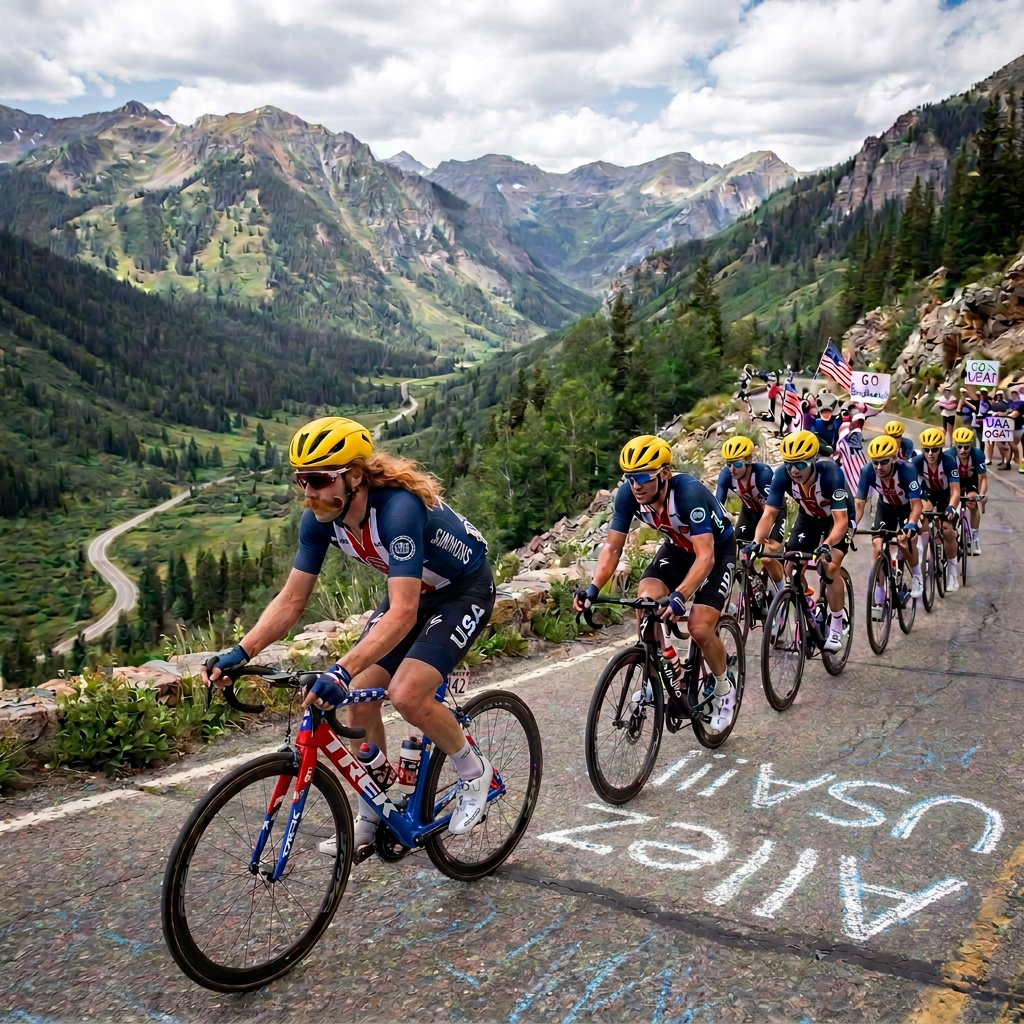
Ironically, the United States currently has one of its strongest collections of professional road cyclists in years. Matteo Jorgenson has developed into one of the world’s premier stage racers. Sepp Kuss has won a Grand Tour and remains one of the elite climbers in professional cycling. Brandon McNulty has demonstrated world-class ability in time trials and in the mountains. Quinn Simmons is among the strongest, most aggressive, and most entertaining riders in the peloton. Sean Quinn and Matthew Riccitello are also competing and developing at the highest level.
Yet these six riders are scattered among separate teams whose priorities are generally centered on foreign leaders.
That is how professional cycling works. Riders are employees, and teams hire them to execute a collective strategy. There is nothing inherently improper about an American rider working for a Danish, Slovenian, Belgian, or other foreign team leader.
But from an American perspective, it is difficult to watch this much talent repeatedly being used to support somebody else’s ambitions.
During this year’s Tour de France, Quinn Simmons has repeatedly demonstrated exceptional strength. He has attacked, covered moves, driven the pace, worked on the front, and remained in contention deep into difficult stages. Yet much of that strength has been used to create opportunities for another rider rather than to pursue his own stage victories or classification ambitions.
Simmons is not alone.
American riders throughout the peloton frequently spend their strongest days protecting, pacing, chasing, carrying bottles, closing gaps, and sacrificing for leaders from other countries.
That is good teamwork.
It is also a reminder of what American cycling currently lacks.
The United States does not need six elite American riders serving six different foreign-centered sporting projects. It needs one first-class American team capable of bringing the best available American riders together under a common competitive vision.
That does not mean the roster should consist exclusively of Americans. Every successful WorldTour team depends on riders, coaches, mechanics, directors, doctors, and technical specialists from multiple countries. The objective should not be rigid nationalism at the expense of performance.
The objective should be an American-controlled organization whose central sporting mission is to give qualified American riders genuine leadership opportunities while surrounding them with the strongest possible supporting cast.
Imagine a team built around Matteo Jorgenson, Quinn Simmons, Brandon McNulty, Sepp Kuss, Sean Quinn, and Matthew Riccitello.
Jorgenson could lead in stage races and selected Grand Tours. McNulty could target time trials, mountain stages, and shorter stage races. Kuss could lead on favorable Grand Tour courses or serve as the decisive final mountain lieutenant. Simmons could target classics, breakaway stages, selective finishes, and potentially the Tour’s points classification. Riccitello and Quinn could continue developing within a system designed to create American leaders rather than merely export American labor.
Add elite international domestiques, world-class coaches, experienced sporting directors, advanced sports science, and the financial infrastructure required to compete against the wealthiest teams in cycling.
The result would be a legitimate American WorldTour project.
The goal should not merely be to win an occasional stage.
The goal should be to restore American relevance in the world’s greatest bicycle race.
Professional cycling remains one of the few truly global sports in which nationality is visible every day. Riders wear national championship jerseys. They represent their countries at the World Championships and the Olympic Games. Fans naturally identify with riders from their own countries.
Danish fans celebrate Danish champions. Slovenian fans celebrate Slovenian champions. Belgian, French, Italian, Spanish, British, and Australian fans do the same.
American fans should have an American team to support.
At present, Americans who follow the Tour must search across the peloton for individual riders wearing the jerseys of teams whose names, sponsors, and priorities are often unfamiliar to the broader American public. An American-centered team would give fans a coherent identity and a reason to follow the entire professional calendar rather than only isolated riders during three weeks in July.
It would also create a stronger development pathway.
Young American riders would see a clear route from junior racing, collegiate cycling, mountain biking, cyclocross, and domestic development programs into an organization committed to producing American leaders. Sponsors would gain a unified American platform rather than a series of disconnected athlete endorsements. Broadcasters and digital-media companies would have an understandable story to present to American audiences.
The United States has done this before.
The 7-Eleven and Motorola teams demonstrated that an American cycling project could enter European racing, survive, develop, and eventually win at the highest level. LeMond proved that an American could win the Tour. Hampsten proved that an American could win the Giro. Armstrong’s era—despite its ultimate disgrace—proved that an American-led team could dominate international attention and make the Tour a major event for American viewers.
The lesson should not be that America’s time in professional cycling is over.
The lesson should be that talent requires organization.
Building a serious American WorldTour team would require tens of millions of dollars annually, experienced management, a multiyear commitment, and patience. It would not guarantee a Tour victory. No amount of money can guarantee victory in the most difficult race in the world.
But there is no serious reason the United States should accept a permanent role as a supplier of domestiques for foreign leaders.
America already has the riders.
It has the sponsors, investors, bicycle companies, technology companies, sports-science expertise, and media capacity.
What it lacks is the decision to bring those resources together.
It is time to build the team.
 Donner Law Firm