
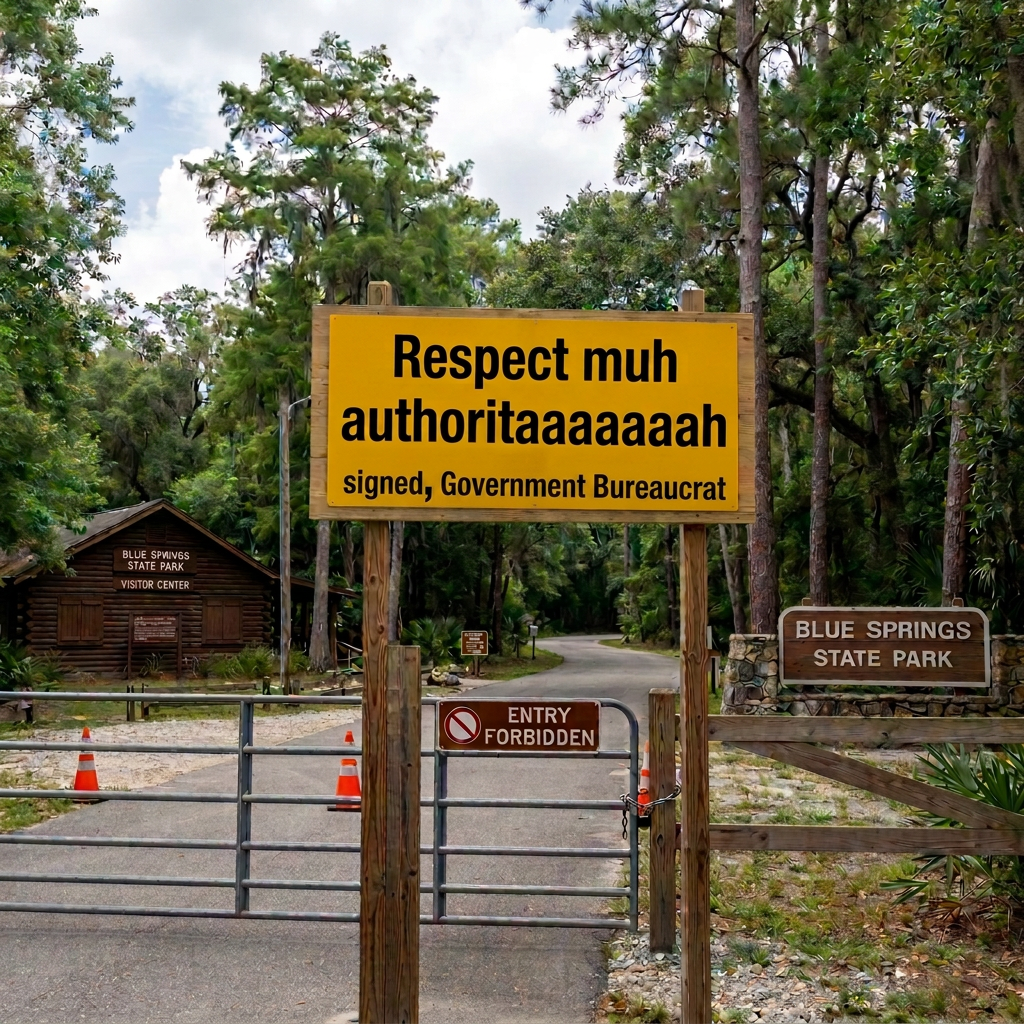
Florida should abolish mandatory day-use appointments, restore first-come access, and remember that government manages public land for citizens—not against them.
By Jeffrey T. Donner, Esq.
August 5, 2026
A Public Park Is Not a Government Appointment
Florida is turning an ordinary visit to public land into another government appointment. Wekiwa Springs State Park requires day-use reservations for every visitor, including annual-pass holders. Blue Spring State Park began requiring day-use reservations on July 15, 2026. Rainbow Springs and Henderson Beach also use mandatory day-use reservations. The state describes this as a way to streamline entry and improve the visitor experience. For many Floridians, it does the opposite. It replaces the simple act of arriving at a public park with an online account, a password, an advance decision, a payment transaction, a reservation record, a cancellation procedure, and the risk that the government will keep the money when the citizen never enters.
That is not a trivial change in procedure. It reflects a change in who is presumed to control the relationship. Under the traditional understanding, the public owns the park and government employees manage it on the public’s behalf. Under the reservation model, the agency acts like the proprietor of a scarce attraction and the citizen acts like a customer seeking timed admission. The citizen must ask first. The citizen must identify himself. The citizen must prepay. The citizen must comply with the agency’s digital process. The citizen bears the consequences when family life, work, illness, weather, traffic, or simple human error interrupts the plan.
A family should be able to wake up on a Saturday morning, look at the sky, load bicycles, kayaks, towels, or swimming gear, and decide to visit a spring. That is part of the point of having public parks close to where people live. A park is not a cruise, a resort, a concert, or a major theme-park vacation. It is grass, water, trees, trails, wildlife, sunshine, and room to breathe. The traditional rule is straightforward: first come, first served. If a parking lot is actually full, pause vehicle entry. When cars leave and spaces reopen, admit the next visitors. That is not disorder. It is an ordinary queue, continuously adjusted to real conditions rather than frozen by predictions made days in advance.
The state should not transform a public commons into an appointment-only product merely because software makes the transformation administratively convenient. Government exists to facilitate the public’s use of public property. The public does not exist to feed data, fees, and compliance into a government reservation platform.
The Starting Principle: The Land Is Public and the Officials Are Agents
The language matters. State parks are not the personal property of the governor, the Department of Environmental Protection, the Division of Recreation and Parks, a park manager, a software contractor, or the ranger at the gate. Those people and institutions possess legal authority to manage public property, but authority is not ownership in the ordinary moral or political sense. They are agents. The people are the principals. The land was acquired, preserved, maintained, and defended through public law and public money for public purposes.
That does not mean every person may do anything anywhere. Public ownership is compatible with rules against setting fires during a drought, damaging archaeological sites, harassing wildlife, dumping garbage, driving vehicles onto fragile land, or occupying a campsite indefinitely. It is also compatible with temporary restrictions tied to a concrete hazard. But those examples do not support the opposite proposition that an agency may treat access itself as a favor dispensed through an appointment system whenever administrators prefer predictable numbers.
The burden should run in the other direction. When the government restricts ordinary, peaceful use of public land, the government should explain why the restriction is necessary, how it is tailored to the actual problem, what evidence supports it, what less restrictive alternatives were considered, what measurable results have followed, and when the restriction will expire. The public should not have to prove why it deserves to enter its own park. The agency should have to prove why the public must be excluded.
This is especially true because bureaucratic systems are rarely self-limiting. A pilot program becomes a permanent program. A rule adopted for peak weekends becomes a year-round requirement. A reservation originally intended to reduce a line becomes the only lawful mode of entry. The software vendor becomes embedded. Employees reorganize their work around the new process. Reports are generated showing that the system is being used, which is then treated as proof that the system is needed. The existence of the machinery becomes the justification for continuing the machinery.
The correct presumption is simpler: public land begins open. Restrictions are exceptions. Exceptions require reasons. Those reasons must be public, specific, measurable, and temporary unless the government can demonstrate an enduring necessity. Administrative preference is not necessity.
Florida’s Constitution Says “In Trust for All the People”
Florida’s own Constitution supplies language that should discipline the debate. Article X, section 11 provides that title to lands under navigable waters within the state, including beaches below the mean high-water line, is held by the state “in trust for all the people.” That provision is not a slogan invented for this article. It is constitutional text. It captures a basic distinction that administrators too often forget: the state holds certain natural resources not as an ordinary private owner maximizing convenience or revenue, but as a trustee for the public.
The constitutional provision does not itself create an unlimited right to enter every acre of every park at every moment. Nor does it eliminate the state’s legitimate authority to conserve natural resources. But it does establish the proper orientation. The state’s title is burdened by a public purpose. The state is not the beneficiary. The public is. Management decisions therefore should be judged by whether they serve the public trust, not merely by whether they make the agency’s operations easier to schedule.
Florida cases repeat this principle. In Hayes v. Bowman, 91 So. 2d 795, 799–800 (Fla. 1957), the Florida Supreme Court explained that the state holds title to lands under tidal navigable waters and the foreshore in trust for the people for navigation, fishing, bathing, and similar uses. The Court stated that such title is not held primarily for sale or conversion into money, but is trust property devoted to serving the people. In Odom v. Deltona Corp., 341 So. 2d 977, 988 (Fla. 1976), the Court likewise described Florida’s trust over navigable waters, shores, and beds as governmental and recognized navigation, commerce, fishing, bathing, and other lawful public uses.
Those decisions concern sovereignty lands and public-trust doctrine, not the precise question whether a day-use reservation is lawful. That distinction should be stated honestly. But the principles are relevant. They reject the mindset that government owns natural resources in the same way a corporation owns an attraction. They describe a fiduciary relationship. A trustee does not begin by asking what procedure is easiest for the trustee. A trustee begins with the interests of the beneficiaries.
When a spring, river, swimming area, or beach is part of a state park, the state has both conservation duties and access duties. It must preserve the resource so that the public can continue to enjoy it. Preservation cannot become a rhetorical solvent that dissolves the public’s role altogether. The purpose of protecting a spring is not to create a perfectly managed spring that ordinary people can no longer visit without an online appointment. The purpose is to protect a spring for the people.
The Public-Trust Tradition Is Older Than Florida’s Reservation Website
The public-trust principle is not a recent administrative innovation. It is rooted in the common law and in the transfer of sovereignty from monarchy to the people. In Illinois Central Railroad Co. v. Illinois, 146 U.S. 387 (1892), the United States Supreme Court explained that submerged lands beneath navigable waters are held in trust so that the people may use the waters for navigation, commerce, and fishing, free from private obstruction. The Court rejected the idea that a state could simply abdicate control over an entire harbor and place it beyond public protection.
The case involved a massive legislative grant of Chicago harbor lands to a railroad, not a park reservation system. It should not be misrepresented as a direct holding against reservations. Its importance lies in the political and legal conception of public natural resources. The state is not merely an owner. It is a sovereign trustee. The trust exists because some resources are so central to public life that government must preserve them for common use rather than surrender them to private dominion or treat them as ordinary inventory.
Florida’s courts have adopted the same basic understanding. In Broward v. Mabry, 58 Fla. 398, 50 So. 826, 829–30 (1909), the Florida Supreme Court recognized that navigable waters and their beds are held for the people. In Odom, the Court repeated the established rule that Florida holds navigable waters, shores, and beds in trust for navigation, commerce, fishing, bathing, and other lawful easements. In Walton County v. Stop the Beach Renourishment, Inc., 998 So. 2d 1102, 1110–14 (Fla. 2008), aff’d sub nom. Stop the Beach Renourishment, Inc. v. Florida Department of Environmental Protection, 560 U.S. 702 (2010), the Florida Supreme Court analyzed Florida’s sovereignty ownership, public-trust obligations, littoral rights, and statutory beach-restoration program in determining the legal consequences of establishing an erosion-control line.
The point is not that every administrative inconvenience violates the public-trust doctrine. The point is that the legal tradition begins with public use as the purpose of governmental stewardship. An agency should feel some constitutional and institutional discomfort when it takes a resource held “for all the people” and places a digital permission barrier in front of it. That discomfort is healthy. It is the feeling produced by remembering whom the institution serves.
Government language often reverses the relationship. Officials speak of “our parks” when they mean the agency’s parks, “our capacity” when they mean the number the agency has decided to process, and “our visitors” as though citizens were guests entering an institutional property. The correct possessive is the public’s. The agency manages our parks. The agency administers our capacity. Government employees serve the people who visit. The distinction is not semantic fussiness. It determines whether access is treated as the default or as a privilege.
Florida’s Beaches Illustrate the Public Character of Natural Places
Florida’s beach cases reinforce the cultural and legal importance of public recreation. In City of Daytona Beach v. Tona-Rama, Inc., 294 So. 2d 73, 77–78 (Fla. 1974), the Florida Supreme Court wrote that no part of Florida is more exclusively hers or more properly used by her people than her beaches. The Court recognized that public access to and enjoyment of Florida’s oceans and beaches had long been protected, and it explained that customary public recreational use of a particular dry-sand area could not simply be extinguished by a private owner when the legal requirements of custom were satisfied.
Again, Tona-Rama is not a reservation case, and the customary-use doctrine is fact-specific. But the Court’s language reflects an understanding that beaches are not merely parcels on an ownership map. They are part of the public life of Florida. Swimming, fishing, walking, resting, and gathering by the water are ordinary uses that help define citizenship in a coastal state.
The same can be said of springs and rivers. A clear spring is not valuable merely because it can be measured, fenced, patrolled, and displayed on a government website. Its public value exists in actual human use: children learning to swim, families launching kayaks, cyclists riding shaded roads, older people walking beneath trees, and residents experiencing a part of Florida that has not been replaced by pavement and commercial development.
Access rules should be designed around that lived public use. A reservation system instead organizes the public around the convenience of the institution. It asks people to convert a fluid decision—whether to visit a natural place today—into a precommitted transaction. That is especially artificial in Florida, where thunderstorms, heat, family schedules, traffic, illness, water conditions, and work demands can change rapidly. The government then labels a citizen a “no-show” when reality defeats the prediction.
The language of “no-show” itself is revealing. It comes from the world of appointments, restaurants, hotels, and ticketed events. A person who does not go to the woods on Saturday did not fail to appear for a service professional. He changed his mind about going outside. When the government adopts appointment language, it quietly imports the commercial assumption that a time slot belongs to the institution and must be allocated to a customer. A public park should not begin from that assumption. A park exists continuously. The trees do not perform at 10:30 a.m. The river does not begin a scheduled consultation. The citizen should not be treated as delinquent for failing to attend.
First Come, First Served Responds to Reality; Reservations Respond to Forecasts
A first-come, first-served system allocates actual capacity in real time. A car arrives and occupies a space. A family leaves and frees a space. The next car enters. The system is imperfect but honest. It measures physical reality rather than intentions stored in a database.
A reservation system substitutes predicted attendance for actual attendance. That substitution creates predictable waste. A reservation can be held by a person who is asleep, sick, working, delayed, discouraged by weather, diverted to another destination, or simply no longer interested. Until the system recognizes the absence and releases the slot, theoretical demand blocks actual use. Empty pavement can coexist with a digital declaration that the park is unavailable.
I have personally visited a Florida park operating under a reservation system and seen a parking lot that appeared roughly half empty while reservations were unavailable. That observation is what it is: direct experience, not a statewide statistical study. But it exposes the design flaw more effectively than bureaucratic terminology does. An unoccupied parking space and an unused reservation are not the same thing. One is capacity. The other is a prediction that failed.
If officials believe mandatory reservations improve total access, they should produce the numbers. Not selected anecdotes. Not a press release saying the rollout was smooth. Not a satisfaction survey answered by people who successfully navigated the system. Publish, for every park and every day, the number of reservations issued, check-ins recorded, cancellations processed, no-shows, refunds, vehicles admitted without reservations, vehicles turned away, parking spaces unused at fifteen-minute intervals, average waiting times, staffing costs, vendor costs, transaction fees, and money retained from citizens who never entered.
Those data would answer the central operational question: does the system put more people in the park, or does it merely make the flow of people more predictable for administrators? Predictability may have some value, but it is not synonymous with access. An agency can create a beautifully orderly spreadsheet by excluding spontaneous visitors and leaving real capacity unused.
The state also should compare mandatory reservations against less restrictive alternatives: live capacity cameras or counters; text alerts; a public dashboard showing parking availability; optional reservations for a minority of capacity; a large walk-up allocation; same-day reservations without accounts; automatic release fifteen or thirty minutes after a selected arrival period; and payment at the gate. Government should not adopt the most intrusive process first and demand that citizens prove a simpler system would work. The burden belongs to the institution imposing the barrier.
There Is No Demonstrated Statewide “Overcrowding Crisis”
The reservation policy is commonly defended with a broad appeal to popularity and overcrowding. That rhetoric is too easy. “The parks are popular” does not establish that every visitor must make an advance reservation. “Some parks reach capacity on some days” does not establish that an appointment system is necessary on all operating days. “Lines sometimes form” does not establish that digital exclusion is superior to a physical queue. A problem must be defined with precision before a remedy can be evaluated.
There is no publicly demonstrated statewide crisis proving that Florida’s ordinary first-come park model has collapsed. Certain springs may experience heavy demand on summer weekends. Certain beaches may fill during holidays. A parking lot can reach capacity. None of those facts is surprising, and none proves that every potential visitor must prepay and reserve. The existence of a busy period supports managing the busy period. It does not support converting the entire park into a scheduled attraction.
The bluntest claim should therefore be stated plainly: there is no general overcrowding problem that justifies universal advance permission. There are particular places at particular times where the number of arriving vehicles exceeds the number of parking spaces or the safe capacity of a swimming area. That is a local and temporal condition, not a philosophical warrant for appointment government.
Government frequently enlarges a narrow operational problem by describing it at a level of abstraction that makes expansive control sound inevitable. A parking queue becomes “visitor management.” A busy swimming basin becomes “resource capacity.” A holiday rush becomes “demand pressure.” Once the language is abstract enough, nearly any procedure can be defended as professional management. The public is then told that complex conditions require expert administration, even when the underlying task is counting cars.
Count the cars. Count the people entering the water. Identify the real bottleneck. Manage that bottleneck. Do not require an Orlando family to create an account on Wednesday because the parking lot might be full on Saturday. Do not reserve the empty parking spaces for people who do not come. Do not make a citizen pay for a prediction and then call the forfeited fee a consequence of his failure.
A government that wants extraordinary control should bring extraordinary evidence. Until then, the ordinary system should remain: arrive, pay if a lawful fee applies, enter while actual capacity exists, and wait only when actual capacity is exhausted.
A Parking Lot Is Not a Natural Resource and a Reservation Is Not Conservation
Officials sometimes blend several different concepts: parking capacity, human safety, environmental protection, and customer convenience. They are not interchangeable. A parking lot can be full while a park’s natural resources remain unharmed. A swimming area can require supervision while a trail does not. A sensitive habitat can require seasonal protection while a paved bicycle route remains suitable for use. A reservation for vehicle entry may regulate parking without doing anything to protect water quality, wildlife, or vegetation.
The state should be required to identify the mechanism by which a mandatory day-use reservation produces conservation. Does it reduce the total number of visitors below a scientifically established carrying capacity? Does it prevent vehicles from idling? Does it limit swimmers at one spring? Does it protect a specific species during a specific season? Does it merely spread arrival times? Each rationale calls for a different remedy.
If the problem is parking, manage parking. Use overflow areas where environmentally appropriate. Provide real-time occupancy information. Permit bicycle and pedestrian entry without consuming vehicle spaces. Coordinate shuttles on peak days. Release spaces as vehicles leave. If the problem is a swimming basin, count swimmers rather than excluding hikers, cyclists, picnickers, or paddlers who do not use the basin. If the problem is a fragile area, close or limit that area instead of treating an entire park as one indivisible unit.
Mandatory reservations encourage bureaucratic bundling. The agency sets one total number because one total number is easy to administer. That simplicity is achieved by making the citizen’s life more complicated and by excluding uses that do not create the bottleneck. A cyclist who arrives under his own power is not a car. A person walking a trail is not occupying a swimming area. A kayaker launching downstream may not burden the spring basin. A government that claims to manage scientifically should be capable of drawing those distinctions.
Conservation is a constitutional and moral responsibility. It is also an easy word to abuse because almost everyone supports it in the abstract. The public should not accept “conservation” as a password that ends scrutiny. The state must show the connection between the restriction and the resource. Otherwise, the restriction is not conservation. It is administration decorated with environmental vocabulary.
The Digital Burden Is Real, Even for People Who Know How to Use Technology
The burden of the reservation system is not limited to people who cannot use a smartphone. A technologically capable person still must identify the correct park, locate the reservation page, determine whether a separate account is required, remember which email address was used, recall or reset a password, navigate dates and entry options, enter or confirm payment information, read cancellation terms, preserve a confirmation, and repeat the process if plans change.
Each individual step may be small. Bureaucracy is built from small steps. The defining feature of modern administrative friction is that no single requirement appears outrageous when isolated. The citizen is asked for one account here, one password there, one confirmation number, one identity check, one prepayment, one click accepting terms, and one more procedure to reverse the transaction. Government then dismisses the complaint because each component takes only a few minutes. The relevant measure is not the duration of one click. It is the cumulative conversion of ordinary life into compliance work.
The system also creates hidden dependence on private infrastructure. The citizen needs a functioning device, internet service, an accessible email account, a payment method accepted by the platform, and enough digital literacy to recover from errors. The state may provide a telephone number, but a telephone workaround does not restore spontaneous access. Calling during specified hours, waiting on hold, dictating information, and receiving a confirmation is still an appointment process.
Older Floridians bear a disproportionate burden, but they are not the only ones. Lower-income families may have limited data service or no credit card. A worker with an unpredictable schedule may not know whether Saturday will be free. A parent may need to decide based on a child’s health or behavior that morning. A person with a disability may need to evaluate pain, fatigue, or mobility on the day of the trip. A family sharing a vehicle may not control transportation until the last moment.
Public institutions should be designed to include those lives rather than forcing everyone into the planning habits of a professional administrator. Digital tools can be useful when they add options. They become coercive when they eliminate the analog option. Let people reserve if they value certainty. Let people check live capacity. But preserve the fundamental ability to arrive and enter when space exists.
Prepayment Turns Public Access into a Forfeiture System
At Blue Spring, the day-use charge is refundable only if the visitor affirmatively cancels, and a no-show is nonrefundable. The amount may be small, but the principle is not. The state takes money in advance for admission, provides no admission when the person does not appear, and keeps the money unless the citizen completes the cancellation procedure.
A family may reserve because dates are disappearing, then discover that a child is sick, a tire is flat, work intervenes, a thunderstorm is approaching, or the family is simply exhausted. The government has supplied no ranger service, no parking, no swimming, no trail use, and no other individualized benefit. Yet the money remains with the state because the citizen failed to perform the administrative act of cancellation.
The small amount makes the system more profitable and less accountable. Many citizens will not spend additional time to recover six dollars. They will not search for the confirmation email, log into the account, recover the password, locate the cancellation function, or telephone during business hours. The government can therefore retain numerous small amounts that no rational person will litigate or formally contest.
This is a hidden tax on changed plans and digital friction. It also worsens the access problem. If the reservation remains active, another family may be unable to obtain it even though the original holder will never arrive. The system produces both revenue and artificial scarcity from the same failure.
At minimum, cancellation should be automatic and effortless. A text message or email should permit one-click release without an account login. Unused reservations should expire quickly after a clearly disclosed arrival window. The state should automatically refund unused entry fees when no admission occurred, less only a transaction cost that is real, disclosed, and legally justified. Better yet, ordinary day-use admission should be paid at the gate.
The government will likely say that a nonrefundable fee encourages people to keep their plans. That is precisely the objection. The state should not discipline citizens into attending the woods. A reservation for a public park is not a court appearance. People should be free to change their minds without paying a penalty to the government for failing to recreate on schedule.
Government Convenience Is Not the Same as Public Convenience
Reservation systems are often sold as conveniences. For the institution, they plainly are. Administrators receive advance numbers. Staffing can be scheduled. Arrival patterns may become more predictable. Cash handling may be reduced. The website can transmit rules before the visitor arrives. Complaints about gate lines may decline because people unable to reserve never reach the gate.
Those are institutional benefits. They should not be mislabeled as public benefits without evidence. A policy can make the agency’s workload smoother by transferring time, uncertainty, and risk to the citizen. The public spends time planning and navigating the portal. The public prepays. The public absorbs the forfeiture. The public loses spontaneity. The public is turned away digitally rather than physically. From the agency’s perspective, the line disappeared. From the citizen’s perspective, access disappeared.
Government programs should be evaluated through total social cost, not merely agency cost. If an online requirement saves a ranger two minutes but forces ten thousand families to spend five minutes each creating accounts and managing reservations, the program has not eliminated work. It has externalized work. It has moved the labor from paid employees to unpaid citizens.
The same is true of uncertainty. A first-come system leaves the agency uncertain how many people will arrive. A reservation system forces the citizen to resolve uncertainty in advance. But family life cannot always be resolved in advance. The policy therefore rewards people with stable schedules and penalizes everyone else.
There is a legitimate role for administration. Parks need maintenance, law enforcement, sanitation, emergency response, habitat protection, and capital planning. But an agency should not assume that every reduction in administrative uncertainty justifies a reduction in public liberty. Free people are unpredictable. They decide to go outside because the weather is unexpectedly beautiful. They leave early because a child is tired. They change destinations. A public institution should accommodate that ordinary freedom unless a concrete necessity prevents it.
The purpose of management is not to make the public behave like entries in a scheduling database. The purpose is to keep the resource open, safe, and preserved while respecting the fact that citizens have lives the agency does not control.
Even Disney Recognized the Limits of Universal Reservations
The comparison to Walt Disney World is not frivolous. Disney is a private company operating intensely managed, capacity-sensitive destinations. Its guests expect to plan, purchase tickets, pass through security, and spend substantial sums. Yet Disney moved away from universal theme-park reservations for ordinary date-based tickets, while retaining reservation requirements for some admission categories.
A Florida resident should not face a more rigid appointment requirement to enter a public spring than many customers face to enter a private theme park. Disney has rides with finite hourly throughput, restaurants, parades, crowd-control zones, fire-code limits, and a commercial interest in managing demand. A spring has water. A trail has dirt. A picnic area has tables. The state should be able to manage those public resources without imposing a more inflexible transaction model than one of the world’s largest tourist resorts.
The comparison also exposes a difference in accountability. A private company that creates too much friction loses customers and revenue. A government agency does not face the same discipline. When the state makes access difficult, the excluded citizen cannot take his public park to a competitor. He can visit another park, but that park may adopt the same platform. Indeed, administrative systems spread precisely because agencies copy one another and because a central vendor can scale the process.
Government therefore requires stronger political discipline than a private attraction, not weaker discipline. The absence of competition means the default should favor open access, simple payment, and minimal data collection. Every required field and every mandatory step should have a demonstrated public purpose.
A reservation can remain an optional service. Some people value certainty and will gladly book. Optional reservations can coexist with walk-up capacity. But once reservation becomes the only path, convenience turns into permission. The state is no longer helping the citizen plan. It is conditioning entry on compliance with the state’s preferred planning method.
Public Access Must Include Cyclists, Walkers, and People Who Do Not Consume Parking
One of the most irrational features of vehicle-centered capacity rules is the failure to distinguish access to the park from consumption of a parking space. A person who arrives by bicycle does not occupy a vehicle space. A nearby resident who walks through an entrance does not add a car to the queue. A paddler entering from a lawful water route may not use the gate at all. Yet a universal reservation system can treat all of them as identical units of “attendance.”
That is administrative laziness. The government may regulate actual impacts, but it should not create fictional equivalence. If the stated problem is a full parking lot, the solution is not to exclude a cyclist. If the stated problem is vehicle congestion at the gate, the solution is not to require a pedestrian to reserve. If the stated problem is crowding in a spring basin, the state can issue wristbands or count swimmers while permitting trail use.
The distinction also matters for public policy. Florida says it wants people to walk and bicycle, reduce vehicle emissions, improve health, and use trails. Then a park system designed around automobile reservations tells the cyclist that he must obtain the same appointment as a person bringing a sport-utility vehicle. That is incoherent.
At Blue Spring, bicyclists may have a zero-dollar fee category, but a zero-dollar reservation is still a reservation. The objection is not confined to money. It is the requirement of advance permission. A cyclist can ride twenty or thirty miles, arrive under his own power, consume no parking space, and still confront a digital rule saying he lacked the necessary reservation. That rule does not manage scarcity. It manufactures a barrier.
The policy should expressly guarantee walk-up admission for cyclists and pedestrians unless the state can identify a genuine, measured, non-parking capacity problem. Even then, restrictions should be tied to the affected area and released as actual users leave. A public trail should not be closed to a rider because an online system allocated theoretical spaces to absent motorists.
Spontaneity Is Not a Defect in Need of Government Correction
Modern government often treats spontaneity as poor planning. That attitude is incompatible with the nature of recreation. People go to parks precisely to escape schedules, screens, offices, and managed environments. They decide based on weather, mood, energy, children, companions, and opportunity.
A family does not owe the state a forecast of its leisure. The government has no legitimate interest in training citizens to reserve every ordinary activity in advance. Yet appointment systems slowly establish that expectation. The public learns that access requires monitoring release dates, creating accounts, selecting slots, and accepting terms. People who do not organize their lives that way become second-class users of public resources.
Spontaneity is particularly valuable to people whose work is not predictable. A lawyer whose hearing ends early, a nurse released from a shift, a construction worker whose job is canceled by weather, a parent whose child suddenly feels better, or a retiree who sees a cool morning should be able to use a public park without having won a reservation days earlier.
The system favors a narrow administrative personality: plan early, keep the confirmation, arrive as predicted, and cancel promptly if reality changes. There is nothing wrong with that personality. There is something wrong with designing public access exclusively for it.
Freedom is often experienced in small decisions rather than constitutional confrontations. The ability to decide, “Let’s go to the spring,” and then go is one of those decisions. It does not need to be romanticized into an absolute legal right to defeat every regulation. It should be recognized as a social good that government should preserve unless a real and substantial reason requires restriction.
A state that values family life, outdoor activity, and individual responsibility should not make citizens ask permission days in advance to sit beside a river. The appointment system is not merely inconvenient. It changes the culture of public space from presumed access to managed authorization.
The Reservation System Discriminates by Lifestyle and Resources
Mandatory reservations are formally equal because the same website is presented to everyone. Their practical effects are unequal. They favor people who have stable calendars, reliable internet, electronic payment methods, flexible transportation, familiarity with online platforms, and enough disposable income to tolerate an occasional forfeited fee.
They disadvantage people who work on call, hold multiple jobs, care for relatives, share vehicles, lack reliable broadband, struggle with English, have disabilities that fluctuate, or cannot commit money to a plan that may fail. They also disadvantage older citizens who did not spend their working lives managing passwords and smartphone applications.
The state may respond that these groups can call. That answer misunderstands the problem. A telephone channel still requires advance action, business-hour availability, communication of payment information, and confidence that the reservation was properly recorded. It also tends to be slower and less visible than the online system. An accommodation that preserves the same appointment structure does not restore open access.
The policy also creates a form of scarcity gaming. People who monitor release times can reserve desirable dates. Those who learn of a family opportunity later discover that capacity has been allocated. Some users will reserve defensively because they fear losing the option, which increases no-shows and intensifies artificial scarcity. The system rewards early claims rather than actual use.
Public resources should not be allocated by digital vigilance when a real-time queue can allocate them by presence. The person standing at the gate ready to enter has a stronger claim to an empty parking space than a person whose name appears in a database but who is thirty miles away and has decided not to come.
Government should not confuse equal rules with equal access. A process can be neutral in form and exclusionary in operation. The cure is not a more polished website. The cure is preserving a substantial walk-up pathway and minimizing the information, planning, and payment demanded before entry.
The Government-Creep Problem Is Not Paranoia; It Is Institutional Behavior
The broader objection is government creep. The phrase is sometimes dismissed as anti-government rhetoric, but it describes a familiar institutional pattern. A temporary pilot begins at one location. Officials announce that the measure is limited. The program generates internal procedures, vendor relationships, training materials, signs, metrics, and budget lines. Other managers are told it worked. The requirement spreads. Eventually the exception becomes normal and the old freedom is remembered as operational chaos.
No conspiracy is required. Bureaucracies expand through incentives. Managers prefer systems that make demand predictable. Vendors prefer recurring contracts. Employees prefer procedures that reduce discretion at the gate. Officials prefer to avoid newspaper photographs of vehicle lines. Each actor can be sincere, and the cumulative result can still be an unnecessary restriction.
The public therefore must object early. Waiting until every popular park requires a reservation will make reversal harder. By then the state will argue that millions of transactions prove public acceptance, that employees rely on the system, that contracts cannot be unwound, and that returning to walk-up access would be disruptive.
Administrative requirements also acquire moral authority simply through repetition. After several years, people begin to say that responsible visitors reserve. A person who arrives without an appointment is described as unprepared, even though arriving without an appointment was the normal way to visit for generations. Government changes the rule and then blames citizens for failing to internalize the new burden.
The objection should be unapologetic. Government is not entitled to every procedure that makes governance easier. The fact that officials can digitize, schedule, monitor, and precharge an activity does not mean they should. A free society leaves ordinary life unadministered unless administration is necessary.
Parks are an ideal place to draw that line. They are among the last public settings where a person should be able to arrive without an account, a transaction history, an appointment, or a planned consumer experience. The trees do not need to know the visitor’s email address.
Government Shutdowns Expose the Absurdity of Treating Nature as an Agency Service
Government shutdowns reveal the conceptual error in its starkest form. A shutdown is a lapse in appropriations, not the physical disappearance of the land or the repeal of every law. Agencies may retain legal authority, and some functions continue. But that legal technicality does not justify the reflexive closure of every outdoor place.
A staffed visitor center cannot operate without staff. A complex facility may require security, sanitation, emergency services, or active resource protection. A campground with toilets, water systems, trash collection, and reservations may not function normally without employees. Those operational facts justify closing the affected service or facility. They do not establish that every mountain, forest, trail, field, or overlook must become forbidden territory.
A mountain does not stop existing because Congress failed to pass an appropriation. A forest is not an agency service in the same sense as a passport office. A trail does not become metaphysically closed because the employees who ordinarily maintain it are furloughed. There are woods, mountains, rocks, rivers, bugs, and wildlife. The public should not be told that nature itself is unavailable merely because normal government services are unavailable.
The insult becomes especially vivid when officials claim that a government shutdown has left them without the money or manpower to keep public land open, yet somehow money and manpower remain available to manufacture a freshly printed “PARK CLOSED DUE TO GOVERNMENT SHUTDOWN” sign, carry it into the woods, fasten it to a gate or chain, and prevent citizens from walking on land that requires no active government service. The agency is supposedly incapable of allowing the public to use the park, but it remains sufficiently operational to purchase the sign, dispatch an employee, install a barricade, and enforce the closure. That is not government disappearing. It is government preserving enough of itself to dramatize its own absence, maximize public inconvenience, and use ordinary citizens as leverage in a political funding dispute.
The presumption during a shutdown should be continued passive access wherever passive access can occur without active services and without a concrete, unacceptable risk to people or resources. Close buildings that cannot operate. Lock equipment that cannot be supervised. Suspend programs that require employees. Post candid warnings that services are unavailable. Restrict only those places where a specific hazard or resource-protection need makes restriction necessary.
The opposite approach—spending effort to barricade unstaffed outdoor space—creates the impression that government views itself as the source of the public’s permission to encounter nature. It is not. Government may have acquired and protected the land, and it may claim legal control, but the political purpose of that control is public benefit.
A citizen should be free to walk into the mountains and look for Bigfoot if he chooses, subject to ordinary laws protecting property, wildlife, and genuinely sensitive areas. He does not need a functioning gift shop, interpretive ranger, or federal brochure to look at trees. A shutdown should mean diminished government services, not an expanded government effort to prevent people from using land that requires no service at all.
The point is not advice to disregard a posted closure and invite arrest. The point is that lawmakers and agencies should write and apply closure authority narrowly. “No staff” should mean “no services” before it means “no public.”
No Staff Should Mean No Services Before It Means No Access
Officials frequently argue that a park cannot open without staff. That assertion is too broad. A nature center needs staff if it is going to operate. A concession stand needs staff. A controlled cave tour needs guides. A crowded swimming area may need lifeguards if the government has undertaken to provide them. A sewage system needs maintenance. But the absence of staff does not logically require the absence of every citizen from every outdoor acre.
If no government service is being provided, there may be no staffing need for the particular use. Walking on an established trail can be self-directed. Looking from an overlook can be self-directed. Cycling on a road can be self-directed. Fishing or paddling may be self-directed subject to ordinary safety rules. Government should identify the service that supposedly makes access impossible rather than invoking “staffing” as a universal incantation.
The claim that parks require staff at all times also conflicts with ordinary experience. Many public lands are entered outside the presence of any employee. Trailheads use self-pay stations. Wildlife management areas have dispersed access. Beaches remain physically open when no official is watching every visitor. People recreate on rivers without a ranger escort. Adults routinely assume ordinary outdoor risks.
There may be liability concerns, but liability concerns should be addressed through statutes, warnings, immunities, and clear rules—not by converting every unsupported fear into closure. Florida and federal law contain protections for governments and landowners providing recreational access, although the precise application depends on the property and circumstances. Legislatures can strengthen those protections where needed.
A government shutdown should not produce the paradox of scarce employees being assigned to keep citizens out of places that could remain open without employees. Nor should agencies use the absence of normal staffing to perform a symbolic show of control. The public does not need government to stand beside every tree and authorize looking at it.
The administratively honest rule is use-specific: if an activity genuinely requires staffing, suspend the activity. If a facility genuinely requires maintenance, close the facility. If an area can remain available without active services and without unacceptable harm, leave it available.
The Pandemic Showed How Easily Outdoor Life Can Be Overregulated
The pandemic supplied an extreme example of government losing proportion. Officials faced a novel disease and genuine uncertainty. Some emergency actions were understandable, especially early. But uncertainty did not make every restriction sensible, and it did not justify treating outdoor existence as presumptively dangerous.
Across the country, governments closed parks, beaches, playgrounds, trails, and exercise facilities. Mask requirements were sometimes applied outdoors without meaningful attention to distance, ventilation, temperature, exertion, or the difference between a crowded event and a person walking alone. The image of a citizen being ordered to cover his face while alone outdoors in intense Florida heat captured the mismatch between categorical rulemaking and actual risk.
The lesson for park policy is institutional: once officials adopt a control mechanism, the mechanism tends to be applied broadly because broad rules are easier to announce and enforce.
Outdoor recreation should have been among the last activities restricted and among the first restored. Sunlight, open air, exercise, and distance created a fundamentally different environment from dense indoor gatherings. Even without debating every scientific detail or every date-specific recommendation, it is obvious that a solitary walker on a trail presented a different situation from a crowded indoor room. Government too often refused to draw that distinction.
The same error appears in reservation policy. Administrators prefer one rule for every visitor because one rule is simpler. But equal simplicity for government can mean irrational treatment of citizens. A cyclist is treated like a motorist. A trail user is treated like a swimmer. A quiet weekday is treated like a holiday weekend. A person outdoors alone is treated like a crowd.
Public trust depends on government demonstrating judgment. Citizens are more likely to respect necessary restrictions when officials distinguish actual hazards from symbolic control. When government applies sweeping rules without a convincing factual connection, skepticism is not irresponsibility. It is a rational response to overreach.
Freedom Does Not Mean the Absence of Every Rule; It Means Rules Must Serve a Demonstrated Public End
An effective argument against overregulation should not pretend that freedom means no rules governing common property. A person cannot burn habitat, block a boat ramp, assault other visitors, abandon trash, poach wildlife, or occupy public land permanently and call the conduct freedom. The public’s equal right to use a place requires rules preventing one user from destroying or monopolizing it.
The distinction is between rules that protect common use and rules that condition common use on administrative convenience. A prohibition on dumping protects everyone. A temporary closure during a wildfire protects life and resources. A limit on boats at a narrow launch can prevent physical conflict. By contrast, forcing a cyclist to reserve a zero-dollar slot because a parking lot might fill does not obviously protect anyone.
American constitutional law frequently uses doctrines of tailoring, fit, reasonableness, and relation to legitimate ends. The exact standard varies by right and context, and ordinary park-admission policies may receive deferential review. This article does not claim that every bad policy is unconstitutional under existing precedent. Political criticism is broader than constitutional invalidity. Citizens may oppose laws and regulations that are technically lawful but foolish, wasteful, paternalistic, or inconsistent with republican government.
Still, constitutional culture matters. In Hague v. Committee for Industrial Organization, 307 U.S. 496, 515–16 (1939) (plurality opinion), Justice Roberts described streets and parks as places that have immemorially been held in trust for public use for assembly and communication. That public-forum doctrine concerns expressive activity, not a general recreational right. But it reflects the deep American understanding that parks are traditional public places, not merely facilities dispensed by administrators.
Constitutional liberty is broader than a list of activities affirmatively licensed by government, even when courts fail to enforce that principle consistently. Peaceful movement and ordinary outdoor activity belong on the liberty side of the ledger. Government should not burden them casually or merely because centralized control is administratively convenient.
The proper standard for political judgment is disciplined skepticism: identify the actual harm, prove the need, choose the narrowest workable measure, publish the evidence, preserve alternatives, and end the restriction when the reason ends. Mandatory universal reservations fail that test unless the state can produce much more than administrative assurances.
The State Should Not Hide Behind the Word “Experience”
Agencies increasingly justify restrictions by saying they improve the “visitor experience.” The phrase is vague enough to cover almost anything. A shorter gate line may improve one person’s experience. The inability to enter at all destroys another person’s experience. Predictable attendance may make a ranger’s day easier. An empty parking lot behind a digital “sold out” notice makes the public’s experience absurd.
The state should define what it means. Is the objective shorter vehicle queues? Fewer confrontations at the gate? Less crowding in the water? Better parking turnover? Lower environmental impact? Higher satisfaction scores? Each goal can be measured. Without metrics, “experience” is public-relations language.
The experience of excluded people is often omitted from agency evaluation. Surveys reach visitors who successfully entered. Website analytics count completed reservations. Complaints from people who abandoned the process may not be captured. A system can report high satisfaction among admitted users while imposing substantial harm on those screened out.
The state should therefore evaluate access, not merely satisfaction. How many people wanted to visit? How many entered? How many were prevented by the reservation requirement despite unused real capacity? How many abandoned the process? How many forfeited fees? How many attempted walk-up entry? How many cyclists or pedestrians were denied? How did the results differ by age, income, language, disability, and work schedule?
Public agencies should be particularly cautious about adopting the vocabulary of hospitality management. Citizens are not guests of the bureaucracy. The state is not curating a premium experience. It is administering public resources. Comfort and order matter, but access is the first value.
A crowded public park can still be a successful public park. The sight of other citizens using public land is not necessarily a management failure. Government should not pursue the sterile ideal of perfectly controlled attendance at the cost of excluding the very public for whom the park exists.
Publish the Evidence or Stop Claiming the System Works
The state has the data or can obtain it. Reservation platforms record transactions. Gate systems record check-ins. Staff can count vehicles. Parking capacity is known. If the reservation program works, the proof should be easy to publish.
For each affected park, Florida should release a daily dataset showing total reservable capacity, reservations issued, reservations canceled, check-ins, no-shows, refunds, fees retained, walk-up admissions, turnaways, parking occupancy by interval, and closures of individual amenities. The state should also disclose the contract with the reservation vendor, transaction costs, administrative labor, customer-service volume, complaint categories, and system outages.
The data should distinguish peak and nonpeak days. A policy justified by July weekends should not hide behind annual averages. It should distinguish vehicle admissions from cyclists and pedestrians. It should identify whether the limiting factor was parking, swimming capacity, resource protection, or staffing. It should compare results before and after implementation using the same metrics.
The state should also publish the rule or legal authority under which mandatory reservations are imposed. Citizens should not have to infer from a webpage whether a pilot is an agency policy, a park-manager practice, a contractual feature, or a formal rule. The responsible official should be identified. The start date, review date, and sunset date should be public.
Without that information, claims of success are administrative assertions. They may be sincere. They are not demonstrated facts. The public should reject the familiar pattern in which government imposes a burden, controls the data necessary to assess the burden, publishes only favorable summaries, and then cites the absence of contrary official evidence as support for continuing the program.
Transparency is especially important because each individual loss is small. No one will file a lawsuit over a six-dollar no-show fee or one ruined Saturday. Aggregated data are the only way to see the scale of the burden. Government has an obligation to reveal that aggregate picture.
Less Restrictive Alternatives Are Obvious
The debate is not a choice between universal reservations and unmanaged chaos. Numerous alternatives exist.
First, preserve first-come, first-served entry as the default and use live capacity information. A public webpage can show whether a parking lot is open, nearing capacity, full, or reopening. Roadside electronic signs can provide updates before drivers reach the entrance. Cameras can show the queue. Text alerts can notify subscribers when capacity returns.
Second, allocate only a minority of capacity to optional reservations. People who need certainty can reserve, while spontaneous visitors retain a meaningful walk-up share. The allocation can vary by season and day based on published data.
Third, release unused reservations rapidly. If a reservation includes an arrival window, failure to check in within a reasonable period should return the space to the public. The system should send an automatic reminder and one-click release link.
Fourth, separate uses. Manage vehicle parking separately from bicycle and pedestrian entry. Manage swimmers separately from trail users. Close or limit only the specific amenity that reaches capacity.
Fifth, permit payment at the gate. Cashless options can be available without being mandatory. Annual-pass holders should not be forced to complete a paid reservation transaction for access already purchased.
Sixth, improve turnover. When vehicles leave, admit waiting vehicles immediately. Do not hold empty spaces for absent reservation holders beyond a brief window.
Seventh, expand physical capacity where environmentally responsible. Not every popular park can or should be enlarged, but some parking and access constraints are the product of government decisions rather than natural limits. The state should not declare scarcity permanent without examining infrastructure.
Eighth, exempt low-impact entry. Cyclists, walkers, and transit or shuttle users should not be counted against vehicle capacity.
Ninth, impose sunset clauses. Any mandatory pilot should terminate automatically unless the agency publishes evidence that it improves actual access and resource protection compared with alternatives.
These options demonstrate why universal reservations are not inevitable. The state selected a heavy-handed method from a menu of narrower tools. It should justify that selection or abandon it.
Annual-Pass Holders Should Not Need to Reserve What They Already Paid to Use
The treatment of annual-pass holders is particularly revealing. An annual pass represents advance payment for access subject to ordinary park rules and actual capacity. Requiring the holder to complete a separate reservation for each visit converts the pass from access into eligibility to request access.
The state may say that a reservation is necessary to count visitors. But counting can occur at the gate. The state may say that every person must be included in capacity planning. But capacity is actual, not theoretical. If the holder arrives and space exists, the prior purchase should be honored.
An annual pass is valuable precisely because it encourages frequent and spontaneous use. A resident can stop for a walk, bicycle ride, swim, or picnic without evaluating whether one visit justifies a separate admission charge. Mandatory reservations defeat that benefit. The pass holder still must plan, log in, select a date, and obtain permission.
The policy also changes the economic bargain after purchase if passes were marketed under a more open-access model. The legal consequences would depend on the exact terms, disclosures, and timing, and this article does not assert a specific contract claim. Politically, however, the unfairness is plain. The state sells convenience and then imposes a new procedure that removes much of the convenience.
At minimum, annual-pass holders should have guaranteed walk-up access whenever actual capacity exists. Their entry can be scanned and counted. If a specific amenity is full, that amenity can be limited. The entire park should not become unavailable merely because reservation inventory was allocated to others who may never appear.
A public pass should mean what an ordinary citizen thinks it means: the holder can go to the park. It should not mean the holder has paid for the opportunity to compete for appointments on a government website.
A Government Fee Must Not Become a Revenue Incentive for Exclusion
Even modest fees can distort institutional incentives. When no-show payments are retained, unused reservations generate revenue without corresponding service costs. The state may not have designed the system to exploit no-shows, but a sound policy should avoid creating any incentive to tolerate or conceal them.
Every retained no-show payment should be publicly accounted for. The state should disclose the total and explain where the money goes. It should not bury the amount inside general park revenue. If the fee is intended solely to secure a reservation, the state should explain why no refund is provided automatically when the reservation produces no admission.
The state should also disclose vendor compensation. Is the platform paid per transaction? Does a contractor receive a percentage? Are convenience fees charged? Does cancellation generate another transaction? Those details matter because software architecture can create pressure to preserve mandatory use.
Public parks may charge lawful admission fees. The objection is not that all fees are illegitimate. The objection is charging in advance, retaining money when no service occurs, and using the reservation itself to block actual users. A gate fee aligns payment with access. A prepaid no-show fee separates them.
The state should adopt a simple rule: no admission, no retained admission fee. A narrowly tailored reservation charge might be defensible if it reflects an actual nonrecoverable cost and is clearly disclosed, but it should not become a penalty or revenue source. For low-dollar day use, the simplest and fairest approach is payment upon entry.
Government should be especially careful because citizens cannot negotiate the terms. There is no competing state park system offering a fairer contract for the same public spring. The relationship is one of public authority, not equal bargaining power. That reality demands restraint.
Public Parks Are Part of Civic Equality
Public parks are among the few places where wealth does not have to determine the quality of one’s day. A person can walk beneath the same trees, swim in the same water, and watch the same wildlife regardless of income. That civic equality is undermined when access depends on planning resources, digital fluency, and willingness to prepay.
The reservation model resembles the broader conversion of public life into managed consumer experiences. Everywhere, people are asked to create accounts, accept terms, receive marketing communications, reserve time slots, and interact through platforms. Public parks should resist that trend. They should remain places where citizenship, not customer status, is the relevant relationship.
This does not require free admission everywhere or unlimited use. It requires procedures compatible with the public character of the institution. A modest gate fee is visible and direct. A first-come queue treats people according to arrival. A reservation-only platform privileges people who understand and anticipate the system.
The democratic value of parks also extends beyond recreation. Parks host speech, assembly, family gatherings, exercise, solitude, and unplanned contact among people who otherwise inhabit separate social worlds. The Supreme Court’s public-forum cases recognize the historic role of streets and parks in civic life. While those cases do not create a universal recreational-access rule, they remind us that parks are foundational public places.
When government erects procedural barriers around such places, the injury is not measured only in minutes or dollars. The culture changes. Citizens learn that public means available after registration. Children learn that going outside requires a confirmation code. Older residents learn that a lifetime of taxpaying does not permit entry without a smartphone process.
Florida should choose the opposite model: open by default, simple to enter, transparent when full, and governed by rules tied to actual harms.
The Proper Relationship Between Conservation and Access
Conservation advocates may fear that criticism of reservations is criticism of environmental protection. It is not. A degraded spring, eroded trail, polluted river, or disturbed habitat serves no one. The state must protect natural resources for future generations.
But conservation and access are not enemies unless officials define them carelessly. The public-trust idea itself joins the two. The resource is protected so it remains available for public purposes. The state must prevent destruction without converting preservation into exclusion for administrative convenience.
Scientific carrying capacity can justify limits when it is real and documented. If a spring can safely sustain only a certain number of swimmers, the state should identify the study, explain the threshold, count swimmers, and enforce the limit. It should not silently translate a swimming limit into a total park reservation limit that excludes people using unrelated areas.
Seasonal habitat restrictions can be legitimate. A nesting area may need closure. A manatee refuge may require vessel limits. A wildfire may require broad exclusion. Those rules are credible when they identify a resource, a risk, a duration, and a causal connection.
Mandatory reservations often lack that precision. They are capacity-management tools presented as conservation. The public should insist on disaggregation. What exactly is being protected? From what activity? At what threshold? During what period? Why is advance reservation necessary rather than real-time control?
Conservation also benefits from public connection. People protect places they know and use. A park system that makes access difficult risks turning natural resources into remote abstractions administered by specialists. Broad, responsible public use builds political support for acquisition, restoration, and funding.
The state’s duty is not to preserve nature from the people. It is to preserve nature from destructive use while preserving it for the people.
Administrative Professionals Are Not the Owners of Public Life
Government employees often perform difficult and valuable work. Rangers respond to emergencies, maintain facilities, protect wildlife, educate visitors, and deal with people who behave irresponsibly. Criticizing a reservation policy is not a personal attack on every employee.
But professional expertise does not create political ownership. Bureaucrats are not a separate class entitled to arrange public life according to their institutional preferences. They hold delegated authority. That authority must remain answerable to elected officials, law, evidence, and public criticism.
The modern administrative state encourages deference through specialized vocabulary. Officials speak of stakeholder engagement, capacity optimization, resource management, operational needs, and visitor-flow solutions. Those terms may describe real work, but they can also obscure simple choices. Did the state leave an empty parking space unavailable to a family because someone else clicked a button days earlier? Did it keep the first family’s money when they never came? Did it require a cyclist to reserve because cars might fill the lot? Plain language restores accountability.
Citizens should not apologize for challenging experts about value judgments. Data may show how many vehicles arrive. Biology may show how many swimmers a spring can tolerate. Engineering may show what a parking lot can hold. Those facts do not decide how much spontaneity should be sacrificed, how unused capacity should be allocated, or whether prepayment is fair. Those are political judgments belonging to the public and its elected representatives.
The government should welcome scrutiny rather than treating critics as uninformed obstacles to professional management. A public servant confident in the policy should be able to publish the data, explain the alternatives, and defend the tradeoffs. If the defense consists mainly of asserting that officials know best, the policy is not sufficiently justified.
The Legislature Should Set Rules Instead of Allowing Permanent Government by Pilot Program
Major access policies should not spread indefinitely through webpages and pilot programs. The Legislature should establish clear statewide standards governing when mandatory day-use reservations may be imposed.
Any statute should begin with a presumption of first-come, first-served access. Mandatory reservations should be authorized only for a defined period and only upon written findings identifying the actual capacity problem, the evidence supporting the limit, the alternatives considered, and the reason less restrictive methods are inadequate.
The law should require a substantial walk-up allocation except where a documented emergency or resource condition makes it impossible. It should prohibit counting cyclists and pedestrians against vehicle parking capacity. It should require rapid release of unused reservations, automatic refunds, accessible cancellation, and publication of operating data.
The statute should also require rulemaking for permanent systems. Formal rulemaking provides notice, public comment, and a record. A policy that affects whether citizens may enter public land should not exist solely as a website instruction that can be changed without meaningful public participation.
Sunset provisions are essential. A pilot should expire after a short period unless renewed through findings based on public data. The agency should not be allowed to cite the disruption of dismantling a system as proof that the system must continue.
Finally, the Legislature should provide an avenue for review. Citizens should be able to challenge a reservation policy administratively without filing expensive litigation. The responsible agency should answer complaints with evidence and written reasoning.
Legislative involvement matters because administrative incentives favor continuity. Elected officials must restore the political presumption that public land is open and that restrictions are exceptional.
The Governor and DEP Should Reverse Course Now
Florida does not need years of study to correct the core mistake. The Governor and the Department of Environmental Protection can restore first-come, first-served day use at affected parks, preserve optional reservations for people who want them, and collect data under the less restrictive system.
At Wekiwa Springs, Blue Spring, Rainbow Springs, Henderson Beach, and any other park using mandatory day-use reservations, the state should immediately establish a meaningful walk-up allocation. It should permit gate payment. It should exempt cyclists and pedestrians from vehicle-capacity reservations. It should automatically release unused slots. It should refund no-show admission fees when no entry occurred.
The state should publish a ninety-day report comparing reservations, actual check-ins, parking occupancy, turnaways, and complaints. If a particular park presents a unique resource problem, the state should identify that problem and tailor a specific rule.
The administration should also reject the instinct to defend the program merely because government already announced it. Reversal is not weakness. It is responsiveness. A pilot exists to reveal problems. Artificial scarcity, no-show waste, digital exclusion, and loss of spontaneity are problems.
Florida often presents itself as a state skeptical of unnecessary government control. That principle should apply when the controlling institution is Florida’s own park bureaucracy. It is easy to criticize distant federal agencies. It is more meaningful to restrain state power where residents encounter it at the gate.
A state that opposed irrational outdoor restrictions during the pandemic should not normalize appointment-only outdoor recreation afterward. Florida can protect springs and beaches without treating citizens like applicants.
A Direct Answer to the Predictable Objections
The first objection is that parks sometimes fill. The answer is yes: when actual capacity is reached, pause entry. A full park justifies a wait, not universal advance permission.
The second objection is that lines are unpleasant. The answer is provide live information, improve traffic management, and admit vehicles as spaces open. Digital exclusion does not eliminate the burden; it hides it from the gate.
The third objection is that reservations help families avoid wasted trips. The answer is make reservations optional and publish live capacity. People can choose certainty without denying walk-up access to everyone else.
The fourth objection is conservation. The answer is identify the resource, activity, threshold, and evidence. Limit the harmful use, not every unrelated use.
The fifth objection is staffing. The answer is identify the task requiring staff. Close the staffed service if necessary. Do not close self-directed outdoor space by default.
The sixth objection is safety. The answer is regulate actual hazards, provide warnings, and preserve emergency closures. Safety is not a blank check for permanent administrative control.
The seventh objection is that the fee is small. The answer is that small losses aggregate, discourage challenge, and create unfair forfeitures. Principle does not become irrelevant because the government takes only six dollars at a time.
The eighth objection is that everyone uses apps now. The answer is that public access does not depend on technological fashion, and many people remain excluded or burdened.
The ninth objection is that critics exaggerate. The answer is publish the data. If the system increases actual access and reduces unused capacity, prove it.
The tenth objection is that government has legal authority. The answer is that legality is not the end of political judgment. Citizens may demand repeal of lawful but bad policy. Citizens may also argue that courts and officials have interpreted governmental authority too expansively.
None of these objections supports a universal, permanent, reservation-only system. At most, they support targeted management tools used when actual conditions require them.
Public Land Should Begin With Public Access
The principle can be stated without apology: public parks belong to the people. Government manages them. Government does not bestow them.
Florida’s Constitution says sovereignty lands are held in trust for all the people. Florida’s courts describe navigable waters, shores, and beds as trust resources serving navigation, fishing, bathing, recreation, and related public uses. The United States Supreme Court’s public-trust decisions reject governmental abdication of resources in which the whole people have an interest. Public-forum doctrine recognizes parks as historic public places. Existing courts may not treat those principles as creating an unlimited legal right to ignore every closure or rule. But they support a powerful political presumption of access—and citizens remain entitled to argue that existing law grants government far more power than a free society should tolerate.
The reservation system reverses that presumption. It tells citizens to identify themselves, create accounts, prepay, and secure permission before using ordinary public land. It allocates real capacity according to digital intentions. It rewards early planners, punishes changed plans, retains small forfeitures, and can leave empty spaces unavailable to people ready to enter.
Florida should stop the policy before it becomes universal. Restore first-come, first-served day use. Let people pay at the gate. Preserve optional reservations. Publish live capacity. Release unused slots. Exempt cyclists and pedestrians from parking limits. Count the actual use that creates the actual constraint. Require evidence and sunsets for restrictions.
During a government shutdown, close the services and facilities that cannot operate, not every mountain, forest, trail, and field. During an emergency, regulate genuine hazards, not symbolic outdoor existence. When staffing is absent, ask whether the particular use truly needs staff. When officials invoke conservation, demand the scientific connection.
A citizen should be able to wake up, see a beautiful day, and go to a park. He should be able to ride a bicycle to a spring without reserving a zero-dollar permission slip. He should be able to walk in the woods, look at mountains, watch bugs, search for wildlife, or look for Bigfoot without treating nature as a scheduled government service.
Let people arrive. Let them enter while actual capacity exists. When a space opens, let the next person in. Protect the resource from damage. Protect the public from real hazards. Then get the bureaucracy out of the way.
Public land should begin with public access—not a demand that the public reserve permission in advance.
 Donner Law Firm