
By Jeffrey T. Donner, Esq.
August 5, 2026
Florida’s Department of Environmental Protection publishes an annual “Economic Impact Assessment” for the Florida State Park System. The fiscal year 2022–2023 report is available here:
https://floridadep.gov/sites/default/files/2023%20EIA%20FINAL%20REPORT.pdf
The report contains ten pages of memoranda, definitions, formulas, charts, district totals, park-by-park calculations, estimated sales-tax revenue, and estimated jobs “supported.” It concludes that Florida’s state parks generated $3,601,939,252 in direct economic impact, produced $241,041,214 in additional state sales-tax revenue, and supported 50,427 jobs.
Those figures are presented with remarkable precision: not approximately $3.6 billion, but $3,601,939,252; not roughly $241 million in sales taxes, but $241,041,214; not approximately 50,000 jobs, but 50,427. The natural reaction is to examine the assumptions and ask whether the calculations are reliable. That is a fair question. The report uses a statewide nonlocal-visitor percentage, a standardized per-person daily expenditure figure, attendance data, park expenditures, and a fixed formula for translating expenditures into jobs.
But that is not my principal objection.
For purposes of this discussion, let us assume the report is completely accurate. Let us assume that every attendance figure is correct, that exactly 74 percent of state-park visitors are nonlocal, and that each qualifying visitor spends exactly $162.13 per day. Let us further assume that Florida’s state parks really generate $3.6 billion in economic activity, produce $241 million in sales-tax revenue, and support precisely 50,427 jobs.
So what?
Why did the government need to calculate any of this?
Even If the Numbers Are Right, So What?
That is the central question. Florida’s taxpayers do not need a government agency to tell them that visitors spend money. They do not need public employees calculating how many park visitors live outside the immediate area or preparing a ten-page report explaining that tourists who visit beaches, springs, campgrounds, historic sites, and trails may purchase gasoline, meals, groceries, lodging, and recreational supplies. Everyone already knows that tourism produces economic activity.
The real issue is not whether the report’s calculations are defensible. The issue is whether calculating, formatting, reviewing, approving, and publishing those calculations serves a necessary public purpose. The report does not persuasively identify one. It does not explain why the Department needed to know that park visitors allegedly spent $3.6 billion rather than $3.4 billion, $3.8 billion, or some other enormous number. It does not identify what operational decision depends upon knowing that the parks supposedly supported 50,427 jobs rather than 49,000 or 52,000, nor does it say what the Department intends to do differently because of the calculated sales-tax revenue.
The report simply produces the numbers and assumes that producing them is itself worthwhile. That assumption deserves scrutiny. Government should not spend public money merely because a calculation can be performed. Data collection is not automatically a public service, and a report is not inherently valuable merely because it is official, polished, and filled with large numbers.
The relevant question should be simple: What decision will this information improve? If the agency cannot identify a meaningful decision, a concrete operational problem, or a direct public benefit arising from the report, taxpayers should not be paying government employees to produce it.
The Report Tells Us What We Already Knew
Florida’s state parks attract visitors. Some visitors are local, some come from other parts of Florida, and others come from different states or countries. Those visitors may spend money before, during, and after their visits on gasoline, food, hotel rooms, sunscreen, fishing equipment, bicycles, camping supplies, or restaurant meals.
None of this is surprising. No reasonable person believed that millions of annual park visits generated exactly zero economic activity. No legislator needed a formula to understand that a popular beach park benefits nearby restaurants and hotels, and no park manager needed a chart to discover that tourists spend money.
The report therefore devotes public resources to proving an uncontested proposition. That is a recurring problem in government. Agencies commission studies, create reports, and assemble presentations not because the underlying question genuinely needs an answer, but because producing documents has become part of the bureaucracy’s routine. The work exists because the work existed last year.
Indeed, the memorandum accompanying this report states that the Division of Recreation and Parks has generated the annual report since 1994. That fact appears to be offered as an explanation for why the report exists. But longevity is not justification. A government task does not become necessary merely because it has been repeated for more than 30 years. The longer an unnecessary assignment continues, the more public money it consumes.
Every recurring governmental function should periodically be required to justify itself from the beginning. Why does this report exist? Who uses it? What decision does it affect? What would happen if the Department stopped producing it? Would a single park close, a single spring become less protected, a single restroom become dirtier, or a single trail remain unrepaired? Would one additional visitor be denied entry? Would any legitimate governmental function cease?
If the answer is no, then the report may be administrative tradition rather than public service.
The Work Is Real Even When the Product Is Useless
Nothing in this criticism is directed personally at the government employees who prepared the report. They may be intelligent, diligent, and conscientious. They may have completed the assignment accurately and exactly as instructed. The individual employee who assembled a table or reviewed a calculation may have had no authority to decide whether the report should exist.
The problem is not necessarily the worker. The problem is the work.
Someone had to collect attendance figures for the state-park system, obtain the visitor-spending data, determine the nonlocal-visitor percentage, enter figures for each administrative unit, and apply the formulas. Someone then had to calculate estimated visitor expenditures, economic impact, sales-tax revenue, and jobs supported for each park; compile district totals; format the tables; prepare the introductory memorandum; proofread the document; review and approve it; convert it into a final file; and publish it on the Department’s website.
The report bears the name of an office chief and includes the initials of individuals involved in preparing or processing the memorandum. It undoubtedly passed through more than one set of government hands, and all of those people were paid with public money while performing that work.
I do not know whether producing the report consumed 10 hours, 30 hours, 100 hours, or more. I do not know the salary of each employee who worked on it. The report does not disclose those facts, and there is no need to invent them. The precise number of labor hours is not the point.
The point is that public employees spent some amount of taxpayer-funded time producing a document that does not appear to improve the lives of the people who paid for it. The finished report did not clean a restroom, repair a trail, maintain a boardwalk, preserve a spring, remove a fallen tree, improve a campsite, shorten an entrance line, provide a family with access to a park, or make a single visitor safer.
It produced a report.
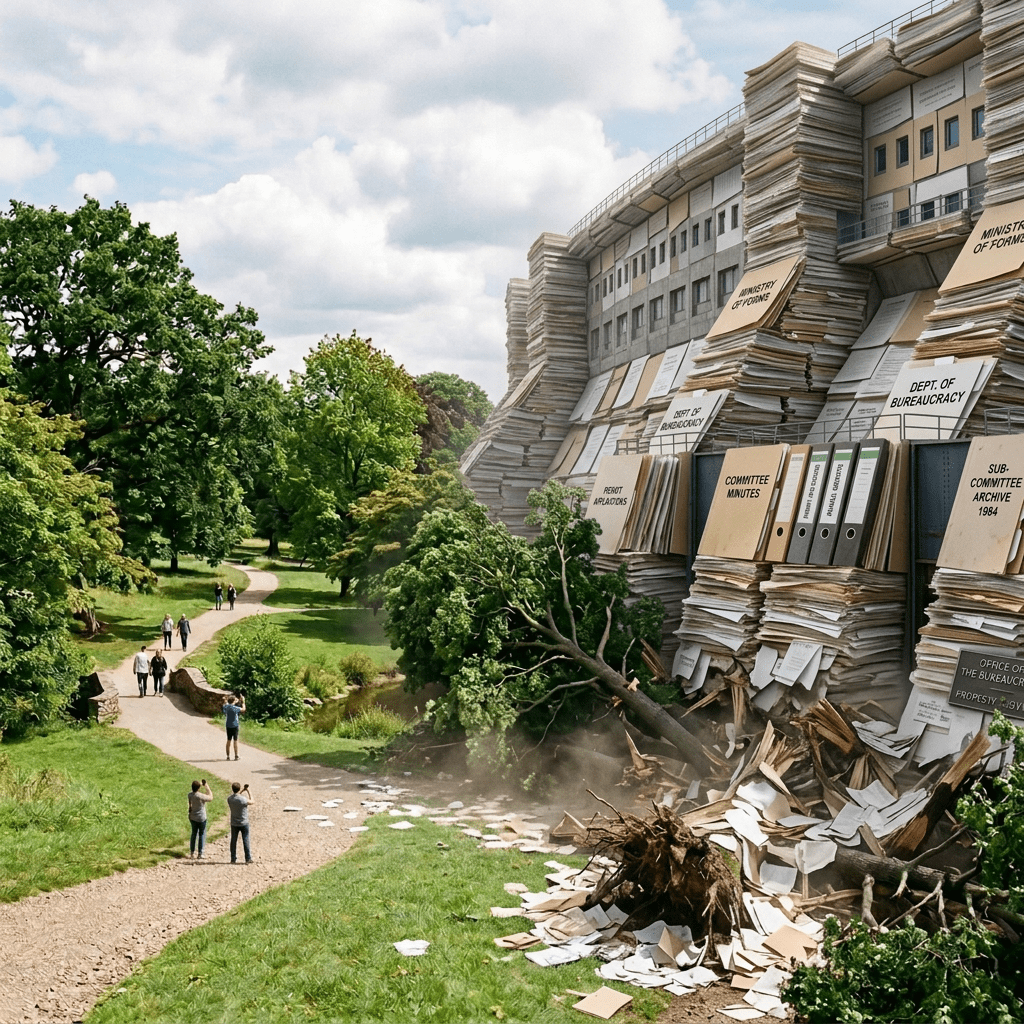
Government too often treats the existence of a finished document as proof that something useful was accomplished. But output is not the same as value. A ten-page report is still waste if no one needed the question answered.
Precision Does Not Create Usefulness
The report’s numbers look authoritative because they are presented with great precision, but precision is not the same thing as importance. Suppose the calculation that produced $3,601,939,252 is mathematically perfect. That still does not explain why taxpayers needed to know the answer to the nearest dollar.
Suppose the parks supported exactly 50,427 jobs under the report’s methodology. What governmental decision changes if the actual number is 50,000? Suppose the estimated additional sales-tax revenue is correct. Is the Department going to alter park operations because of that figure? Is admission policy tied to it? Is maintenance scheduled according to it? Are park managers evaluated based on it?
The report does not say. The appearance of precision can distract from the absence of purpose.
A government agency can calculate almost anything. It could estimate the economic impact of public libraries, boat ramps, courthouse visitors, road shoulders, public fountains, municipal landscaping, or people attending county-commission meetings. That does not mean taxpayers should fund those calculations.
Before government measures something, it should identify why the measurement matters. The public purpose must come first, and the data collection should follow. In this report, the order appears reversed. The Department has a recurring report, so it collects the data necessary to continue producing the report. The continued production of the report then becomes its own justification.
That is bureaucratic circularity.
The Methodology Only Makes the Larger Point More Obvious
Although the central objection remains valid even if every number is correct, the report’s methodology illustrates how administrative activity can be transformed into impressive-looking figures.
The report begins with annual park attendance and multiplies that number by a 74-percent nonlocal-visitor ratio derived from a 2006 Florida State Park Visitor Study. It then multiplies that result by an average per-person, per-day expenditure of $162.13. The report explains that the spending categories include transportation, groceries, restaurants, and lodging, while also acknowledging that state-park-specific spending data are unavailable.
The Department adds park expenditures to arrive at “total direct economic impact,” calculates estimated state sales-tax revenue from visitor expenditures, and estimates jobs supported based upon a ratio of 16 full-time-equivalent jobs for each $1 million in new local expenditures.
Perhaps this is a legitimate methodology for producing a broad economic-impact estimate. Economists and tourism agencies regularly use models of this kind. But that still does not answer the threshold question: Why does the Florida Department of Environmental Protection need to produce this calculation for every state park, every year?
The report gives Henderson Beach State Park an estimated direct economic impact of nearly $70 million and attributes 974 jobs to it. It assigns economic impacts and job numbers to trails, museums, springs, historic sites, and beaches. Perhaps those estimates are reasonable. Perhaps they are not. Either way, what is the Department supposed to do with the information?
Does a larger estimated economic impact mean the Department should devote more resources to that park? Would that not favor already-popular tourist destinations over smaller parks with ecological, historical, or local recreational importance? Does a park with a lower economic-impact estimate deserve less protection? Should a quiet trail used by local residents be viewed as less valuable because its visitors do not stay in hotels?
The report does not confront those questions. It simply treats economic activity as something worth calculating and reporting.
State Parks Do Not Need an Economic Alibi
Florida’s state parks do not need to prove that they generate billions of dollars in surrounding commerce. They are not shopping centers, convention facilities, or publicly subsidized marketing programs for hotels and restaurants. They exist to preserve and provide public access to Florida’s beaches, springs, rivers, forests, trails, wildlife, historic locations, and open spaces.
Their value is not dependent upon whether visitors spend enough money outside the gate. A father taking his child to swim in a spring receives value even if he brings lunch from home. A local resident walking through a nature preserve receives value even if she spends nothing. A bicyclist riding through a state park does not need to purchase gasoline, rent a hotel room, or eat at a restaurant to justify access to public land. A retired couple visiting a historic site should not matter less because they live nearby and therefore do not count as “new dollars” entering the local economy.
The economic-impact framework subtly changes the justification for public parks. Instead of saying that parks are valuable because they preserve natural resources and provide public recreation, government begins defending them because visitors allegedly stimulate commerce. That is the wrong foundation.
Once government accepts that premise, parks must continuously prove their economic worth through attendance totals, spending assumptions, tax estimates, and job multipliers. The agency then needs employees to gather the numbers, analysts to process them, managers to review them, communications personnel to distribute them, and another report the following year.
A government function that did not need an economic justification thereby becomes the reason for creating a recurring administrative process whose principal product is economic justification.
Government Work Has an Opportunity Cost
Government labor is not free. Every hour a public employee spends preparing a report is an hour that employee cannot devote to another task. Every salary devoted to administrative analysis is money that cannot be used for maintenance, staffing, enforcement, resource protection, or tax relief.
Defenders of reports like this often treat them as though they cost nothing. The employees were already on salary, the argument goes, so preparing another report created no additional expense. That reasoning is false.
A salaried employee’s time is a public resource. Using that time for one purpose necessarily means it is unavailable for another. Even if no additional employee was hired specifically to prepare this report, the work still consumed compensated labor, management attention, computer systems, office space, benefits, administrative support, and institutional capacity.
The proper question is not merely whether the report required a new appropriation. The question is whether this was the best use of the resources already appropriated.
Would the public have benefited more if the same employees had analyzed park-maintenance backlogs, examined why visitors are turned away, reviewed whether reservation systems create unused capacity, identified unnecessary regulations, simplified admission procedures, analyzed complaints, or determined which facilities most urgently require repair? Could the State simply have eliminated unnecessary work and reduced staffing through attrition? Could some portion of the money ultimately have remained with taxpayers?
Government rarely asks those questions because bureaucracy has weak incentives to reduce its own workload. In private enterprise, eliminating unnecessary work can improve profitability. In government, eliminating unnecessary work may undermine the justification for positions, departments, and budgets. That creates an institutional preference for continued activity.
The Report Measures Everything Except Actual Performance
The report’s greatest irony is that the Department is willing to estimate billions of dollars in economic impact while failing to publish many of the basic operational metrics that would allow Floridians to evaluate how well the parks are actually managed.
It does not tell us whether park restrooms are clean, disclose maintenance backlogs, measure trail conditions, report average entrance delays, identify how often visitors are turned away, compare available parking with actual use, disclose visitor complaints by park, or show whether staffing levels correspond to periods of actual demand. It does not provide meaningful measurements of whether state-park policies improve public access.
Most relevant now, it does not provide the information needed to evaluate mandatory day-use reservations. At Blue Spring State Park and other parks subject to reservation requirements, the public should be able to determine how many reservations are made, how many reservation holders actually arrive, how many cancel, and how many simply fail to appear. The Department should disclose how much money is refunded, how much is retained when no admission is provided, how many parking spaces remain empty because a reservation holder did not arrive, and how many visitors are turned away while reserved capacity goes unused.
The public also should know how often the system shows a park as unavailable when actual capacity remains, whether reservations have reduced entrance lines or congestion, whether they have improved safety, what the reservation vendor charges, and what the program costs to administer.
Those are not abstract economic-impact estimates. They are direct measurements of a government policy. They could reveal whether the policy works, identify waste, support reform, and help Floridians decide whether the Department is managing public access responsibly.
Yet those are not the numbers featured in the polished report. Instead, we receive estimated spending and modeled jobs. That contrast is revealing. Government readily produces numbers that make government programs look valuable. It is often much slower to produce numbers that allow the public to determine whether those programs are effective.
A Report Useful Primarily to the Agency
The economic-impact report may not help the average park visitor, but it is not useless to everyone. It is useful to the agency.
The Department can cite the $3.6 billion estimate in budget requests. Officials can repeat the 50,427-jobs figure in presentations. The sales-tax number can be included in press releases. Park advocates can use the report in legislative testimony, and administrators can argue that state parks are powerful economic engines requiring continued or increased funding. The document can be circulated to “interested parties” as evidence of the Division’s importance.
In other words, the report may function less as an operational management tool than as an institutional advocacy document. That distinction matters. Taxpayers should be skeptical when agencies use public money to produce studies that chiefly demonstrate the value of the agencies producing them.
There is an unavoidable conflict of interest when government evaluates its own importance using a model it selected, assumptions it applies, and outputs it publishes. Even where the methodology is reasonable, the exercise can become self-congratulatory. The agency spends public money to publish a report showing that the agency’s programs generate enormous benefits, then uses that report to justify additional public spending on the agency.
That is not neutral information gathering. It is bureaucratic self-promotion financed by the people being asked to pay more.
Busy Is Not the Same as Useful
One of government’s most persistent failures is its inability to distinguish between employees being busy and the public receiving value. An employee can spend an entire week compiling a spreadsheet and still accomplish nothing useful. A committee can hold five meetings without solving a problem. An office can generate hundreds of pages of reports without improving a single service, and a department can meet every internal deadline while failing the public.
Government often measures activity because activity is easier to document than results. How many reports were completed? How many meetings were held? How many applications were processed? How many studies were commissioned? How many pages were published?
Those measurements demonstrate that employees did something. They do not demonstrate that the something needed to be done.
A serious public-sector performance system would ask harder questions. Did the work improve service, reduce cost, eliminate delay, protect a resource, solve a documented problem, make government easier for citizens to navigate, or produce information that changed a decision?
The economic-impact report does not appear to satisfy those standards. Its principal accomplishment is that it exists.
Government Reports Rarely Die
Unnecessary reports persist because government programs develop bureaucratic inertia. Once an annual report has been assigned, someone becomes responsible for it. A calendar reminder is created, a prior-year template exists, data are requested, spreadsheets are updated, and supervisors expect a draft. The report appears in workflow documents and job descriptions, and new employees are trained to continue producing it.
No one wants to be the person who asks whether the assignment should be abolished, because eliminating the work may call into question the workload of the office responsible for it. This is how temporary or questionable tasks become permanent institutions.
The report has been generated since 1994. That means generations of employees may have spent public time updating the same basic exercise. Attendance changes, expenditure assumptions change, the tables are recalculated, and the annual headline changes. But the fundamental conclusion remains the same: state parks attract visitors, and those visitors spend money.
At what point has the proposition been sufficiently established? Must taxpayers fund the same conclusion every year forever? Would every two years be enough? Every five years? Once a decade? Or perhaps never, unless an identifiable policy decision genuinely requires the information?
The burden should be on the government to answer those questions.
What Government Should Publish Instead
This criticism is not an argument against all data collection. Government should collect information that serves a legitimate operational, financial, legal, environmental, or public-safety purpose. The State should know whether public funds are being spent lawfully, measure water quality, monitor threats to natural resources, track maintenance needs, evaluate public access, determine whether contractors are performing, investigate whether fees are appropriate, and identify which policies work and which fail.
A useful state-parks report might include actual attendance by park, date, and time; entrance delays and turnaway rates; parking capacity and utilization; maintenance backlogs; trail, restroom, and facility conditions; water-quality data; resource-protection concerns; staffing levels compared with actual demand; visitor complaints and satisfaction data; reservation totals, cancellations, and no-shows; refunds and retained fees; vendor costs and transaction charges; unused capacity; safety incidents; capital projects and completion status; specific operational problems identified during the year; and concrete corrective actions planned for the next year.
That information could help legislators allocate resources, help park managers prioritize work, allow taxpayers to evaluate performance, expose failing programs, and lead to better decisions.
That is what public data should do. It should not merely produce an impressive number that validates the agency producing it.
The Taxpayer Is Not an Unlimited Funding Source
Government employees are sometimes discussed as though their salaries come from an abstract public fund disconnected from individual citizens. They do not. Every government salary is paid from money obtained from taxpayers, fees, borrowing, or transfers that ultimately impose costs on the public.
The person who worked overtime paid taxes. The family struggling with a mortgage paid taxes. The small-business owner trying to meet payroll paid taxes. The retiree living on a fixed income paid taxes. The young worker trying to save for a home paid taxes.
That money should not be treated casually.
When government spends even a relatively small amount on unnecessary work, the answer cannot be that the amount is insignificant compared with the entire state budget. Every large government budget is composed of thousands of supposedly insignificant expenditures. Waste survives because each individual item is defended as too small to matter.
But the principle matters even when the line item is modest. Government should not take money from citizens to finance work that does not materially serve them. The State should have to justify each recurring program, report, office, and position—not merely by showing that employees are occupied, but by demonstrating a concrete public benefit.
Where that benefit is absent, the work should end. Where the work ends, staffing should be reduced through attrition, reassignment, consolidation, or elimination as appropriate. Where government collects more money than it needs to perform legitimate functions, the excess should be returned to taxpayers.
Cutting Government Requires Eliminating Work
Politicians often promise to reduce government but focus on symbolic expenses. They eliminate travel, reduce printing, freeze office-supply purchases, or announce a hiring pause. Those measures may be worthwhile, but they do not address the structural problem.
Government cannot be meaningfully reduced without eliminating government work. Every unnecessary report supports a chain of administrative activity. Someone prepares it, someone supervises that person, someone maintains the data system, someone handles records requests, someone administers payroll and benefits, someone manages the office, someone prepares the budget, and someone defends the program.
To reduce government significantly, leaders must identify entire categories of work that do not need to exist. That will require uncomfortable judgments. Some tasks are performed competently but remain unnecessary. Some offices contain good people doing work that taxpayers should not be funding. Some employees may be diligent and still occupy positions government does not need.
That is not a moral condemnation of the employees. A person can be honorable, capable, and hardworking while holding a publicly funded position that should be eliminated. Private businesses confront this reality regularly. They discontinue products, close divisions, automate functions, consolidate offices, and eliminate roles when the work no longer justifies its cost.
Government should not be exempt from the same discipline.
Nothing against the individuals who prepared this economic-impact report. They may have done exactly what their supervisors required. But whoever collected the data, completed the calculations, assembled the tables, reviewed the report, and published it drew a government salary while producing something that did little or nothing to improve the daily lives of Floridians.
That is the institutional failure.
A Thirty-Percent Reduction Should Not Be Unthinkable
Calls to reduce government staffing are often met with warnings about eliminating teachers, police officers, firefighters, park rangers, or emergency services. That response avoids the actual issue. There is an enormous difference between front-line public services and the administrative machinery that accumulates around them.
Florida could begin by examining every report, study, planning office, communications function, administrative layer, duplicate supervisory position, and recurring data exercise. The State should ask whether each function is legally required, protects public safety, preserves a public resource, delivers a direct service, prevents fraud or waste, or materially improves a governmental decision. It should also ask whether the function could be eliminated, automated, consolidated, or performed less frequently, and what would actually happen to the public if the position disappeared.
A serious review might conclude that some agencies can reduce administrative staffing substantially without closing a park, eliminating a police officer, removing a classroom teacher, or denying an essential service.
A 30-percent reduction in government employment should not be dismissed as inherently impossible or extreme before anyone examines what thousands of government employees actually do. Perhaps the defensible number is smaller in some agencies and larger in others. The point is that government should not begin with the presumption that every existing task and position must continue.
The presumption should run the other way. Government should prove that a function is necessary before forcing taxpayers to continue funding it.
The Better Use of the Money May Be Not Taking It
Government officials often respond to identified waste by proposing that the money be redirected to another program. Sometimes that is appropriate. But government does not automatically deserve to retain every dollar merely because it can identify another way to spend it.
The better use of unnecessary public spending may be to stop collecting the money. Give it back. Reduce taxes. Lower fees. Allow individuals and businesses to decide how to use their own earnings.
A dollar left with a taxpayer is not a dollar wasted. It may pay for groceries, housing, medical care, education, savings, investment, or a private business. Government should not presume that public officials will use every marginal dollar more wisely than the person who earned it.
If Florida can eliminate unnecessary administrative work, reduce positions, consolidate offices, and discontinue reports that do not provide a concrete public benefit, the savings should not automatically disappear into another bureaucracy. Some portion should be returned to the people.
The Question Government Failed to Ask
The authors of the economic-impact report appear to have asked how much economic activity can be attributed to state-park visitors. They developed a methodology, gathered data, performed calculations, and published an answer.
The question they apparently did not ask was more important: Why does the State need this answer?
That question should have come first.
Perhaps there is a legitimate explanation. Perhaps a statute requires the report. Perhaps it informs a specific legislative appropriation. Perhaps the Department can identify a concrete decision that depends upon the calculation. But the report itself does not establish that purpose. It proceeds as though calculating economic impact is self-evidently valuable.
It is not.
Government does not exist to satisfy administrative curiosity, produce content for presentations, or create work for employees. It exists to perform limited public functions that individuals cannot efficiently perform on their own. Every task should be tied to one of those functions.
When the connection is missing, the work should stop.
Maintain the Parks, Not the Paperwork
Florida’s state parks are valuable. They do not need a ten-page economic-impact report to prove it.
Floridians know why the parks matter. They swim in the springs, walk the trails, camp with their families, visit historic sites, fish, paddle, bicycle, watch wildlife, and enjoy land that has been preserved for public use. The Department’s responsibility is to protect those resources and keep them reasonably accessible.
That requires real work: maintaining the parks, protecting the springs, repairing the trails, cleaning the restrooms, managing actual capacity, reducing entrance delays, measuring whether reservation policies work, publishing data that reveal real performance, eliminating unnecessary barriers, and opening the gates.
When a proposed government assignment does not accomplish any of those things, officials should ask the question that should have been asked before this report was prepared:
Even if the numbers are right, so what?
If government cannot provide a good answer, it should not spend public money producing the numbers.
The people of Florida do not need another chart telling them that parks have value. They need a government disciplined enough to know when not to create one.
 Donner Law Firm