
By Jeffrey T. Donner, Esq.
August 17, 2026
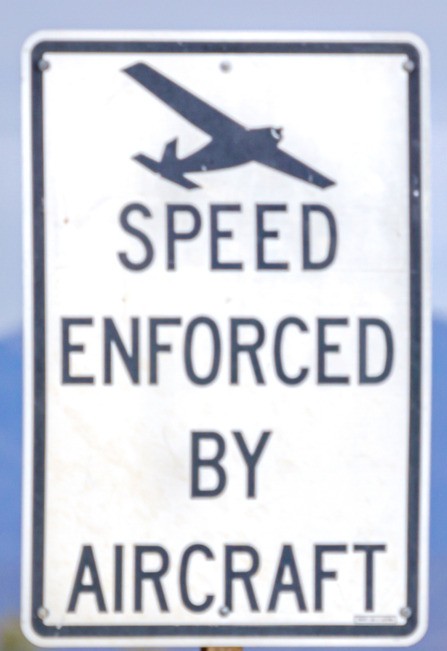
Anyone who has spent much time driving Florida’s Turnpike has seen the signs. They appear along a modern toll road traveled by vehicles equipped with GPS navigation, adaptive cruise control, collision-avoidance systems, cellular data connections and enough onboard computing power to make the technology of the Apollo program look primitive. Yet there, beside all of this twenty-first-century machinery, is a warning that seems to have been transported directly from another age:
SPEED ENFORCED BY AIRCRAFT.
I have been driving up and down Florida’s Turnpike for roughly 35 years. In all those years, I cannot recall ever seeing a Cessna—or any other airplane—that appeared to be circling over the Turnpike clocking motorists. Of course, that proves nothing by itself. Aircraft conducting traffic enforcement would not necessarily be conspicuous from the highway, and my personal experience is not a statistical study. But after seeing those signs for decades, I finally began wondering about something I suspect almost nobody ever asks: When was the last time the State of Florida actually did what the sign says?
That question has now become the subject of public-records requests to the Florida Highway Patrol and Florida’s Turnpike Enterprise. I want to know the last time FHP actually used an airplane to measure the speed of motorists in Florida, the last time it did so specifically on the Turnpike, how frequently it has done so in recent years, how many citations have resulted, and whether the State continues to spend money maintaining signs that warn motorists about an enforcement method that may have become largely obsolete.
The answer may turn out to be that Florida still conducts aircraft speed enforcement from time to time. If so, the signs are accurate, and I will report that. But if the records instead show that the practice disappeared years ago while the signs remained standing, the story becomes considerably more interesting. In that event, Florida would be maintaining official highway signs telling millions of motorists that the government is watching them from airplanes when, as a practical matter, it is not.
Yes, Florida Really Did Enforce Speed Limits From Airplanes
The first point worth establishing is that the signs were not invented as a joke or as some empty scare tactic. Aircraft speed enforcement was real, Florida law expressly authorized it, and the Florida Highway Patrol actually maintained a substantial aircraft fleet.
Section 316.1905 of the Florida Statutes still provides that an officer may act upon speed information relayed by another officer “stationed on the ground or in the air” who is operating an approved speed-calculating device. The statute also requires accuracy testing of speed-calculating devices and addresses the admissibility of evidence obtained from them. Most interesting for present purposes, the statutory history traces the provision back to Chapter 71-135, Laws of Florida—1971.
This was not merely theoretical statutory authorization. FHP’s own historical materials report that in 1980 the Patrol obtained five additional aircraft, bringing its fleet to eleven and permitting the assignment of an airplane to each troop. In other words, Florida once had a real governmental aviation infrastructure supporting highway patrol operations.
The basic concept was simple. Rather than requiring the officer who ultimately stopped the car to personally measure its speed, an officer in an aircraft could observe traffic from above, determine a vehicle’s speed over a measured distance, identify the vehicle, and relay that information to officers positioned on the ground. The ground officer would then make the stop and issue the citation. Florida’s statute specifically accommodates that division of labor by authorizing an officer to act on speed information communicated by another officer in the air.
There was nothing inherently irrational about the technique. From the air, a trooper could observe a long section of highway without the sight-line limitations confronting an officer parked beside the roadway. Particularly on limited-access highways, aerial observation could allow one aircraft officer to work with several ground units. In its time, it was a legitimate traffic-enforcement method.
What makes it fascinating today is not that Florida ever did it. It is that the signs are still there.
The Perfect Traffic-Enforcement Idea for 1971
There is something wonderfully specific about the year 1971 appearing in the statutory history. The idea of enforcing speed limits from airplanes makes much more intuitive sense when placed into the technological culture of that period.
The government-media complex had claimed we had landed human beings on the Moon less than two years earlier. Aviation and aerospace represented technological progress in a way that is difficult to recreate today. Commercial aviation was expanding. Government agencies were finding new uses for fixed-wing aircraft and helicopters. The future, at least in the popular imagination, involved more things happening in the sky, not fewer.
This was the cultural environment in which The Jetsons had presented ordinary families flying to work in personal spacecraft. It was also an era in which sophisticated technology tended to be large, visible and expensive. If the government wanted a bird’s-eye view of a highway, it put a human being in an airplane and sent him into the sky.
The aircraft system was not created because police had no other means of measuring automobile speed. Ground-based electronic speed enforcement was already part of the law-enforcement landscape of the period, and by the 1970s governmental studies were expressly comparing aerial enforcement with enforcement using stationary radar and chase cars. The airplane represented another tool—one that happened to fit extremely well with the era’s faith in aviation and large-scale technological solutions.
Viewed from 1971, there is nothing particularly strange about it. Viewed from 2026, there is something almost archaeological about it.
The old sign is a technological fossil. It preserves on a metal rectangle beside the highway an idea about the future that arrived, served its purpose and may have largely disappeared, while the warning announcing it remained behind.
The Government Is Watching You—From a Cessna
There is also something undeniably Orwellian about the language itself. “SPEED ENFORCED BY AIRCRAFT” is, when stripped of its bureaucratic familiarity, an extraordinary statement for a government to place beside a public road.
The government is telling you that you may be watched from the sky.
We have become so accustomed to traffic signs that we barely process what they say. Imagine encountering the concept for the first time. A citizen is traveling down a highway, and the State announces that somewhere overhead may be a government employee observing his movements from an airplane, calculating whether he has violated the law and communicating that information to police officers waiting farther down the road.
One need not argue that such a program is unconstitutional to recognize its surveillance character. There is a significant difference between saying that governmental observation is legally permissible and saying that it is not governmental observation. Aircraft speed enforcement is surveillance in the most literal sense: a government officer takes an elevated position from which he can watch people who may have no idea where he is.
That is what gives the signs their peculiar quality. They do not merely state the speed limit or warn that police patrol the highway. They specifically advertise the State’s capacity to observe motorists from a place motorists cannot readily observe in return.
George Orwell, of course, was writing about something far more sinister than traffic enforcement. 1984 describes totalitarian political surveillance, not speeding tickets. The comparison should not be stretched beyond usefulness. But the enduring power of Orwell’s imagery arises from a basic human discomfort with a government that can watch people while remaining unseen itself. On that much narrower point, there is something almost comically Orwellian about a highway department planting a sign beside the road announcing: We may be watching you from above.
The Great Irony: The Airplane Is Now the Quaint Part
The irony is that the supposedly ominous airplane now looks primitive compared with the surveillance capabilities of the world we actually built.
An aircraft-enforcement operation required an airplane. It required fuel. It required maintenance. It required a pilot or qualified officer to go into the air. It required an officer to watch individual automobiles, make speed calculations, identify a particular vehicle and communicate with another human being on the ground. Ground units then had to locate that vehicle and make a conventional traffic stop.
It was surveillance, but it was expensive, episodic and intensely dependent upon human labor.
Compare that system with the technological infrastructure of the modern highway. Electronic tolling systems can identify transactions without a toll collector ever seeing the driver. Cameras can record traffic continuously. Automated license-plate-recognition technology exists and is sufficiently integrated into contemporary transportation policy that Florida statutes now specifically regulate the installation and retention of records generated by such systems on the State Highway System. Florida’s 2025 statutory compilation includes separate provisions governing automated license-plate-recognition systems and the retention of their records.
None of that means every camera is tracking every motorist or that every available technology is being used for law enforcement. It means simply that the technical problem solved in 1971 by putting a man in an airplane can now be approached through technologies that do not require anyone to leave the ground.
Indeed, the old system now seems almost reassuringly inefficient. There was a finite number of airplanes. There was a finite number of officers who could fly in them. There were only so many hours in a day. The government could not cheaply observe every mile of every highway at every moment because observation required people and expensive machinery.
Digital technology changed the economics of observation. The defining characteristic of modern surveillance is not merely that it sees more. It is that machines can collect, sort, store and retrieve information at a scale that would have been inconceivable to the people who wrote Florida’s aircraft-enforcement statute in 1971.
That is why the old sign has become so unintentionally funny. It still attempts to intimidate motorists with the prospect of a human being in a small airplane while motorists are traveling through a world filled with technologies far more capable of persistent observation.
The Cessna may now be the least Orwellian thing on the highway.
But Is Florida Actually Still Doing It?
That brings us back to the factual question that started this inquiry.
I do not presently know when FHP last conducted an aircraft speed-enforcement operation on Florida’s Turnpike. I do not know whether it occurred last month, five years ago or twenty years ago. I do not know how many speeding citations in Florida during the last decade resulted from observations made by an officer in an airplane. I do not know whether FHP still maintains personnel trained specifically for this purpose or whether the statutory authority has simply outlived the operational program that originally gave it significance.
Those are precisely the questions that should be answered with records rather than assumptions.
I have therefore requested records from the Florida Highway Patrol sufficient to establish the most recent use of aircraft for speed enforcement anywhere in Florida and specifically on Florida’s Turnpike. I have also requested records concerning aircraft-enforcement operations, citations generated through those operations, policies and procedures, aircraft used for traffic enforcement, program costs and any decision to reduce, suspend or discontinue the practice.
Separately, I have requested records from Florida’s Turnpike Enterprise concerning the signs themselves. Those records should reveal where the signs remain installed, when they were installed or replaced, what policies govern their continued use, whether FHP has communicated with the Turnpike about aircraft enforcement, and whether anyone has ever considered removing the signs if the underlying enforcement practice has become obsolete.
This distinction matters because the agency that enforces the traffic laws and the agency responsible for highway infrastructure do not necessarily make the same decisions. It is entirely possible for an enforcement practice to fade away while the physical infrastructure associated with it continues through bureaucratic inertia. A sign can remain beside a highway for years simply because no particular event forces anyone to reconsider whether it belongs there.
That possibility is what makes the public-records inquiry worthwhile.
A Traffic Sign Is Supposed to Mean Something
If FHP still periodically flies aircraft over Florida highways to detect speeding violations, then there is nothing mysterious about these signs. They warn motorists about an enforcement method that remains in use, even if the average driver rarely happens to witness it.
But suppose the records show something different. Suppose aircraft speed enforcement on the Turnpike has not occurred for ten or fifteen years. Suppose the airplanes once used for that purpose are gone, the dedicated operations ended long ago, or the number of aircraft-assisted speeding citations has effectively fallen to zero.
At what point does an official warning cease to be a warning and become a bluff?
There is no constitutional right, so far as I know, to have every traffic-enforcement technique advertised with perfect statistical precision. Nor am I suggesting that the existence of an old sign would somehow invalidate an otherwise lawful speeding citation. The question is more basic than that. Government signs are official communications. When the State erects a sign saying “BRIDGE OUT,” we expect the bridge to be out. When it says “ROAD WORK AHEAD,” we expect there to be road work somewhere ahead. When it says “SPEED ENFORCED BY AIRCRAFT,” the ordinary meaning is that speed is, at least sometimes, enforced by aircraft.
If that ceased being true decades ago, leaving the signs in place becomes difficult to defend as useful public information.
Perhaps there is a deterrence rationale. Maybe someone believes drivers slow down because they think a hidden airplane is watching them. But that rationale itself would be interesting. It would mean that the sign is being retained not because it accurately describes a meaningful present enforcement practice but because the possibility of an enforcement practice—perhaps one the State rarely or never actually uses—is thought to influence behavior.
That would make the sign less like an informational traffic-control device and more like a very old governmental bluff.
The Records Will Tell Us Which Story This Is
For the moment, I am not claiming that Florida has stopped enforcing speed limits from aircraft. I suspect that the practice is dramatically less common than the continuing signs would lead a motorist to believe, but a suspicion is not evidence. The entire point of Florida’s public-records law is that citizens do not have to rely on suspicion when government records can provide the answer.
The documents should tell us whether aircraft speed enforcement remains a functioning traffic-enforcement technique or whether it has become another piece of governmental infrastructure that survived long after the operational practice behind it faded away.
Either answer is interesting.
If FHP produces recent flight logs, enforcement reports and aircraft-assisted speeding citations, then I will have learned that those strange signs are considerably more literal than I thought. I will also have some questions about the economics of putting an airplane into the sky to enforce traffic speeds in an age of radar, lidar, cameras and other modern technologies.
If the records instead show that the last meaningful aircraft speed-enforcement operations occurred years ago, then a different question deserves an answer: Why are Florida motorists still being told that their speed is “enforced by aircraft”?
For approximately three decades, I have driven past those signs without giving them much more than an occasional amused glance. I finally decided to ask the State to show its work.
When Florida responds, I will publish what the records show.
 Donner Law Firm