
A federal court refused to end maritime negligence claims arising from a catastrophic marina fire, concluding that evidence of practical control, repeated safety oversight, constructive notice, and reliance presented issues for trial. The decision also shows why surviving summary judgment is not the same as proving liability.
By Jeffrey T. Donner, Esq.
August 28, 2026
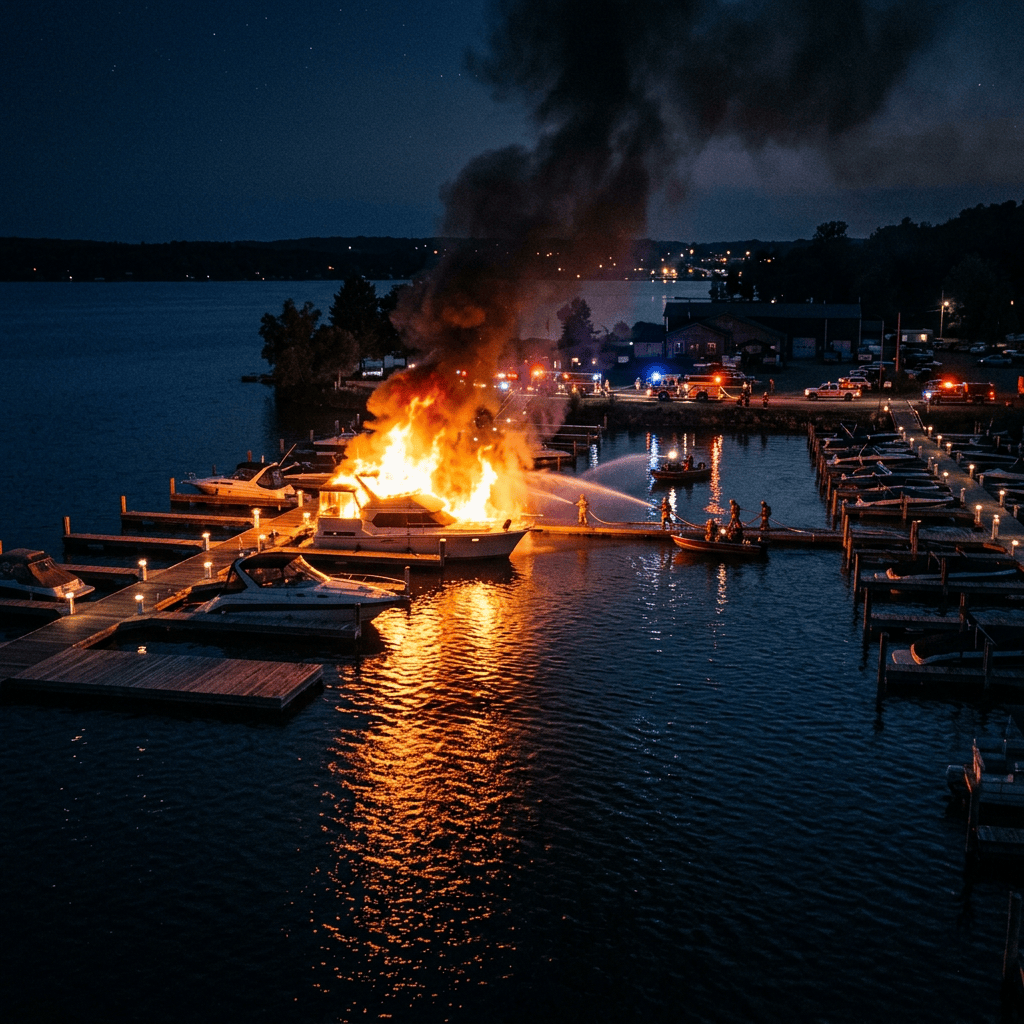
Shortly after midnight on January 27, 2020, a fire began aboard the Dixie Delight, a 43-foot houseboat berthed at Dock B of the Jackson County Park and Marina in Scottsboro, Alabama. The fire spread rapidly to neighboring vessels and the wooden dock. Because the Dixie Delight was in one of the slips nearest shore, the spreading fire obstructed the principal path to land for people farther down the dock.
The resulting scene was horrific. Sixteen people attempted to escape aboard two boats whose engines would not start, forcing them to paddle with folding chairs and wash brushes. Burning vessels broke loose, collided with the escape boats, and forced several people into the water. Eight people died, another suffered serious injuries, and substantial property was destroyed. The National Transportation Safety Board later reported that the ignition source could not be determined, although the fire likely originated in a bulkhead near the houseboat’s electrical panel. The NTSB also concluded that limited marina fire-safety practices contributed to the severity of the fire and loss of life.
In Paulk v. Tennessee Valley Authority, Case Nos. 5:22-cv-15-CLM, 5:22-cv-105-CLM & 5:22-cv-114-CLM, slip op. (N.D. Ala. Aug. 13, 2026), ECF No. 412, Judge Corey L. Maze addressed an unusually complicated collection of summary-judgment and expert-witness motions in three consolidated cases. The plaintiffs asserted maritime negligence claims against the Tennessee Valley Authority (“TVA”), while TVA pursued third-party claims against Jackson County, the City of Scottsboro, and the Electric Power Board of the City of Scottsboro (“SEPB”).
The court denied summary judgment to TVA, Jackson County, and Scottsboro, allowing the principal negligence, direct-liability, and contribution claims against them to proceed to trial. The surviving claims include three general-maritime-law negligence counts against TVA and an Alabama wantonness claim limited to wrongful-death plaintiffs seeking punitive damages. The court granted summary judgment to SEPB, however, because the operative electrical-service agreement and the contracting parties’ course of performance placed the allegedly defective portion of the marina’s electrical system outside SEPB’s area of responsibility.
The opinion provides important lessons about maritime negligence, operational control, constructive notice, voluntary undertakings, expert testimony, and contractual allocation of responsibility. It is especially relevant to marinas and waterfront businesses in Florida, where the same Eleventh Circuit maritime principles frequently apply.
Why Maritime Law Applies to an Inland Marina Fire
The location may surprise readers who associate admiralty law only with oceans, commercial shipping, and offshore casualties. The Jackson County marina sits on the Guntersville Reservoir, an impoundment of the Tennessee River in northeastern Alabama. Federal admiralty jurisdiction, however, can extend to incidents on navigable inland waters. Under 28 U.S.C. § 1333, federal district courts have original jurisdiction over civil cases of admiralty or maritime jurisdiction, and the Supreme Court applies both a location inquiry and a connection-to-maritime-activity inquiry when a tort occurs on navigable waters.
The modern test comes from Jerome B. Grubart, Inc. v. Great Lakes Dredge & Dock Co., 513 U.S. 527 (1995). A court first asks whether the tort occurred on navigable water or whether an injury on land was caused by a vessel on navigable water. It then examines the incident at an appropriate level of generality, asking whether that type of incident could potentially disrupt maritime commerce and whether the general character of the activity giving rise to the incident bears a substantial relationship to traditional maritime activity. The inquiry does not turn on whether the particular vessel was earning freight or whether the casualty actually shut down commercial navigation.
Sisson v. Ruby, 497 U.S. 358 (1990), makes the application especially clear. There, a fire began aboard a noncommercial pleasure yacht stored at a marina on navigable waters and damaged other vessels and the marina. The Supreme Court treated the incident generally as a fire on a vessel docked at a marina, held that such a fire had the potential to disrupt maritime commerce, and concluded that storing and maintaining a vessel at a marina on navigable waters bore a substantial relationship to traditional maritime activity. The fact pattern in Paulk—a fire beginning aboard a houseboat in a marina, spreading to other vessels and the dock—is closely analogous.
In an earlier January 2025 order, the district court held that the consolidated cases satisfied both parts of the maritime-connection test. The plaintiffs then elected to designate their claims as admiralty claims under Federal Rule of Civil Procedure 9(h). That election has practical consequences. It ordinarily means a bench trial rather than a jury trial, and it activates distinctive maritime procedures—including Rule 14(c), which allowed TVA to bring third parties into the action and tender them directly to the plaintiffs.
Admiralty jurisdiction does not mean that every issue is governed exclusively by a single federal statute. General maritime law supplies the core negligence rules, but state law may sometimes supplement maritime remedies when it does not conflict with federal maritime principles. Contract law may determine how defendants allocate responsibility among themselves. Federal procedural rules govern the action in district court. Paulk therefore sits at the intersection of maritime tort law, Alabama contract law, state wrongful-death remedies, federal-agency law, and federal civil procedure.
TVA’s Federal Status Did Not Automatically End the Case
TVA is not an ordinary private marina owner. It is a federally created corporate agency and instrumentality charged with managing and developing the Tennessee River system. That status presented a threshold question: could the plaintiffs sue TVA for damages at all?
The TVA Act answers much of that question through a broad “sue-and-be-sued” clause, 16 U.S.C. § 831c(b). In Thacker v. Tennessee Valley Authority, 587 U.S. 218 (2019), the Supreme Court unanimously rejected the argument that courts should import the Federal Tort Claims Act’s discretionary-function exception into the TVA Act. The Court explained that when TVA acts in the commercial world, the sue-and-be-sued clause generally places it in the same position as a private enterprise. A narrower implied restriction may remain when a suit challenges a governmental function and allowing the action would seriously interfere with governmental operations, but federal status alone is not a complete tort defense.
Applying Thacker at the pleading stage, the district court concluded that the plaintiffs had characterized TVA’s relevant conduct—management of land and facilities used for a fee-generating marina, safety oversight, and conduct comparable to that of a wharfinger—as commercial rather than uniquely governmental. The court also held that the TVA Act’s own waiver, rather than the Suits in Admiralty Act, governed the claims as pleaded. Those rulings allowed the maritime negligence counts to proceed and preserved, for the wrongful-death plaintiffs, a state-law wantonness count only to the extent it supplied a potentially available punitive remedy.
That earlier order did not establish TVA’s liability, and the later summary-judgment opinion did not revisit every sovereign-immunity question from scratch. The sequence nevertheless matters. A litigant suing a federal entity must identify the waiver that opens the courthouse door before ordinary duty, notice, breach, and causation questions can be reached. In Paulk, the broad TVA-specific sue-and-be-sued provision allowed the litigation to move to those merits questions; it did not make the merits any easier to prove.
The Court Did Not Find That Any Remaining Defendant Caused the Fire
The procedural posture is critical. The court did not find that the allegedly oversized breaker caused the fire, that TVA or any other remaining defendant breached a duty, or that additional fire-safety measures would have prevented the deaths and injuries. It decided that genuine factual disputes prevented those questions from being resolved on summary judgment.
At the summary-judgment stage, a court must generally view disputed evidence in the light most favorable to the nonmoving party. It cannot choose between competing witnesses, decide which expert is more credible, or resolve factual conflicts that require a trial. The plaintiffs’ success on these motions therefore means that their evidence was sufficient to permit the factfinder to consider their claims. It does not mean that the plaintiffs have proved those claims.
That distinction is particularly important because Paulk is headed for a bench trial. The same district judge who declined to resolve the disputed facts on paper will ultimately hear the testimony, assess the experts, determine what happened, and decide liability.
This is also an unreported federal trial-court ruling, not a decision of the Eleventh Circuit. It does not bind Florida courts as appellate precedent. Its value lies in the court’s fact-specific application of established maritime principles to overlapping layers of ownership, regulation, inspection, and operational control.
The Plaintiffs’ Alleged Electrical Defect
The plaintiffs’ fire-causation theory centered on a 55-amp breaker allegedly installed in the electrical panel serving the Dixie Delight’s slip. According to the plaintiffs’ causation expert, the vessel was designed for no more than 30 amps of current, and the oversized shore-side breaker permitted excessive current to reach the vessel’s electrical connection. A witness testified that he saw the marina manager install the 55-amp breaker approximately eight months before the fire and photographed it.
The defendants disputed both essential parts of that theory. They contested whether the Dixie Delight was connected to the 55-amp breaker on the night of the fire, an issue complicated by potentially inaccurate slip labels inside the breaker panel. They also presented experts who maintained that shore power could not have caused the fire, that the vessel was not drawing enough power to overheat its system, and that breakers aboard the vessel should have protected it even if the shore-side breaker was oversized.
Those competing accounts created classic trial issues. If the Dixie Delight was not connected to the 55-amp breaker, the plaintiffs’ electrical-causation theory may fail. Even if it was connected, the factfinder must still decide whether the breaker caused the fire. The court could not make either determination by choosing one side’s expert opinions over the other’s at summary judgment.
Why TVA’s Control Mattered More Than Formal Ownership
Jackson County constructed, operated, and maintained Dock B and leased its slips to boat owners. TVA did not operate the dock in that ordinary sense. But the duty analysis did not end with the name on the deed or the identity of the day-to-day operator.
The United States owned the submerged land and surrounding navigable waters, with TVA holding custody and control as the federal government’s agent. A 1963 indenture granted Jackson County a parcel and easement rights while reserving TVA’s rights to inspect the property and, upon a breach of the County’s obligations, to re-enter and retake possession. Jackson County also needed TVA approval to construct and operate Dock B under § 26a of the TVA Act. TVA’s regulations required dock electrical systems to be installed without creating a public hazard and in compliance with state and local electrical codes, while also stating that issuance of a permit did not itself mean TVA had undertaken a duty to make that safety determination. See 18 C.F.R. Part 1304.
The practical evidence went further than those formal rights. TVA conducted periodic shoreline inspections. Its Clean Marina Initiative addressed emergency plans, fire extinguishers, fire-department access, and related practices. Its Campground Compliance Initiative used inspections and scorecards that expressly included electrical hazards at boat slips. After TVA discovered electrical concerns at another recreational operation, it required Jackson County to submit certifications from electricians confirming that the marina’s electrical system complied with the National Electrical Code. County personnel also testified that they complied when TVA directed operational changes and that TVA had the final say over the fire protection used at Dock B.
The court therefore declined to examine TVA’s roles as land manager, federal regulator, and safety-program administrator in isolation. Any single role might not have created a tort duty by itself. Taken together, however, TVA’s property rights, regulatory leverage, inspections, safety programs, and actual influence over Jackson County led the court to hold that TVA owed marina users at least a general duty of reasonable care.
The broader point reaches beyond this particular federal agency. In maritime and premises-liability cases, formal title is relevant, but practical control may be more important. Courts can examine who had the actual ability to inspect, require corrective work, dictate operating conditions, and protect users from dangerous conditions. An entity cannot necessarily retain substantial control and then rely solely on another party’s formal ownership to avoid every corresponding duty.
The Wharfinger Rule Sets a Duty of Care, Not Strict Liability
TVA argued that its duty could be no higher than Jackson County’s duty as the marina’s wharfinger, and the court agreed to analyze notice and breach under an ordinary-reasonable-care standard. “Wharfinger” is an old maritime term for a person or entity that maintains a wharf and offers berthing facilities. The label does not make a marina the insurer of every vessel or passenger using its slips.
The Supreme Court’s decision in Smith v. Burnett, 173 U.S. 430 (1899), remains the traditional starting point. A wharfinger does not guarantee the safety of every berth. It must, however, exercise reasonable diligence to determine whether the berth is safe and must remove a dangerous condition or give adequate warning when reasonable diligence would disclose it. The duty is therefore tied to reasonable inspection, discoverability, knowledge, and an opportunity to act—not perfect prevention.
Although Smith involved a submerged obstruction at a berth rather than an electrical system and fire protection on a covered dock, its structure translates readily to modern marina operations. The relevant questions include the kind of inspection a reasonably careful operator would conduct, the hazards such an inspection should encompass, what records or warnings existed, how long the condition remained, and whether the responsible entity had a realistic ability to correct it. The standard is flexible enough to account for a facility’s design and use, but demanding enough that an operator cannot ignore reasonably detectable hazards merely because no casualty has yet occurred.
The district court’s control analysis fit that traditional principle. It cited authorities treating possession and control—not title alone—as the source of an ability and corresponding duty to protect others from unsafe conditions. TVA had reserved inspection and re-entry rights, exercised permitting leverage, reviewed marina safety practices through several initiatives, and, according to County witnesses, issued directions that the County followed. The court did not hold that any regulator with inspection authority becomes a wharfinger. It concluded that the combined evidence permitted a finding that TVA exercised enough practical control to owe a duty no higher than the County’s ordinary maritime duty of reasonable care.
That limitation is as important as the duty itself. The plaintiffs must still connect the scope of TVA’s control to the particular risks they say should have been addressed. A right to inspect for navigation obstructions does not automatically prove an undertaking to audit every breaker. A clean-marina certification does not automatically guarantee comprehensive fire-code compliance. At trial, the parties can test whether TVA’s actual conduct expanded beyond those narrower functions and whether a reasonable entity exercising that level of control would have found or corrected the specific conditions in dispute.
Eight Months Created a Constructive-Notice Issue
The plaintiffs did not claim that TVA actually knew about the 55-amp breaker. Their fire-causation claim therefore depended on constructive notice.
Under Eleventh Circuit maritime law, ordinary reasonable care generally requires actual or constructive knowledge of the risk-creating condition. Keefe v. Bahama Cruise Line, Inc., 867 F.2d 1318, 1322 (11th Cir. 1989). Constructive notice may be shown through substantially similar prior incidents or by evidence that a dangerous and reasonably detectable condition existed long enough to invite corrective measures. Tesoriero v. Carnival Corp., 965 F.3d 1170, 1178–79 (11th Cir. 2020).
There was no evidence of a substantially similar earlier incident. But the plaintiffs’ evidence placed the oversized breaker in a visibly labeled panel for eight months and six days. TVA personnel had inspected marina facilities and electrical conditions through various programs, and TVA understood that electrical defects at recreational facilities could endanger the public.
The court compared those circumstances with maritime cases in which hazards lasting only 10 to 20 minutes were enough to create a notice question when employees were assigned to monitor the affected area. If a short-lived condition may support constructive notice in the right circumstances, the court reasoned, a labeled breaker allegedly remaining in place for eight months could also permit such a finding where the defendant conducted relevant inspections.
Again, the court did not find that TVA actually should have discovered the breaker. It held that the alleged duration and detectability of the condition, combined with TVA’s inspection history and electrical-safety activities, created a factual question for trial.
Constructive Notice Depends on More Than a Calendar
The eight-month interval is powerful evidence for the plaintiffs, but time alone does not decide constructive notice. The condition also must have been reasonably detectable, and the defendant’s responsibilities must have brought the condition within the range of what reasonable care required it to observe. A concealed defect can remain for years without necessarily establishing constructive knowledge. Conversely, an obvious condition in a location continuously monitored for the very hazard at issue may support notice after a much shorter period.
That is why the court’s comparison to Lebron v. Royal Caribbean Cruises Ltd., 818 F. App’x 918 (11th Cir. 2020), and D’Antonio v. Royal Caribbean Cruise Line, Ltd., 785 F. App’x 794 (11th Cir. 2019), requires context. Those cases involved hazards lasting roughly 10 to 20 minutes in areas employees were assigned to observe. They do not establish a universal minimum time. They show that duration, employee presence, inspection responsibility, detectability, and awareness of the general hazard operate together.
In Paulk, the breaker allegedly bore a visible 55-amp marking, and a photograph purportedly documented it. Yet the panel’s slip labels may have been inaccurate, the parties disputed whether that breaker actually served the Dixie Delight, and the record did not establish that every TVA visit was a detailed electrical inspection. At trial, the factfinder can examine who opened the panel, what an inspector would need to know about the vessel and circuit, how often a relevant inspection should reasonably occur, and whether the marking would have signaled a danger rather than merely a different circuit configuration.
Notice doctrine must also be matched to the theory of liability. A direct premises or condition claim ordinarily requires proof that the defendant had actual or constructive notice of the dangerous condition. A vicarious-liability claim asks a different question: whether an employee negligently created the risk while acting within the scope of employment. Under Yusko v. NCL (Bahamas), Ltd., 4 F.4th 1164 (11th Cir. 2021), a plaintiff asserting vicarious liability for an employee’s negligent act need not separately prove that the employer had notice of a condition the employee created.
The distinction explains why the notice arguments differed among defendants. No evidence showed that TVA itself installed the disputed breaker, so the direct claim against TVA depended on constructive notice. Jackson County’s marina manager allegedly installed it as part of his work, potentially supporting vicarious liability without a separate corporate-notice showing. The same facts may also support direct notice to the County because knowledge acquired by responsible personnel and the visibility of equipment within their operational domain can be attributed differently under governing law. Pleadings, discovery, and summary-judgment briefing should keep those routes to liability separate; a notice defense effective against one theory may not answer the other.
The Fire-Mitigation Theory Was Separate From the Ignition Theory
The plaintiffs also asserted a distinct fire-mitigation theory. Even if the factfinder cannot determine precisely how the fire began, the plaintiffs contend that missing safety measures allowed it to spread and made escape more difficult.
The alleged omissions included the absence of a written emergency-response plan, regular fire drills, properly placed and maintained fire extinguishers, a rescue skiff, readily accessible flotation devices, and certain roof-venting or fire-suppression features. The plaintiffs also challenged the presence of non-navigable vessels and gas grills on Dock B.
TVA acknowledged actual or constructive notice of the existing conditions but denied having any maritime duty to require additional measures. The court nevertheless held that TVA’s aggregate control and safety activities could support a duty of reasonable care extending to fire mitigation. Testimony indicated that Jackson County followed TVA’s operating directives and relied on TVA to identify the fire protection required at Dock B.
Whether the existing measures fell below the maritime standard of reasonable care—and whether any additional measure would have prevented or reduced the losses—remains for trial. The court also recognized that industry standards and voluntary safety guidelines may help the factfinder determine reasonable care even when they do not have the force of law or establish negligence per se.
Codes and Safety Programs Are Evidence, Not Automatic Answers
The record referred to several different sources of safety expectations: state and local electrical codes, the National Electrical Code, National Fire Protection Association materials, TVA’s permit conditions, the Clean Marina checklist, the Campground Compliance Initiative scorecard, and guidance supplied during fire-marshal inspections. It would be a mistake to treat all of them as legally interchangeable.
A statute or regulation may impose a mandatory requirement. A contract or permit may bind particular parties without itself creating a tort remedy for every person who might be injured. An industry standard may inform what reasonable professionals customarily do even though it lacks the force of law. A voluntary checklist may be evidence that an entity recognized a risk or represented that it would examine certain conditions, but it may also contain express limits on its purpose. Whether violation of any one source amounts to negligence per se depends on governing law, the provision’s text, the class of persons it protects, the harm it seeks to prevent, and causation.
The court therefore took a measured approach. It did not declare that a cited NFPA provision, an OSHA document, or a TVA initiative conclusively established the maritime standard of care. It allowed relevant materials to remain part of the evidentiary picture. The factfinder may consider them alongside expert testimony, facility design, actual practice, the foreseeability of a dock fire, the burden of precautions, and the authority each defendant possessed.
Compliance, likewise, is not always a complete defense. A code often establishes a minimum requirement rather than the full extent of reasonable care under unusual circumstances. But the reverse is also true: an expert cannot transform every aspirational recommendation into a mandatory legal rule. A proponent must explain why the particular guidance was accepted in the relevant field, applicable to this marina and time period, feasible under the circumstances, and connected to the injury. The opposing party may show that a different standard applied, that the guidance addressed another type of facility, or that the proposed measure would not have changed the outcome.
The NTSB investigation supplies essential context but not a civil judgment. The agency reported that the ignition source could not be determined, even though the fire likely originated in a bulkhead near the Dixie Delight’s electrical panel. It also identified limited marina fire-safety practices as contributing to the severity of the event. Those findings do not establish that the shore-side 55-amp breaker caused ignition, that a particular defendant breached a civil duty, or that a proposed precaution would have saved a particular person. The admissibility and permissible use of investigative material can present its own evidentiary issues, and the district court reserved some such questions for trial.
For operators, the safest practical response is not to debate labels after a casualty. The facility should identify which rules are legally binding, which consensus standards it has adopted, which recommendations it has chosen not to adopt, and why. Inspection forms should state their scope. Deviations and compensating safeguards should be documented. When a certification program identifies a deficiency, someone should be assigned to correct it, confirm completion, and preserve the supporting record. A safety program creates its greatest protection when its promises, procedures, and proof of performance align.
A Voluntary Safety Inspection Can Create a Duty
Scottsboro did not own, operate, or control the marina. Its potential liability arose from a different doctrine: the voluntary undertaking.
The city’s fire marshal had conducted visual inspections that included access for emergency responders, fire extinguishers, extension cords, and the condition of electrical breaker boxes. Written records documented inspections in 2012 and 2016, but the former fire marshal testified that there was a “good chance” his office inspected the marina annually.
Both Alabama law and general maritime law apply Restatement (Second) of Torts § 324A. See Howell v. United States, 932 F.2d 915, 918 (11th Cir. 1991). Under that rule, an entity that undertakes to provide services necessary to protect third persons may be liable for failing to exercise reasonable care if its conduct increases the risk, it assumes another party’s duty, or the other party or the injured person relies on the undertaking.
The marina manager testified that Jackson County corrected deficiencies identified during Scottsboro’s inspections and relied on the inspections in deciding whether Dock B’s electrical system was safe. From that evidence, the factfinder could conclude that Scottsboro undertook a safety-inspection responsibility, that Jackson County relied on it, and that a reasonable visual inspection should have identified the allegedly oversized breaker. The reliance theory resembles Hutcherson v. Progressive Corp., 984 F.2d 1152, 1157 (11th Cir. 1993), where the recipient might have monitored its operations more closely absent dependence on another’s safety monitoring. The uncertainty over how often the city inspected the marina, including whether it inspected during the critical eight-month period, remains a trial issue.
The ruling does not mean that every courtesy inspection creates unlimited liability. A voluntarily assumed duty ordinarily tracks the scope of the undertaking. But once an entity chooses to inspect a particular condition for the protection of others, it may acquire a duty to exercise reasonable care within that undertaking—particularly when the property operator relies on the inspection.
The court also rejected Scottsboro’s reliance on Alabama’s municipal-immunity statute to defeat the maritime wantonness theory. Because federal maritime law supplied the substantive standard, the court concluded that contrary state-law immunity could not alter it. The court left the ultimate questions of wantonness and punitive damages for trial.
Punitive Damages Remain an Open Question, Not an Award
The wantonness ruling requires another procedural caution. Alabama Code § 11-47-190 is generally understood to protect municipalities from liability for wanton misconduct. The district court reasoned that applying that state immunity would alter the substantive maritime rule governing the claim, so the state provision had to yield. That conclusion follows the principle that state law may supplement maritime law but may not contradict it or destroy the uniform operation of a federal maritime remedy. See Yamaha Motor Corp. v. Calhoun, 516 U.S. 199 (1996).
The federal standard itself remains disputed. In In re Amtrak Sunset Limited Train Crash, 121 F.3d 1421 (11th Cir. 1997), the Eleventh Circuit described a demanding basis for maritime punitive damages. The Supreme Court later held in Atlantic Sounding Co. v. Townsend, 557 U.S. 404 (2009), that punitive damages historically available under general maritime law remained available for a shipowner’s willful and wanton disregard of the maintenance-and-cure obligation. District courts have differed over how broadly Townsend affects In re Amtrak outside that specific context.
Judge Maze did not resolve that broader doctrinal conflict at summary judgment. Because the same evidence would be tried to the court on negligence and wantonness, he reserved the precise standard and remedy question until a fuller record exists. The surviving count therefore means only that the wrongful-death plaintiffs may attempt to prove the required culpability and legal entitlement. It does not mean punitive damages are certain, that the evidence already establishes wantonness, or that every plaintiff may pursue that remedy.
Why Jackson County Also Remained in the Case
Jackson County admitted for purposes of summary judgment that it owed marina users a duty of reasonable care. Its arguments focused instead on breach, causation, and notice.
The competing expert opinions and the factual dispute about which breaker served the Dixie Delight prevented summary judgment on causation. The County’s notice argument also failed at this stage because its own marina manager allegedly installed the breaker. Under Yusko v. NCL (Bahamas), Ltd., 4 F.4th 1164, 1170 (11th Cir. 2021), a maritime plaintiff pursuing vicarious liability for an employee’s negligence need not separately prove the shipowner’s actual or constructive notice of a condition the employee created. The court further reasoned that the manager’s electrical work and the breaker’s alleged visibility could independently support notice.
The County’s “open and obvious” defense did not eliminate the fire-mitigation claim. Under Carroll v. Carnival Corp., 955 F.3d 1260, 1269 (11th Cir. 2020), the open and obvious nature of a condition may defeat a failure-to-warn theory, but it does not necessarily defeat negligent-maintenance or negligent-operation claims. The plaintiffs were not merely alleging that the County failed to warn them that Dock B lacked safety measures; they alleged that the County operated and maintained the dock negligently.
The Experts Survived—For Now
The defendants challenged three plaintiffs’ experts. John Frost, a safety engineer, offered opinions about the oversized breaker and the adequacy of the inspection program. Michael Pratt, a professional engineer and certified fire-and-explosion investigator, addressed marina fire protection and industry practices. Dr. Boris Datnow offered medical-causation testimony concerning whether smoke and heat exposure accelerated one person’s death.
The court denied the exclusion motions without prejudice. Frost’s lack of marine-specific fire-investigation experience did not disqualify him because the electrical-overheating issue was not unique to boats. Challenges to his use of OSHA materials rather than NFPA 921, and to the disputed factual assumptions underlying his opinion, could be explored through competing evidence and cross-examination. The court likewise found a sufficient foundation at this stage for Pratt’s experience-based opinions about marina fire protection and industry practices.
Those rulings did not finally determine that every opinion will be admitted. The court reserved objections concerning the experts’ assumptions, methodologies, use of an NTSB report and safety materials, and any impermissible legal conclusions. Dr. Datnow’s testimony was not necessary to decide the summary-judgment motions, so the challenge to his testimony was also preserved for later.
The bench-trial posture mattered. When the judge is also the factfinder, the risk of confusing or overwhelming a jury with questionable expert testimony is reduced. The court chose to hear a fuller presentation before making final admissibility and credibility decisions. “Denied without prejudice” meant exactly that: the expert disputes were postponed, not conclusively decided in the plaintiffs’ favor.
Rule 702’s requirements nevertheless remain in force. The proponent must establish that the witness is qualified, the testimony will help the factfinder, the opinion rests on sufficient facts or data, and the expert reliably applied reliable principles and methods. As the Eleventh Circuit observed in United States v. Brown, 415 F.3d 1257, 1268–69 (11th Cir. 2005), a judge in a bench trial is “keeping the gate” for himself. That allows the judge to hear disputed testimony provisionally and evaluate it in context; it does not authorize the judge to admit unreliable opinions. In re Teltronics, Inc., 904 F.3d 1303, 1312 (11th Cir. 2018), likewise recognizes more flexibility where there is no jury to be exposed to questionable scientific evidence.
Frost’s opinion illustrates the difference between qualification and factual foundation. The court considered him sufficiently qualified at this stage because electrical overheating is not a phenomenon unique to marine fires. But his causal analysis assumed that the Dixie Delight was connected to the 55-amp breaker. If trial evidence establishes that a different breaker served the vessel, that predicate may fail regardless of Frost’s credentials. Cross-examination can also test his treatment of the vessel’s onboard protection, its electrical load, alternative ignition hypotheses, and the physical evidence that survived the fire.
The debate over NFPA 921 also requires precision. NFPA 921 is a widely used guide for scientific fire and explosion investigations, but the court refused to treat it as the only potentially reliable methodology. Frost relied in part on OSHA materials that the court regarded as offering a broadly similar framework, leaving differences for cross-examination and later admissibility rulings. That holding does not permit an expert to replace analysis with experience. An experience-based witness still must explain how that experience leads to the conclusion, why it supplies a sufficient basis, and how the methodology was reliably applied to the facts.
Pratt’s opinions present a related boundary. His extensive investigative experience could support testimony about marina fire-protection practices and industry materials. But an expert may not convert guidance into law, define the court’s legal duty, or simply announce that a party was negligent. The court reserved objections concerning his assumptions, the specific materials on which he relied, and his proposed use of the NTSB investigation. Federal law restricts the use of an NTSB accident report in a civil damages action, and Paulk did not decide which portions, if any, an expert may rely on or repeat at trial.
The practical lesson for casualty investigations is immediate evidence preservation. Counsel and insurers should retain qualified fire and electrical experts early, photograph every panel and conductor before anything is moved, map each slip to its actual circuit, preserve damaged components under a documented chain of custody, obtain vessel and shore-power maintenance records, and identify all post-casualty alterations. A sophisticated methodology cannot recover evidence that was never documented or was lost before the experts arrived.
The Contractual Boundary That Removed the Utility From the Case
SEPB obtained summary judgment because its 2016 electrical-service agreement with Jackson County placed the disputed equipment beyond SEPB’s contractual “point of delivery.” Although the agreement did not precisely define that phrase, both contracting parties had consistently treated the point of delivery as the connectors at the top of the utility pole adjacent to Dock B. Jackson County assumed responsibility for the downstream breaker boxes, wiring, outlets, and shore-power equipment.
The court gave substantial weight to that course of performance. TVA and the plaintiffs offered no record evidence showing that SEPB had actually assumed responsibility beyond the top of the pole. The separate allegation that SEPB locked the shore-power disconnect also failed because the only competent evidence showed that the lock was installed after the fire. In addition, no evidence showed that anyone tried to access the disconnect during the emergency, defeating causation even if a pre-fire lock had existed.
The ruling illustrates the practical importance of clearly defining maintenance and responsibility boundaries in utility, marina, construction, and property-management agreements. A phrase such as “point of delivery” should be tied to a specific and identifiable physical location. When drafting is imprecise, years of consistent conduct may become the best evidence of what the contracting parties intended.
The decision also addressed an unusual maritime procedural issue. TVA tendered SEPB directly to the plaintiffs under Federal Rule of Civil Procedure 14(c), but SEPB answered TVA’s claims without separately responding to the plaintiffs’ complaint. The court declined to treat that omission as a default because SEPB had actively litigated for years and moved for summary judgment. Counsel should view that ruling as equitable relief from a technical omission, not as permission to ignore Rule 14(c)’s pleading requirements.
Rule 14(c) Can Put a Third Party Directly Opposite the Plaintiff
Ordinary third-party practice under Rule 14(a) generally allows a defendant to implead someone who may owe the defendant contribution, indemnity, or another form of derivative liability. Admiralty practice goes further. When the plaintiff designates a claim under Rule 9(h), Rule 14(c)(1) allows the defendant to bring in a person who may be liable either to the plaintiff or to the defendant arising from the same transaction or occurrence. Under Rule 14(c)(2), the defendant may demand judgment in the plaintiff’s favor against that third-party defendant. The action then proceeds as if the plaintiff had sued both parties, even when the plaintiff did not choose the additional defendant.
This procedure aims to resolve responsibility for a maritime casualty in one action and reduce the risk of inconsistent judgments. It also changes the tendered party’s obligations. The third-party defendant must defend under Rule 12 against the plaintiff’s claims as well as the third-party plaintiff’s claims. A party receiving such a tender should therefore answer or otherwise respond to both, preserve all available defenses, and determine immediately whether it needs to implead anyone else.
SEPB’s experience shows both the breadth and the limit of the rule. Its failure to separately answer the plaintiffs’ complaint did not produce a default because it had actively defended the substance of the dispute for years, including through a summary-judgment motion. But the court’s pragmatic decision was tied to that history and Rule 8’s direction to construe pleadings to do justice. Future litigants should not assume that active participation will always cure the omission.
At the same time, Rule 14(c) is procedural. It can place an unchosen party directly opposite the plaintiff, but it cannot create a substantive duty that the applicable law and evidence do not recognize. SEPB still obtained summary judgment because the record placed the disputed breaker downstream of its contractual responsibility and because the evidence did not support the separate locked-disconnect theory. The tender brought SEPB into the contest; it did not determine the result.
The Indemnity Dispute Is Not Yet Ripe for a Final Answer
TVA separately sought contractual indemnity from Jackson County under the 1963 indenture. The court offered a provisional reading under which the disputed paragraph might require the County to indemnify TVA for concurrent negligence while excluding injuries caused solely by TVA’s negligence. But the court expressly refused to decide whether the provision is enforceable or whether the County must ultimately indemnify TVA.
Those issues may never need to be decided unless the plaintiffs first prove liability, fault is allocated, TVA pays some or all of a judgment, and TVA then seeks reimbursement. The court also identified unresolved questions about whether the provision expresses indemnity clearly and unequivocally, whether Alabama law permits a local government to indemnify another party for that party’s negligence, whether public policy restricts such an agreement, and whether any damages cap applies.
The contract may ultimately allocate financial responsibility between TVA and Jackson County. It cannot, however, eliminate tort claims belonging to injured people who were not parties to the agreement. This is an important distinction in virtually every risk-allocation dispute: a release or indemnity provision may determine who ultimately bears a loss without extinguishing an injured nonparty’s underlying claim.
Alabama law permits parties in appropriate circumstances to allocate responsibility for an indemnitee’s own negligence, but the intent must be expressed clearly and unequivocally and the arrangement is closely scrutinized. Nucor Steel Tuscaloosa, Inc. v. Zurich American Insurance Co., 343 So. 3d 458 (Ala. 2021), directs attention to the contract’s wording, the parties’ relative bargaining positions, the identity of the drafter, and the degree of control retained by the indemnitee. The Paulk provision did not use the words “indemnify” or “hold harmless.” Magic words are not always indispensable, but the intended transfer of liability must still be unmistakable.
The court’s tentative reading distinguished concurrent negligence from TVA’s sole negligence. That distinction could become important only after findings on duty, breach, causation, and comparative fault. Further complications arise because Jackson County is a governmental entity: authority to commit public funds, public-policy limitations, damages caps, and the interaction between indemnity and available insurance may affect enforceability or collectability. The opinion responsibly left those questions open rather than issuing an advisory ruling on facts that may never occur.
For future contracts, “indemnity” should not be a single generic sentence. The parties should address whether the obligation covers the indemnitee’s concurrent negligence, whether sole negligence is excluded, when a defense must be accepted, who controls counsel and settlement, whether defense costs are inside or outside any cap, how punitive or wanton conduct is treated, what notice and tender procedures apply, and whether the promise survives expiration. Insurance requirements, additional-insured endorsements, waivers of subrogation, and contractual indemnity should be coordinated but not confused: a certificate of insurance is not the policy, and an indemnity promise does not itself create insurance coverage.
The Practical Lessons for Florida Marinas and Waterfront Businesses
The central lesson from Paulk is that authority and responsibility tend to travel together. An entity that reserves control, conducts safety inspections, dictates corrective measures, or invites reliance on its expertise may acquire legal duties even when another entity holds formal title or performs the daily work.
Marina operators, property owners, governmental entities, utilities, management companies, and insurers should therefore examine more than their contracts. They should compare the written allocation of responsibility with actual practice. Who opens the electrical panels? Who decides what fire equipment is required? Who records inspections and follows up on deficiencies? Who can order corrective work? Whose approval is necessary before conditions change? If the operational answers differ from the paperwork, a court may focus on the operational reality.
Inspection programs require similar discipline. Their scope should be defined, inspectors should be qualified for the tasks they undertake, records should be preserved, reported hazards should be tracked through correction, and the facility operator should understand what the inspection does—and does not—cover. A disclaimer may help define the relationship, but it may not overcome evidence that an entity actually assumed broader responsibility and induced reliance.
Emergency planning also cannot begin after a casualty. Marinas present unusual fire risks because vessels are close together, fiberglass and onboard materials can burn rapidly, narrow docks can become blocked, and occupants may need to escape over water at night. Written response plans, drills, accessible extinguishers and flotation devices, emergency access, evacuation options, and coordination with local fire departments are not merely paperwork concerns. As the NTSB’s investigation emphasized, they may determine whether an initial vessel fire becomes a mass-casualty event.
Finally, Paulk is a reminder to describe summary-judgment decisions accurately. TVA, Jackson County, and Scottsboro remain in the litigation because the record permits competing factual inferences, not because the court found them negligent. SEPB left the case because the evidence did not support a duty extending to the disputed equipment. The remaining parties still must prove or defeat breach, causation, damages, wantonness, contribution, and possibly indemnity at trial.
The opinion’s most durable point is therefore a practical one: legal responsibility often follows actual control, actual conduct, and actual reliance—not labels alone.
This article provides general information and does not constitute legal advice. The outcome of any maritime or waterfront dispute depends on its specific facts, contracts, governing law, and procedural posture.
 Donner Law Firm