
By Jeffrey T. Donner, Esq.
August 28, 2026
Property-loss disputes are rarely as simple as identifying a single broken component and asking whether the policy covers it. A retaining wall may fail after heavy weather, but the wall may also have inadequate drainage. A roof may leak during a hurricane, but it may have deteriorated before the storm. A ceiling may fall because insects damaged concealed materials, but the rest of the room may remain usable. In each situation, the outcome can depend on the precise policy language, the interaction of multiple causes, and the quality of the evidence connecting those causes to the claimed damage.
A recent federal decision applying Alabama law, Mishra v. State Farm Fire & Casualty Co., illustrates the evidentiary risks. The case is not controlling Florida authority, and Florida courts would not necessarily analyze every issue the same way. It nevertheless provides a useful starting point for examining a broader and frequently litigated area of Florida insurance law: losses involving storms, water, structural deficiencies, ensuing damage, and collapse.
Florida law does not supply one universal causation rule for every property claim. Courts begin with the policy. They then consider the insured’s initial burden, the insurer’s obligation to prove an exclusion, any anti-concurrent-causation language, the existence of a genuinely separate ensuing loss, and whether the evidence is sufficient to create a disputed issue for trial.
The Mishra decision: an evidentiary failure as much as a coverage decision
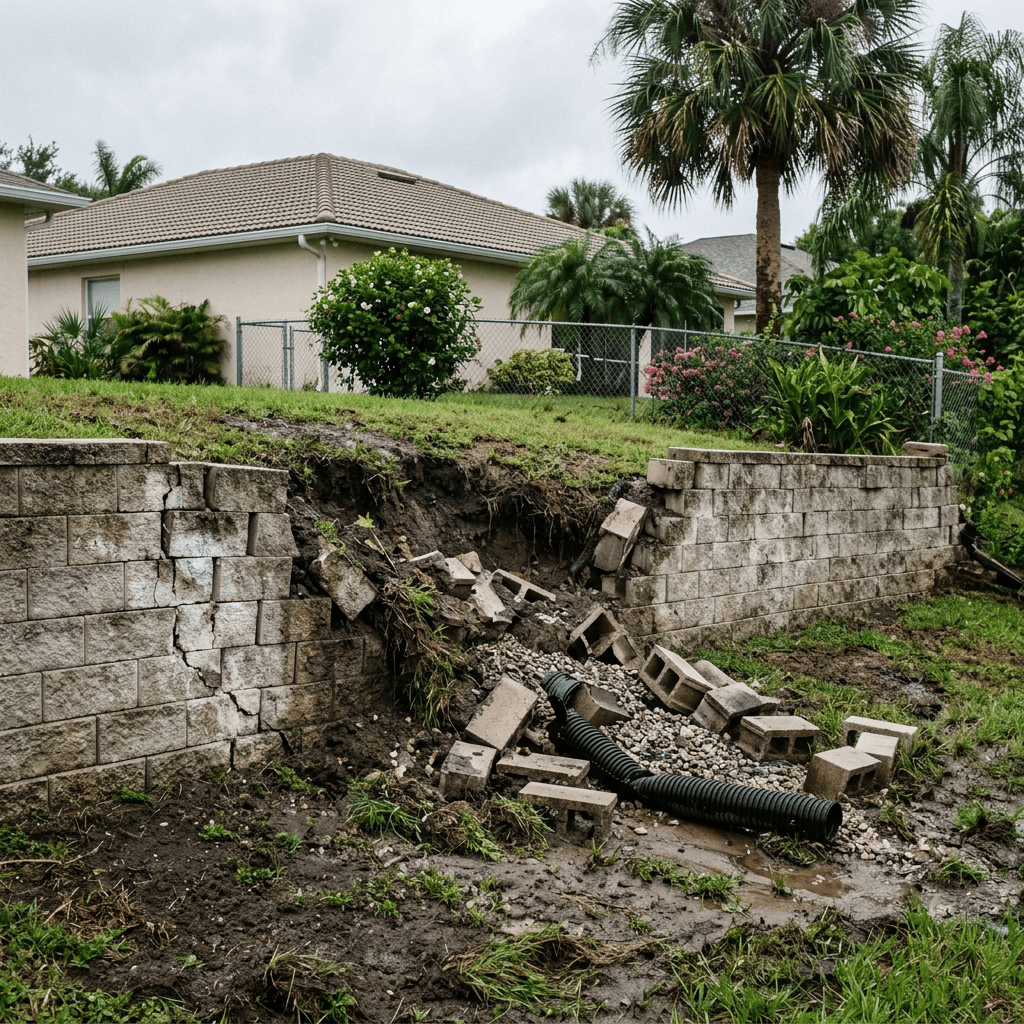
In Mishra, Pranav and Mamta Mishra owned an Alabama residence insured under a State Farm homeowners policy. The morning after a January 2023 storm, they discovered that a retaining wall, driveway, and fence had collapsed. Trees had also fallen in the vicinity.
State Farm retained a forensic engineer who concluded that the wall failed because it lacked adequate drainage and lateral reinforcement. According to the engineer, hydrostatic pressure accumulated behind the wall and caused it to rotate and collapse. Weather information reviewed by the engineer showed maximum winds of approximately 22 miles per hour, with gusts of approximately 29 miles per hour.
The insureds’ engineer agreed that the wall had inadequate drainage and was not structurally sound. He suggested that wind acting on nearby trees might have transmitted force through their root systems to the wall, but he described that theory only as plausible. He did not identify weather data establishing the necessary wind conditions, did not reliably quantify the asserted forces, and could not remember whether it had been windy or raining when the loss occurred.
The court excluded the insureds’ causation opinion under the federal expert-evidence standard. Once that opinion was removed, State Farm’s engineering evidence concerning drainage, reinforcement, and hydrostatic pressure was not rebutted by admissible expert testimony.
That evidentiary ruling substantially determined the coverage result. The policy excluded, among other things, loss to a retaining wall caused by the pressure or weight of water. It also excluded losses caused by defects, weaknesses, or inadequacies in design, construction, or maintenance, subject to particular policy language concerning resulting losses. The policy’s additional collapse coverage did not independently restore coverage on the established facts.
The court granted State Farm summary judgment on the breach-of-contract claim and on the insureds’ related Alabama bad-faith claim. The important point is narrower than the proposition that retaining-wall failures are never covered. The court decided the case under the language of this policy and the admissible evidence in this record. It did not establish a universal rule for retaining walls, storm losses, or collapse claims.
Mishra also applied Alabama substantive law. Florida lawyers should therefore use the decision as a factual and evidentiary illustration—not as a substitute for Florida authority.
Florida courts begin with the policy, not with a generalized theory of fairness
Florida treats an insurance policy as a contract. Courts ordinarily enforce unambiguous policy language as written. Ambiguities are generally construed against the insurer and in favor of coverage, and exclusionary provisions receive particularly careful construction. That interpretive principle, however, does not permit a court to rewrite a policy or create an ambiguity merely because the exclusion produces a difficult result.
An “all-risk” policy is broad, but it is not an “all-loss” policy. The label does not mean that every form of property damage is covered regardless of its cause or the policy’s exclusions.
In Mejia v. Citizens Property Insurance Corp., 161 So. 3d 576, 578 (Fla. 2d DCA 2014), the Second District explained the basic burden framework for an all-risk claim. The insured must first establish that the insured property suffered a loss while the policy was in effect. Once the insured satisfies that initial burden, the insurer bears the burden of proving that an exclusion applies.
The trial court in Mejia had required the insured to prove that sinkhole activity caused the damage. The Second District held that this improperly placed the burden of disproving the exclusion on the insured. The insured’s initial obligation was to demonstrate a loss during the policy period, after which Citizens had to prove the applicability of its exclusion.
The Fourth District addressed the burden framework in greater detail in Jones v. Federated National Insurance Co., 235 So. 3d 936 (Fla. 4th DCA 2018). Jones involved competing theories concerning damage from Hurricane Wilma and preexisting construction deficiencies. The court reversed because the jury instructions misallocated the initial burden and directed the jury to apply the efficient-proximate-cause doctrine too broadly.
Jones should not be reduced to the proposition that any combination of covered and excluded causes automatically produces coverage. The opinion describes a more careful sequence. The insured first must prove a loss within the policy period. The insurer must then establish that an exclusion applies. If the evidence shows multiple causes and the policy does not contain applicable language addressing concurrent causes, the court must determine which Florida causation doctrine governs and properly allocate the parties’ respective burdens.
A more recent illustration appears in Belizaire v. Citizens Property Insurance Corp., No. 4D2023-2488 (Fla. 4th DCA Feb. 12, 2025). There, the Fourth District reversed summary judgment for Citizens after concluding that the insureds’ affidavits were sufficient to meet their initial burden. The insurer had not supported its exclusion defense with competent inspection testimony establishing the alleged excluded cause. The decision does not mean that an insured’s affidavit always defeats summary judgment. It shows that the court must assess the evidence actually submitted by each party under the applicable burden framework.
These cases establish the analytical starting point, but they do not eliminate the importance of proof. Once an insurer produces competent evidence of an excluded cause, an insured cannot necessarily survive summary judgment through speculation, a bare assertion that a storm occurred, or a conclusion unsupported by the witness’s observations and methodology.
Efficient proximate cause and concurrent cause are distinct doctrines
Property damage may arise from more than one condition. Florida courts have applied two different causation doctrines in such cases: the efficient-proximate-cause doctrine and the concurrent-cause doctrine.
Under the efficient-proximate-cause approach, a court looks for the peril that set the other causes in motion or constituted the dominant cause of the loss. Coverage generally follows the characterization of that efficient cause.
The concurrent-cause doctrine addresses circumstances in which independent causes converge to produce one loss and no single cause can reasonably be identified as the sole or efficient cause. Subject to the policy’s actual language, coverage may exist when at least one independent contributing cause is covered.
An important early Florida decision is Wallach v. Rosenberg, 527 So. 2d 1386 (Fla. 3d DCA 1988). The insureds alleged that their seawall failed when a neighboring seawall collapsed during a storm. They relied in part on alleged third-party negligence, while the insurer invoked policy exclusions related to earth movement and water.
The Third District approved application of the concurrent-cause doctrine where an insured risk constituted a concurrent cause of the loss even if it was not the prime or efficient cause. The decision did not hold that the mere allegation of a covered cause establishes coverage. The insured must still prove a factual basis for the covered contributing cause, and the court must still examine the policy’s exclusions and causation language.
The Florida Supreme Court later addressed the doctrine in Sebo v. American Home Assurance Co., 208 So. 3d 694 (Fla. 2016). The insured residence in Sebo suffered extensive water intrusion and other damage associated with defective construction, rain, wind, and hurricane conditions. The record did not permit the causes to be separated in a meaningful way or permit one cause to be designated as the sole or efficient cause.
The Supreme Court approved the reasoning in Wallach and applied the concurrent-cause doctrine. Because independent perils had converged and the policy did not contain applicable language precluding the doctrine under those circumstances, the existence of a covered contributing cause supported coverage.
Sebo is sometimes stated too broadly. It does not hold that every loss involving one covered cause and one excluded cause is covered. The Court emphasized both the inability to identify a single proximate cause and the particular policy language before it. The Court also observed that the policy used anti-concurrent-causation language elsewhere, demonstrating that the insurer knew how to include such language when it intended to do so.
The distinction is critical. Sebo applies the concurrent-cause doctrine in the absence of controlling policy language that validly changes the result. It does not authorize courts to disregard an applicable anti-concurrent-causation provision.
Anti-concurrent-causation language may change the result
An anti-concurrent-causation clause typically provides that loss caused by an excluded peril remains excluded regardless of whether another cause contributed concurrently or sequentially. If such a clause is unambiguous and applies to the facts proved, it can prevent the concurrent-cause doctrine from producing coverage.
In Security First Insurance Co. v. Czelusniak, 305 So. 3d 717 (Fla. 3d DCA 2020), rainwater entered a residence through walls and windows as well as through doors. The policy contained an exclusion applicable to water entering through walls and windows, accompanied by anti-concurrent-causation language. Although water entering through the doors was not expressly included in that exclusion, the undisputed evidence established that excluded wall-and-window water contributed to the same loss.
The Third District concluded that the anti-concurrent-causation provision applied and required judgment for the insurer. The decision illustrates the significance of both the clause and the evidence: the insurer established that an excluded cause subject to the clause actually contributed to the claimed loss.
The Third District considered a materially different record in Tower Hill Prime Insurance Co. v. Bermudez, 388 So. 3d 165 (Fla. 3d DCA 2023), rehearing denied Jan. 19, 2024. The insureds alleged that shockwaves from nearby blasting damaged their home. Tower Hill contended that the damage resulted from earth movement and other excluded conditions.
The policy included anti-concurrent-causation language within the earth-movement exclusion. At trial, however, the insureds’ expert testified that the damage came from airborne shockwaves and did not involve movement of the soil. Tower Hill’s expert disputed that conclusion. The jury found that the insurer had not proved the earth-movement exclusion.
The Third District did not invalidate the anti-concurrent-causation clause. Instead, it reasoned that the clause within the earth-movement exclusion was not triggered if the jury accepted the insureds’ evidence that no earth movement occurred. Other potentially contributing conditions were governed by exclusions that did not contain the same anti-concurrent-causation language.
Czelusniak and Bermudez therefore point to the same disciplined inquiry:
- What cause or causes does the evidence establish?
- Which exclusion, if any, applies to each cause?
- Does the relevant exclusion contain anti-concurrent-causation language?
- Has the insurer proved the factual predicate necessary to trigger that exclusion and clause?
The presence of anti-concurrent-causation language on the policy page is not, by itself, the end of the analysis. The insurer must establish that an excluded peril governed by that language contributed to the claimed loss. Conversely, once that factual predicate is established, a court generally cannot avoid the clause merely because a covered condition also contributed.
Defects and ensuing losses must be kept analytically separate
Policies frequently exclude loss caused by defective design, construction, workmanship, materials, maintenance, deterioration, or similar conditions. Some policies then restore coverage for a “resulting loss” or “ensuing loss” that is not otherwise excluded.
This type of provision does not ordinarily create coverage for the cost of correcting the defect itself. It preserves coverage, depending on the wording, for a distinct physical loss that results from the excluded condition and is independently covered.
The Florida Supreme Court’s leading decision is Swire Pacific Holdings, Inc. v. Zurich Insurance Co., 845 So. 2d 161 (Fla. 2003). A developer discovered structural design deficiencies during construction and incurred approximately $4.5 million to correct them before an actual structural failure occurred. The builder’s-risk policy excluded loss or damage caused by design error but included coverage for physical loss or damage resulting from such an error.
The Supreme Court held that the cost of correcting the defective design was not a covered resulting loss. The insured had repaired the excluded defect itself; there was no separate physical loss caused by that defect. The Court also rejected reliance on the policy’s sue-and-labor clause because, under the language before it, that provision required an actual covered loss to have occurred or to be in progress.
Swire does not make every loss associated with defective construction uncovered. Its more precise lesson is that a resulting-loss exception does not ordinarily swallow the exclusion by converting the cost of fixing the defect into an ensuing loss. A claimant relying on such an exception should identify a distinct physical consequence, explain how it resulted from the excluded condition, and establish that the consequence is not itself excluded.
The Second District applied similar reasoning to a different set of facts in Peek v. American Integrity Insurance Co., 181 So. 3d 508 (Fla. 2d DCA 2015). Defective Chinese drywall emitted sulfur compounds, producing odors and corrosion. The insureds did not present competing causation evidence, while the insurer’s expert connected the conditions directly and continuously to the defective drywall. The court concluded that the odors and corrosion were not separate ensuing losses on that record.
Because Peek preceded the Florida Supreme Court’s decision in Sebo, it should not be used to replace Sebo’s later treatment of independent concurrent causes. Its more limited continuing value lies in its discussion of whether the claimed consequence was genuinely separate from the excluded defective material.
The distinction can be expressed simply:
- Repairing an inadequately designed wall is generally not transformed into a covered ensuing loss merely because the inadequacy created the need for repair.
- If the defective wall fails and causes separate damage to otherwise sound covered property, the separate damage may require additional analysis under the policy’s resulting-loss language.
- That separate damage is not necessarily covered if another exclusion independently applies to it.
- The insured must still prove that the separate damage occurred and establish a non-speculative causal connection.
In Mishra, the insureds argued that the loss should be covered through the policy’s resulting-loss language. The court rejected the argument because the established causes remained within the policy’s exclusions and the insureds had not identified and supported a distinct covered resulting loss. Florida courts would independently construe the particular Florida policy, but Swire supplies a similar warning against treating an ensuing-loss provision as a general exception to every defect exclusion.
Collapse coverage depends heavily on the policy’s definition
“Collapse” has no single meaning that governs every Florida insurance policy. Modern policies commonly define the term and impose several requirements, such as abruptness, falling or caving in, and an inability to occupy the building or affected part for its intended purpose.
The Fifth District construed one such provision in Kings Ridge Community Association v. Sagamore Insurance Co., 98 So. 3d 74 (Fla. 5th DCA 2012). Roof trusses, the roof, and the ceiling had deflected downward by approximately twelve inches, leaving the building unsafe and unfit for occupancy. The policy defined collapse as an abrupt falling or caving in of a building or part of a building with the result that it could not be occupied for its intended purpose.
The insurer argued that there was no collapse because the affected components had not fallen completely to the ground. The Fifth District rejected that argument. The policy did not specify how far a component had to fall or cave in, and the substantial downward movement had made the premises unoccupiable. The policy’s collapse provision also expressly addressed specified causes, including certain weight-related causes and hidden defects.
Kings Ridge does not establish that any sagging, cracking, or deflection constitutes a collapse. The court relied on the degree of displacement, the inability to occupy the property, and the language of that policy.
A 2026 Third District decision illustrates the other side of the line. In Escobar v. Citizens Property Insurance Corp., No. 3D24-0883 (Fla. 3d DCA Mar. 25, 2026), a piece of drywall fell from a bathroom ceiling because of concealed insect or vermin damage. The Citizens policy required an abrupt collapse of a building or part of a building and required the building or affected part to be unoccupiable for its intended purpose.
The Third District affirmed summary judgment for Citizens. The court reasoned that drywall itself is not something that can be occupied for an intended purpose. Even assuming the drywall qualified as a “part” of the building, the bathroom remained usable; there was no evidence that the shower, toilet, or sink had become nonfunctional.
The decision was issued as a slip opinion, and its reasoning should be stated narrowly. The appellate court did not announce a universal structural-integrity test for collapse. It applied the policy’s occupancy requirement to the drywall and bathroom involved in that claim.
Together, Kings Ridge and Escobar show why collapse cases should not be decided through labels alone. Relevant questions include:
- Did something fall or cave in abruptly?
- What, precisely, is the allegedly collapsed “part” of the building?
- Can that part meaningfully be occupied?
- Did the event make the building or relevant area unusable for its intended purpose?
- Does the policy exclude a structure that remains standing?
- Does the additional collapse provision identify the cause at issue?
- Are there separate exclusions applicable to the structure or the cause?
A retaining wall also raises threshold questions that may not arise with an interior room or roof system. The policy may define “building,” “dwelling,” “other structure,” or covered property in a way that includes or excludes the wall. It may separately exclude water pressure against retaining walls even if some additional collapse coverage exists. The answer must come from the entire policy, not from the collapse provision in isolation.
The quality of the causation evidence often decides the case
A legally viable coverage theory cannot survive without admissible evidence supporting its factual premises. This is particularly important in disputes involving structural engineering, wind forces, drainage design, hydrostatic pressure, soil movement, or hidden deterioration.
Florida Statutes section 90.702 incorporates the Daubert reliability framework for expert testimony. Expert testimony must be based on sufficient facts or data, arise from reliable principles and methods, and reflect a reliable application of those principles and methods to the facts.
Credentials alone are not enough. A qualified engineer may still offer an inadmissible opinion if the reasoning is speculative, the necessary factual inputs are missing, or the methodology is not explained. Conversely, an expert opinion need not be mathematically certain merely because another qualified expert disagrees. A genuine and adequately supported conflict between experts is ordinarily a matter for the factfinder.
In Archer v. Tower Hill Signature Insurance Co., 313 So. 3d 645 (Fla. 4th DCA 2021), the policy required a storm-created opening before interior rain damage would be covered. The insured submitted affidavits from a contractor and public adjuster asserting that wind caused roof damage, but the affidavits did not adequately describe the nature or location of the opening or explain the factual and methodological basis for the conclusions. The Fourth District affirmed summary judgment for the insurer.
Archer does not hold that an insured must always retain a particular type of expert. It holds that conclusory affidavits were insufficient under the policy and record involved.
Compare Acosta v. Citizens Property Insurance Corp., No. 4D2024-0926 (Fla. 4th DCA Oct. 8, 2025). There, a jury found that Hurricane Irma created an opening in the insureds’ roof. The trial court later entered judgment notwithstanding the verdict for Citizens, but the Fourth District reversed and directed reinstatement of the verdict.
The insureds’ expert had relied on National Weather Service and NOAA information, CoreLogic data, drone photographs, thermal imaging, and two physical inspections. He opined that winds of approximately 95 miles per hour created a roof opening. Citizens offered a competing expert opinion and different interpretations of the photographs. The Fourth District held that the competing evidence presented a matter for the jury and that the trial court had improperly reweighed the evidence after the verdict.
Acosta arose after trial and concerned judgment notwithstanding the verdict, while Archer involved summary judgment. The cases nevertheless illustrate the practical difference between a conclusion and a supported opinion. The expert in Acosta identified data, inspections, imaging, and a reasoned connection between the storm and the opening. The affidavits in Archer lacked comparable explanation.
Applied to a retaining-wall claim, a defensible causation opinion may require consideration of:
- Original plans and construction details;
- Drainage openings, weep holes, backfill, and waterproofing;
- Reinforcement and anchoring;
- Wall geometry and visible rotation or displacement;
- Rainfall and wind data for the relevant location and time;
- Soil conditions and hydrostatic pressure;
- Tree locations, root systems, and any claimed transmission of force;
- Pre-loss photographs and maintenance records;
- Evidence of gradual movement, cracking, or prior repairs; and
- Alternative explanations offered by the opposing expert.
A statement that a tree-root theory is “possible” or “plausible” may identify a hypothesis, but it does not necessarily establish that the hypothesis probably explains the actual loss. The witness should be able to explain the supporting facts and how the methodology rules in the proposed cause or rules out material alternatives.
Florida’s current summary-judgment standard matters
Florida adopted the federal summary-judgment standard effective May 1, 2021. See In re Amendments to Florida Rule of Civil Procedure 1.510, 317 So. 3d 72 (Fla. 2021). Under the current rule, summary judgment is appropriate when there is no genuine dispute of material fact and the moving party is entitled to judgment as a matter of law.
The court does not ordinarily weigh competing admissible evidence or choose between adequately supported expert opinions. But an opponent must identify evidence from which a reasonable factfinder could rule in that party’s favor. Speculation, conclusions without a factual foundation, and opinions that would not be admissible at trial do not create a genuine dispute merely because they appear in an affidavit.
The burden of proof at trial remains important. If the insurer bears the burden of proving an exclusion, it must support that exclusion with competent evidence. Belizaire illustrates the problem for an insurer that seeks summary judgment without adequate proof of the excluded cause. If the insurer does produce admissible evidence establishing an exclusion, however, the insured must identify competent evidence that genuinely disputes the relevant facts or supports an applicable coverage-preserving theory.
This is the procedural lesson of Mishra. The insureds had a proposed alternative causation theory, but the court concluded that their expert had not reliably supported it. Once the opinion was excluded, there was no admissible evidence countering State Farm’s engineering explanation.
A coverage dispute and a bad-faith claim are not the same case
Mishra also involved an Alabama bad-faith claim, which failed after the court concluded that there was no breach of the insurance contract. Florida’s statutory framework is different and should be analyzed independently.
Florida Statutes section 624.155 authorizes specified civil remedies against insurers and includes a civil-remedy-notice process. The current statute provides, among other things, that mere negligence alone is insufficient to constitute bad faith.
For property insurers, section 624.1551 currently requires an insured to establish through an adverse adjudication by a court that the property insurer breached the insurance contract and to obtain a final judgment or decree before bringing the specified extra-contractual action. Lawyers must confirm the version of the statutes applicable to the particular policy, loss, and procedural history rather than assume that the current language applies retroactively.
Even when the insured establishes contractual liability, bad faith does not follow automatically. Coverage and bad faith involve distinct inquiries. A bona fide coverage dispute may be resolved against an insurer without establishing that the insurer handled the claim in bad faith. Conversely, claim-handling conduct can be relevant to statutory issues even though the underlying coverage dispute must first be resolved in the manner required by the governing statute.
Citizens Property Insurance Corporation presents an additional issue. In Citizens Property Insurance Corp. v. Perdido Sun Condominium Ass’n, 164 So. 3d 663 (Fla. 2015), the Florida Supreme Court held that Citizens’ statutory immunity barred a first-party bad-faith action under section 624.155. The Court distinguished such a claim from an ordinary action for breach of the insurance contract, which could proceed.
Accordingly, neither an insurer’s victory nor an insured’s victory on coverage should be casually described as resolving every potential extra-contractual issue. The defendant, the governing statutes, the applicable statutory version, and the procedural prerequisites all matter.
Practical lessons for Florida property claims
The cases discussed above support several practical conclusions without converting fact-specific holdings into universal rules.
First, the complete policy must be read before selecting a causation theory. The declarations, coverage grant, definitions, exclusions, anti-concurrent-causation language, collapse provisions, ensuing-loss exceptions, and endorsements may interact. Quoting one favorable sentence is rarely sufficient.
Second, the insured’s initial burden under an all-risk policy is limited but real. The insured must establish a loss to insured property during the policy period. The insurer then bears the burden of proving an exclusion, but the insured cannot rely indefinitely on the burden framework if the insurer produces unrebutted, admissible evidence establishing the excluded cause.
Third, “multiple causes” is the beginning of the analysis rather than the conclusion. Counsel must determine whether the evidence supports a dominant efficient cause, genuinely independent concurrent causes, or one continuous excluded process. Sebo, Wallach, Czelusniak, and Bermudez cannot be applied responsibly without comparing their policy language and factual predicates.
Fourth, anti-concurrent-causation language matters only when the insurer proves that a cause governed by the language contributed to the loss. If that predicate is established, the provision may be decisive. If it is not established, the mere presence of the clause does not prove the exclusion.
Fifth, an ensuing-loss provision is not general coverage for the excluded defect. The claimant should identify the allegedly separate physical damage and explain why it is distinct from the cost of repairing the defective component. Swire remains an important warning against relabeling correction of a defect as resulting damage.
Sixth, collapse coverage is intensely policy-specific. Kings Ridge establishes that a complete fall to the ground is not necessarily required under language covering an abrupt falling or caving in that makes the property unoccupiable. Escobar establishes that the occupancy requirement still has independent force. Neither decision permits courts to ignore the words used in the particular policy.
Seventh, expert causation opinions require more than credentials and conclusions. Weather information, measurements, photographs, inspections, structural details, and a reasoned explanation connecting the data to the opinion can distinguish a triable dispute from speculation. Archer, Acosta, and Mishra demonstrate different outcomes produced by different evidentiary records and procedural settings.
Finally, coverage and bad faith must be treated separately. A court’s disagreement with an insurer’s coverage position does not, standing alone, establish statutory bad faith. Florida’s current property-insurance statutes impose prerequisites that must be analyzed according to the applicable statutory version and defendant.
Conclusion
Losses involving storms, retaining walls, roofs, water intrusion, construction deficiencies, and collapse sit at the intersection of contract interpretation and technical causation. No single Florida decision resolves the entire field.
Mishra offers a useful cautionary example: when an insurer supports an exclusion with a detailed engineering opinion and the insured’s competing theory is excluded as speculative, the coverage dispute may end at summary judgment. But because Mishra applies Alabama law, Florida claims must be analyzed under Florida’s separate burden rules, causation doctrines, evidentiary standards, and statutory framework.
Florida decisions such as Mejia, Jones, Wallach, Sebo, Czelusniak, Bermudez, Swire, Kings Ridge, Escobar, Archer, and Acosta do not produce a simple covered-or-excluded formula. They produce a method:
Read the complete policy. Identify each supported cause. Determine which party bears the relevant burden. Apply the causation language actually included in the policy. Separate the defective component from any genuinely distinct resulting damage. Test collapse against the policy’s definition. Then determine whether the evidence is sufficiently reliable and specific to permit a reasonable factfinder to accept the proposed theory.
That disciplined, policy-specific approach is the most reliable way to evaluate these claims—and the best protection against overstating what any individual case actually holds.
This article provides general information concerning Florida insurance law and is not legal advice for any particular claim or policy.
 Donner Law Firm